Introduction
In February 1992, the new Carina E model was presented by Toyota for the European market. The designation "E" is used in Europe as a mark of superior quality. This vehicle inherited all the well-known qualities of its predecessor, the Carina II, and added many new advantages.
The Carina E model was offered in three body styles: four-door "Sedan", five-door "Hatchback" and "Estate" (Fig. 1.1.).
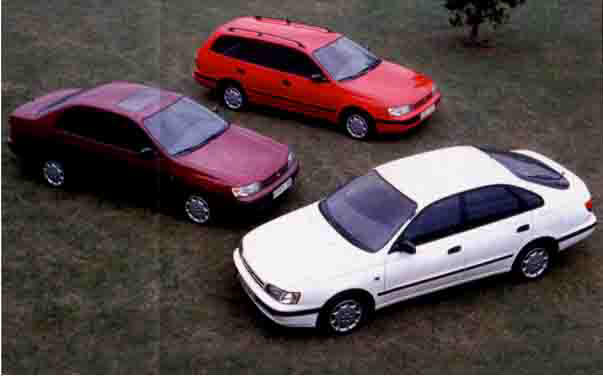
Fig. 1.1. Body styles of the Toyota Carina E: hatchback, sedan and estate
The manufacturer offered five internal combustion engines (ICE) for the customer to choose from.
Two 1.6-liter gasoline engines with double overhead camshafts and 4 valves per cylinder. One is a standard engine, the second is a "lean-burn" engine (an engine running on a lean air-fuel mixture) with lower power and torque, but with more economical fuel consumption.
In addition, there were two 2.0-liter gasoline engines, also with double overhead camshafts and four valves per cylinder: one standard type and one sporty type specifically for the 2.0 GTi model. Finally, a 2.0-liter diesel engine was supplied.
All engines are in-line, mounted transversely in the engine compartment, and have four cylinders with 4 valves in each.
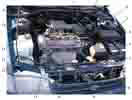
Fig. 1.2. General view of the engine compartment of the Toyota Carina E with the 4A-FE gasoline engine, 1600 cm 3 ; with manual transmission,
where: 1 - throttle body assembly; 2 - ignition coil; 3 - upper strut mount; 4 - air cleaner housing; 5 - battery; 6 - distributor; 7 - fuse and relay box; 8 - horns; 9 - radiator filler cap cover; 10 - exhaust manifold heat shield; 11 - alternator; 12 - cooling system expansion tank cap; 13 - 4A-FE engine; 14 - engine oil filler cap; 15 - washer reservoir filler cap.
Valve train operation on all engines is driven by a drive belt and two overhead camshafts. The valves are adjusted using sealing plates (adjusting shims). The engines have a sealed cooling system with a expansion tank. The cooling fan has an electric drive with thermostatic control.
The clutch has a hydraulic actuation system.
All models were generally supplied with a 5-speed manual transmission. An automatic transmission could be fitted to models with the 1.6-liter engine (4A-FE engine) and the 2.0-liter engine (3S-FE engine).
The Carina E model has independent front and rear wheel suspension. The MacPherson front suspension consists of a strut assembly with a coil spring and gas-filled shock absorbers. Versions with the 3S-GE engine are equipped with "Super Struts" front suspension.
At the rear, trailing arms are used, with two parallel brackets on the left and right in the transverse direction and a reaction rod in the longitudinal direction. In addition, a stabilizer bar is installed at the front and rear on all models.
The steering is a rack-and-pinion type with a small drive pinion and, depending on the equipment level, power-assisted steering.
The Carina E model is equipped with a reinforced dual-circuit brake system with front disc brakes and rear drum brakes, as well as a load-sensing brake force regulator. Models with an anti-lock braking system (ABS) have rear disc brakes.
The following description mainly covers the 1996 model year Toyota Carina E with "Hatchback" and "Sedan" body styles, with the 4A-FE gasoline engine of 1587 cm³ and the 3S-FE (1998 cm³). A brief technical specification of the Toyota Carina E with the 1587 cm³ engine is given in Table 1.1.
Table 1.1. Technical specifications of the Toyota Carina E, "Sedan" body
| 1. | Maximum output, kW (HP) at crankshaft speed, rpm | 85 (115) 6000 |
| 2. | Max. torque, N·m at crankshaft speed, rpm | 147 4800 |
| 3. | Maximum speed, km/h | 195 |
| 4. | Acceleration from 0 to 100 km/h, s | 11,4 |
| 5. | Curb weight, kg | 1060 |
| 6. | Gross weight, kg | 1600 |
| 7. | Weight per unit of power, kg/kW | 12,8 |
| 8. | Fuel consumption at V (90/120) = const and urban cycle, L/100 km | (5.5 / 7.2) and 8.8 |
| 9. | Fuel octane rating, RON | 95 |
| 10. | Fuel tank capacity, L | 60 |
| 11. | Engine displacement, cm³ | 1587 |
| 12. | Cylinder bore, mm | 81 |
| 13. | Compression ratio (:1) | 9,5 |
| 14. | Piston stroke, mm | 77 |
| 15. | Engine type | 4A-FE |
| 16. | Fuel System | Electronic fuel injection |
| 17. | Alternator (14 V), A | 40-70 |
| 18. | Battery (12 V), Ah | 40-60 |
| 19. | Engine/drive location | Front-wheel drive |
| 20. | Gear ratio 1st/2nd gear 3rd/4th gear 5th/6th gear | 3,55 / 1,9 1,3 / 0,97 0,815 |
| 21. | Final Drive | 0,406 |
| 22. | Number of gears, manual transmission (automatic transmission) | 5(4) |
| 23. | Vehicle length, mm | 4530 |
| 24. | Vehicle width, mm | 1695 |
| 25. | Vehicle height, mm | 1410 |
| 26. | Wheelbase, mm | 2580 |
| 27. | Track, front/rear, mm | 1465/1445 |
| 28. | Turning circle diameter, m | 10 |
| 29. | Ground clearance, mm | 155 |
| 30. | Front wheel suspension | MacPherson with stabilizer bar |
| 31. | Rear wheel suspension | Independent with transverse and longitudinal stabilizer |
| 32. | Tires | 185/65 R 14 86H |
Test yourself
A quick Toyota Carina quiz: every answer comes with an explanation and a link to the manual page.