Seat Belts, Checking
WARNING
After every accident the seat belt system must be inspected systematically! If damage is determined at any inspection point, the customer must be informed that it is necessary to replace the seat belt.
Check points:
- Seat Belt Webbing, Checking
- Belt Retractor, Checking Locking Function
- Seat Belt Latch, Visually Inspecting
- Seat Belt Latch, Function Test
- Seat Belt Relays and Belt Tongue, Checking
- Fastening Elements and Mounting Points, Checking
Inspection Points
Seat Belt Webbing, Checking
- Pull the seat belt webbing completely off automatic belt retractor.
- Inspect the seat belt webbing for contamination and, if necessary, wash with mild soap solution ⇒ also refer to the Owner's Manual.
If one of the types of damage (1 or 2) shown in the following is detected on a vehicle which has been in an accident - seat belt must be replaced completely with seat belt latch and seat belt height adjuster.
If one kind of damage under points 1, 2, 3 and 4 is detected on a vehicle which has not been in an accident, only the damaged seat belt needs to be replaced.
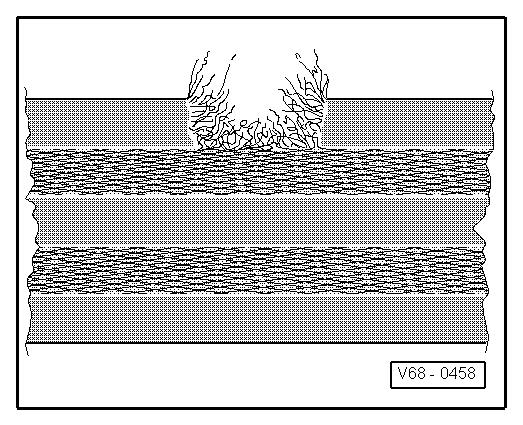
Seat belt webbing cut, torn or chafed.
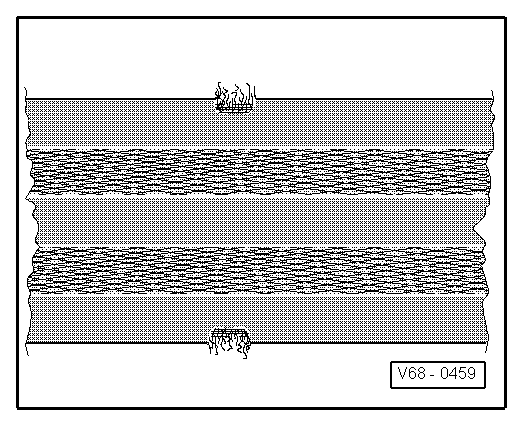
Webbing loops on belt edge torn.
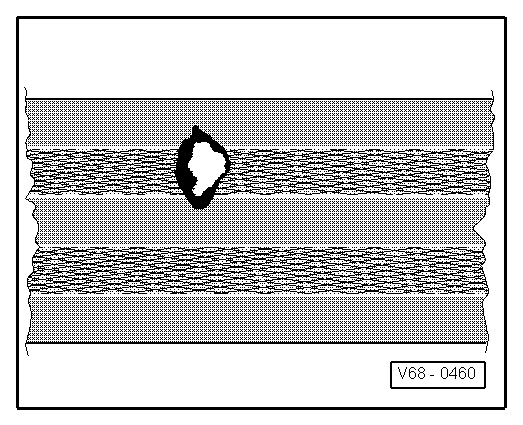
Burn marks from cigarettes or similar.
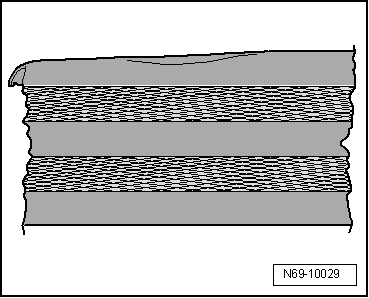
One side of belt edge deformed or area of belt edge is wavy.
Belt Retractor, Checking Locking Function
The automatic belt retractor has two locking functions.
- The first locking function is initiated by the belt being jerked out of the retractor (belt extraction acceleration).
Checking
- Pull the seat belt webbing out of the belt retractor with a firm jerk.
No locking effect - replace the entire seat belt with seat belt latch.
If there are malfunctions when pulling out or retracting the belt, first check whether position of retractor has been altered.
The second locking function is initiated by change in vehicle velocity (vehicle-dependent locking function). For this, the vehicle must be moved on a level surface.
Checking
- Fasten the seat belt.
- Accelerate the vehicle to 20 km/h and then perform a hard braking maneuver with the foot brake.
Replace the entire seat belt with the seat belt latch if the seat belt is not locked by locking mechanism during the braking procedure.
WARNING
For safety reasons, road test should be carried out on traffic-free stretch to ensure that other motorists/pedestrians etc. are not endangered.
Seat Belt Latch, Visually Inspecting
- Inspect the seat belt latch for the formation of cracks and fracturing.
If damaged, replace the entire seat belt with seat belt latch.
Seat Belt Latch, Function Test
Checking the seat belt latch:
- Insert the belt tongue into the seat belt latch until it clicks into place. Check whether the locking mechanism is properly engaged by giving the seat belt webbing a firm jerk.
Replace the entire seat belt with the seat belt latch if the belt tongue fails even once to engage properly in the seat belt latch during at least five tests.
Check the release mechanism:
- Press the seat belt latch with finger pressure to release the seat belt.
- With the seat belt webbing relaxed, the belt tongue must spring out of the seat belt latch without assistance.
Perform the test at least five times. Replace the entire seat belt with the seat belt latch if the belt tongue fails to spring out even once.
WARNING
Under no circumstances may lubricant be used to eliminate noise or stiffness at the seat belt latch buttons.
Seat Belt Relays and Belt Tongue, Checking
The plastic-covered guides show fine parallel scoring after straining of the belt system (belt was fastened during accident). (Wear from frequent belt use can be identified by smooth signs of wear that are free of scoring.)
- Check plastic for deformation, rupture and the formation of cracks.
For groove build-up and/or damage, replace the entire seat belt with the seat belt latch.
Fastening Elements and Mounting Points, Checking
- Latch bracket deformed (fully extended)
- Height adjuster not functional
- Mounting points (seat, pillar, vehicle floor) distorted or thread damaged
- If damage is found on the components, replace the entire seat belt with the seat belt latch.
- Replace the mounting points.
Note
For damage found that is not accident-related, for example, wear, only replace the part that is damaged.
Child Seat Anchors (LATCH), Checking After a Collision
Inspection Points
- After a collision, child seat anchors must be inspected for damage and deformation.
- Child seat anchors that are welded into the body cannot be repaired or corrected.
- Child seat anchors that are bolted to the body must be replaced if damaged or deformed.
Test yourself
A quick Volkswagen Tiguan quiz: every answer comes with an explanation and a link to the manual page.