Passenger Occupant Detection for Front Passenger Airbag Deactivation
Note
- The passenger occupant detection system controls the automatic passenger airbag deactivation.
- This equipment is only installed on vehicles released in the USA and Canada.
Tools
Required Special Tools and Testing Equipment
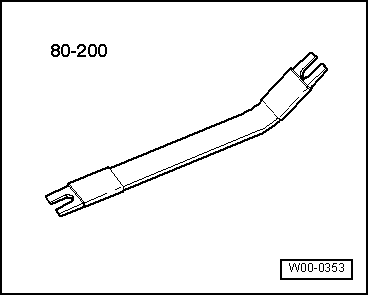
- Pry Lever -80 - 200-
Passenger Occupant Detection System Safety Precautions
Caution
- After every repair on the front passenger seat in which the seat and/or backrest cover was "detached," the basic setting on Passenger Occupant Detection System Control Module -J706- must be performed. Perform a basic setting with a diagnostic tester that has "Guided Fault Finding".
- Do not bend the passenger occupant detection system mat.
- A leaking mat must be replaced (repair kit).
- Do not bend the passenger occupant detection system pressure hose.
- Passenger occupant detection system (repair kit) components must not fall on hard surfaces.
- Passenger occupant detection system must not come in contact with grease.
- There is the danger that the passenger occupant detection system components may be damaged by sharp objects when working on the seat. It is necessary to avoid this danger.
- The mat, the fleece and various covers must be fitted to be free of folds.
- When installing, make sure that the seat cushion and cover are installed correctly.
- Replace all upholstery clips and clip connectors from the cover and make sure it is positioned correctly on seat when doing so.
- The system basic setting is only possible at temperatures between 0º and +40 ºC (32 º and 104 ºF).
- Make sure that no objects are placed on seat when performing basic setting.
- Using seat covers or cushions impairs the function of the passenger occupant detection system and the effectiveness of the airbag system.
- Do not install any clips near the mat. This also applies to changes to the seat wiring harness.
Procedure for after a Collision with Belt Tensioner and/or Airbag Deployment
- Each time the passenger airbag and/or belt tensioner on the passenger side is deployed, a basic setting must be performed on the Passenger Occupant Detection System Control Module -J706-. Perform a basic setting with a diagnostic tester that has "Guided Fault Finding".
- If the seat rails and/or seat pan must be replaced after an accident due to deformation, the passenger occupant detection system must also be replaced with the "passenger occupant detection system repair kit". Perform a basic setting on the Passenger Occupant Detection System Control Module -J706-. Perform a basic setting with a diagnostic tester that has "Guided Fault Finding".
Overview - Passenger Occupant Detection System
WARNING
The replacement part (service kit) for the passenger occupant detection system is already pre-calibrated and must not be separated under any circumstances. The service kit consists of:
- Passenger Occupant Detection System Control Module -J706-
- Passenger Occupant Detection System Pressure Sensor -G452-
- Passenger occupant detection system mat
- Seat Cushion
WARNING
Follow all safety precautions when working on the passenger occupant detection system.
Note
The passenger occupant detection system is only installed in the front passenger side.
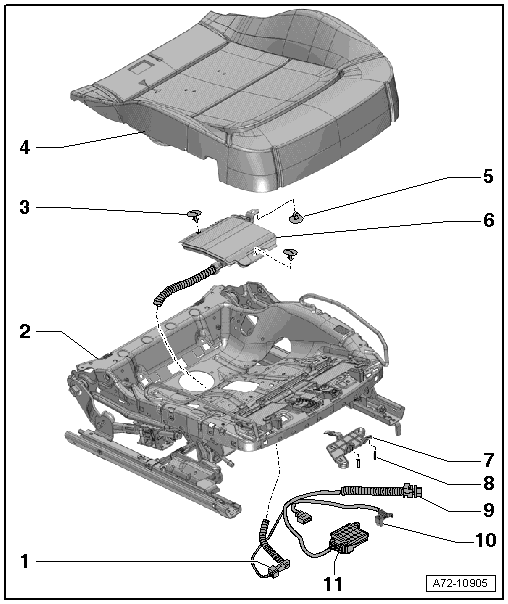
- Passenger Occupant Detection System Pressure Sensor -G452-
- Is a component of the passenger occupant detection system mat
- Removing and Installing.
- The connector may be disconnected for removing and installing
- Seat Pan
- Clip
- Cushion
- For the seat pan
- Do not separate from the passenger occupant detection system mat -6-
- Clip
- Do not release.
- Mat
- For the passenger occupant detection system
- Is a component of the Passenger Occupant Detection System Pressure Sensor -G452-
- Do not separate from the seat pan padding -4-.
- Removing and Installing.
- Mount
- For the Passenger Occupant Detection System Control Module -J706-
- Expanding Pin
- For securing the mount to the seat pan
- Wiring Harness
- Can be disconnected from Passenger Occupant Detection System Pressure Sensor -G452- and Passenger Occupant Detection System Control Module -J706-
- Front Passenger Seat Position Sensor -G554-
- Is a component of the wiring harness -9-
- Removing and Installing.
- Passenger Occupant Detection System Control Module -J706-
- Removing and Installing.
- The connector may be disconnected.
Passenger Occupant Detection System, Removing and Installing
WARNING
- Follow all safety precautions when working on the airbag.
- Before handling pyrotechnic components (for example, disconnecting the connector), the person handling it must "discharge static electricity". This can be done by touching the door striker pin, for example.
WARNING
The replacement part (service kit) for the passenger occupant detection system is already pre-calibrated and must not be separated under any circumstances. The service kit consists of:
- Passenger Occupant Detection System Control Module -J706-
- Passenger Occupant Detection System Pressure Sensor -G452-
- Passenger occupant detection system mat
- Seat Cushion
Removing
- Move the seat height to the middle position before removing the seat.
- Remove the front passenger seat.
- Disconnect the ground cable from the battery with the ignition on.
Note
On vehicles with a luggage pass-through, it is sufficient to fold the backrest forward, it does not have to be removed.
- Remove front backrest.
Note
The connectors on the Passenger Occupant Detection System Pressure Sensor -G452- and the Passenger Occupant Detection System Control Module -J706- may be disconnected.
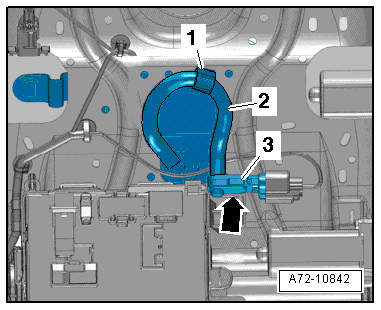
- Using a narrow screwdriver, carefully press the Passenger Occupant Detection System Pressure Sensor -G452--item 3- off the bracket -arrow-.
- Open the passenger occupant detection system pressure hose guide -1- and free up the pressure hose -2-.
- Release the retaining spring -1- and tilt the Passenger Occupant Detection System Control Module -J706--item 2- out of the mount.
- Remove the connector -4- from the bracket by pressing the release and removing the connector from the bracket.
- Open the tab on the electrical wiring harness guide -5--arrow- and free up the wiring harness -3-.

- Remove the front seat cover and cushion.
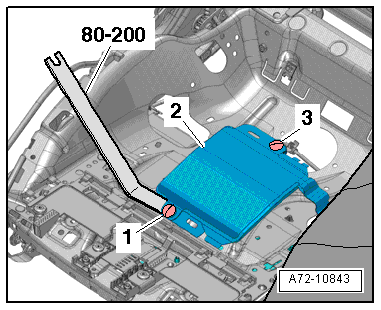
- Carefully pry out the passenger occupant detection system mat clips -1- and -3- on the front of the seat pan using a Pry Lever -80 - 200-.
- Remove the cover with the seat pan cushion by first guiding the Passenger Occupant Detection System Pressure Sensor -G452- through the opening in the seat pan.
WARNING
Risk of damage!
Do not bend the passenger occupant detection system pressure hose and mat.
- Remove the cover with the seat pan cushion, the mat -2- for the passenger occupant detection system and the Passenger Occupant Detection System Pressure Sensor -G452-.
Installing
- Clean the threaded bolt holes for self-locking nuts, for example using a thread tap.
- Replace all self-locking bolts.
Install in reverse order of removal. Note the following:
WARNING
- Follow all safety precautions when working on the airbag and passenger occupant detection system passenger airbag deactivation.
- Before handling pyrotechnic components (for example, connecting the connector), the person handling it must "discharge static electricity". This can be done by touching the door striker pin, for example.
- Do not bend the passenger occupant detection system pressure hose and mat.
Note
Make sure the connectors are installed all the way and engage audibly.
WARNING
The ignition must be on when connecting the battery. If pyrotechnic components (for example, airbag, belt tensioner) are not repaired correctly, they may deploy unintentionally after connecting battery. There must not be anyone inside the vehicle when connecting the battery.
- Connect the battery ground cable with the ignition on.
When installing a new service kit and after each repair on the front passenger seat where the seat and/or the backrest cover is "disengaged", a basic setting procedure must be performed on the passenger occupant detection system control module.
- Finally, select the "Airbag" function in "Guided Fault Finding" using the Vehicle Diagnostic Tester → Vehicle diagnostic tester.
Passenger Occupant Detection System Control Module -J706-, basic setting
Seat Position Sensor, Removing and Installing
The seat position sensor is a component of the wiring harness to the Passenger Occupant Detection System Control Module -J706-, whose connectors must not be disconnected. To replace the seat position sensor, the electrical wires to the seat position sensor must be disconnected and the new seat position sensor must be connected with crimp connectors.
Removing
WARNING
- Follow all safety precautions when working on the airbag.
- Before handling pyrotechnic components (for example, disconnecting the connector), the person handling it must "discharge static electricity". This can be done by touching the door striker pin, for example.
- Remove the front passenger seat.
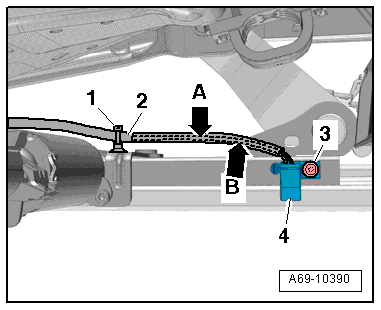
- Remove the screw -3- and (0,3 N·m) and seat position sensor -4- from the seat pan lower frame.
Caution
Do not damage the insulation on the individual wires.
- Cut the protective hose -2- to just in front of clip -1-.
- Cut through both wires at the places marked with -arrow A- and -arrow B- to approximately 1/3 to 2/3 of the free length.
Installing
WARNING
- Observe safety precautions for work on airbags.
- Before handling pyrotechnic components (for example, connecting the connector), the person handling it must "discharge static electricity". This can be done by touching the door striker pin, for example.
- Cut the wires on the new seat position sensor to the same length as those on the old sensor.
The same wire colors must have the same length.
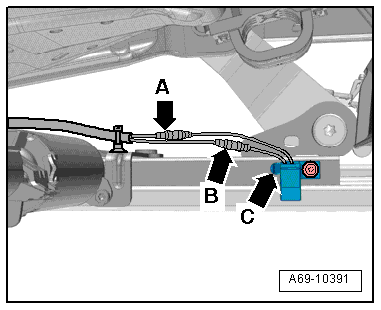
- Connect the wires with crimp connectors -arrow A- and -arrow B-.
- Wrap the entire length of the wiring harness from the clip to the seat position sensor with fabric-reinforced adhesive tape.
- Install the seat position sensor, making sure the hook -arrow C- on the sensor is inserted in the lower seat pan.
The rest of the installation is performed in reverse order of removal, noting the following:
Note
Make sure the connectors are installed all the way and engage audibly.
WARNING
The ignition must be on when connecting the battery. If pyrotechnic components (for example, airbag, belt tensioner) are not repaired correctly, they may deploy unintentionally after connecting battery. There must not be anyone inside the vehicle when connecting the battery.
- Connect the battery ground cable with the ignition on.
Note
If the Airbag Indicator Lamp -K75- indicates a fault, check the DTC memory, erase it and check it again using the Vehicle Diagnostic Tester.
Test yourself
A quick Volkswagen Tiguan quiz: every answer comes with an explanation and a link to the manual page.