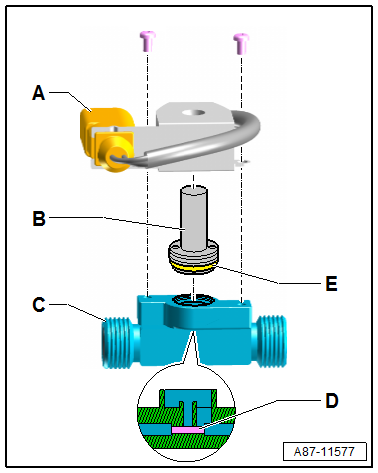
Remove the solenoid coil -A- and the solenoid valve -B- before drilling open. Drill open the shut-off valve -C- using a suitable drill (diameter of the drill for example 5.0 mm). Clean the shut-off valve -C- from shavings produced by drilling -D-. Install the solenoid valve -B- with the seals belonging to it -E- on the drilled open shut-off valve -C-. Flushing
|
Check refrigerant quantity in the refrigerant cylinder, there must be at least 7 kg of refrigerant R134a. |
 Note If necessary, switch on the heater installed on the refrigerant cylinder for 30 minutes before the first flushing procedure. This increases pressure in the refrigerant cylinder and accelerates charging of the flushing circuit.
|
Evacuate the A/C service station old oil container. |
|
Connect the supply hose (high pressure side) of A/C service station to the low pressure line leading to the A/C compressor (line with larger diameter) using an adapter. Refer to → Chapter "Adapter for Assembling Flushing Circuit". |
|
Connect return hose (low pressure- or intake side) of A/C service station to output of refrigerant circuit flushing device. |
|
Connect the input on the refrigerant circuit flushing device to the high pressure line leading to the A/C compressor (line with smaller diameter) using an adapter. Refer to → Chapter "Adapter for Assembling Flushing Circuit". |
Note Components are always (with the exception of the electrically-driven A/C compressor) flushed in the opposite direction of refrigerant flow when the A/C system is operating. Refer to → Chapter "Flushing Circuit Block Diagrams". While flushing, contaminants from the refrigerant circuit enter the refrigerant circuit flushing device and the A/C service station and are absorbed by the filters and dryers installed there. Depending on the contaminant, these components are to be replaced in shorter intervals in line with operating instructions for A/C service station or refrigerant circuit flushing device. The filter in the refrigerant circuit flushing device depends on the type and degree of contamination in the flushed refrigerant circuit. It should be replaced after 2 flushing cycles, at the most. If a heavily contaminated refrigerant circuit is flushed (the refrigerant oil from the circuit is black and viscous or there are many shavings in the refrigerant circuit), the filter should be replaced after flushing. With a refrigerant circuit heavily contaminated in this way, it is wise to flush the circuit again after changing the filter. Depending on the type of contamination, dirt (old refrigerant oil and abraded material from A/C compressor) is deposited on the viewing glass(es). Clean viewing glass(es) after flushing and flush the refrigerant circuit once more with one flushing procedure as a check. Fluid refrigerant cannot be conducted with the necessary speed through the expansion valve, restrictor and desiccant bag of certain receiver/dryers, therefore these components must be removed and replaced by an adapter. Refer to Heating, Ventilation & Air Conditioning. Adapters for connecting A/C service station and for bridging certain components of refrigerant circuit. Refer to → Chapter "Adapter for Assembling Flushing Circuit".
|
Switch on the service station and flush the refrigerant circuit (duration for one flushing cycle with three flushing procedures is approximately 1 to 1.5 hours for about 4Kg of coolant R134a). |
Note Perform flushing of refrigerant circuit according to operating instructions of the A/C service station. Depending on A/C service station version, the old oil container holds only approximately 125 cm 3 of refrigerant oil. In the event a system with a larger volume of refrigerant oil must be flushed, it may be necessary to empty the old oil container after the first flushing procedure of a flushing cycle. Observe the refrigerant which flows back from the refrigerant circuit. The refrigerant circuit is only clean when the refrigerant flows clear and completely colorless through the viewing glass(es) on the flushing device in the A/C service station. When flushing, the complete amount of refrigerant oil is washed out of the refrigerant circuit (except for minor remains which can be disregarded). If contamination is especially severe, it may be necessary to perform the flushing cycle twice (two flushing cycles with three flushing operations each). Before the second flushing cycle, the filter on the flushing device must be replaced. Sequence of flushing procedure (sequence occurs automatically according to the A/C service station program) After switching on, the flushing circuit (refrigerant circuit with connecting hoses and refrigerant circuit flushing device) is first evacuated and the refrigerant circuit is simultaneously checked for leaks. Depending on A/C service station version, it is possible that manually switching to advance the program is required. A prescribed amount of refrigerant (e.g. 4 kg) is filled into the evacuated flushing circuit via the high pressure side of the A/C service station (opposite the normal direction of flow during normal A/C system operation and thus on the low pressure side of vehicle refrigerant circuit). Depending on the version of the A/C service station, refrigerant is added until the flushing circuit is completely full. This can be detected by e.g. refrigerant no longer flowing in after a certain period of time. After the prescribed quantity of refrigerant has been filled, for example. the heater for the refrigerant circuit flushing device is switched on (only in the event the refrigerant is extracted in gaseous form from the refrigerant circuit flushing device), depending on version of A/C service station and refrigerant circuit flushing device. After the refrigerant has been extracted, the heater on the refrigerant circuit flushing device (if applicable) switches off, the refrigerant circuit may be evacuated again (depending on the version), and the refrigerant oil extracted from the refrigerant circuit is separated by the A/C service station after evacuating. The sequence of filling refrigerant, extracting (and evacuating) is repeated twice (performed a total of three times). After the third extraction, the flushing circuit is evacuated depending on the version of the A/C service station.
|
After the flushing cycle has ended, check the viewing glass(es) on the flushing device. If they are dirty, clean them according to the instructions for the flushing device or A/C service station. Perform one addition flushing cycle as a check. One flushing procedure is sufficient (approximately 30 min.) |
|
Check pressure in refrigerant circuit, there must be no positive pressure in the refrigerant circuit (evacuate refrigerant circuit briefly once more if necessary). |
|
Disconnect A/C service station connections from vehicle refrigerant circuit. There must be no positive pressure in the refrigerant circuit. |
|
Replace these vehicle-specific components. |
Restrictor and reservoir
Expansion valve and receiver/dryer or dryer cartridge in receiver/dryer
|
Refer to Heating, Ventilation & Air Conditioning and the Parts Catalog. |
|
Depending on the complaint, replace A/C compressor. Refer to Heating, Ventilation & Air Conditioning and the Parts Catalog or drain the remaining refrigerant oil from the removed A/C compressor. Refer to → Chapter "Components, Replacing" (replace refrigerant circuit components) and refill the prescribed quantity of fresh refrigerant oil. Refer to the vehicle-specific repair manual. |
Note A certain prescribed quantity of refrigerant oil is in the A/C compressor original part. If the vehicle has two evaporators, then the refrigerant circuit requires a specific quantity of refrigerant oil. Refer to the vehicle-specific repair manual. If the A/C compressor is not be replaced, the quantity of refrigerant oil in the A/C compressor must be topped off to the prescribed capacity (tilt the refrigerant oil out and refill the prescribed quantity into the A/C compressor or refrigerant circuit). Refer to → Chapter "Components, Replacing" (replacing refrigerant circuit components) and vehicle-specific repair manual.
|
Completely reassemble the refrigerant circuit. Refer to Heating, Ventilation & Air Conditioning. |
|
Evacuate and recharge refrigerant circuit according to specification. Refer to → Chapter "Refrigerant Circuit with A/C Service Station, Draining" and → Chapter "Refrigerant Circuit with A/C Service Station, Filling". |
|
Start up A/C system according to specification. Refer to Heating, Ventilation & Air Conditioning and → Chapter "A/C System, Operating after Charging". |
|
|
 |
 WARNING
 Caution If it is suspected that chemicals were added to the refrigerant circuit to seal leaks, do not connect the A/C service station and do not extract the refrigerant. Chemicals that seal leaks in the coolant circuit form deposits that affect the function of the A/C system and lead to failure of the A/C system and the A/C service station. Remind the customer that the refrigerant circuit contains substances that VW has not approved. As such, the refrigerant circuit cannot be flushed. It is only possible to service the refrigerant circuit by replacing all the components which come in contact with this material.