Spare wheel or temporary spare wheel
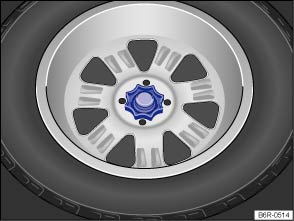 Fig. 130
In the luggage compartment: hand wheel for securing
the spare wheel.
 Read and observe the introductory information
and safety warnings first⇒
 Introduction
to the topic Removing the spare wheel
- Open the tailgate and fold up the luggage compartment cover ⇒ Luggage compartment.
- If necessary, remove the variable luggage compartment floor ⇒ Luggage compartment.
- Lift the floor covering at the cutout and remove it from the luggage compartment.
- If necessary, remove the onboard tool kit with its container ⇒ Onboard tool kit.
- Turn the hand wheel in the center of the spare wheel ⇒ Fig. 130 counterclockwise until fully unscrewed, and remove the spare wheel.
- Remove the floor covering.
- Place the removed wheel rim-side down into the spare wheel well so that the center hole of the rim is exactly above the bore.
- Turn the hand wheel clockwise on the threaded pin until the removed wheel is securely fastened.
- If necessary, return the onboard tool kit to the container in the luggage compartment.
- Put the floor covering back in the luggage compartment floor.
- Fold down the luggage compartment cover.
- Close the luggage compartment lid.
If the spare wheel differs in design from the regular tires, such as winter tires or an emergency wheel, it may only be used briefly in a breakdown, and with careful driving ⇒ .
It must be replaced with a normal, serviceable road wheel as soon as possible.
Observe the driving instructions:
- Do not drive faster than 80 km/h!
- Avoid full-throttle acceleration, hard braking and fast cornering!
- Do not use snow chains on the emergency wheel ⇒ Snow chains .
- After fitting the spare wheel or emergency wheel, check the tire inflation pressure as soon as possible ⇒ Tire inflation pressure .
The tire inflation pressure of the spare wheel or emergency wheel should be checked together with the regular tires, at least once a month. The spare wheel is to be inflated to the highest tire pressure specified for the vehicle ⇒ Tire inflation pressure .

 Warning
Improper handling of the spare wheel or temporary spare wheel can lead to loss of vehicle control, collisions or other accidents, and serious injury.
- Never use the spare wheel or emergency wheel if it is damaged or worn down to the wear indicators.
- On some vehicles the spare wheel may be smaller than the original tire. The smaller spare wheel can be identified by a sticker and the marking 80 km/h or 50 mph. This marking indicates the maximum permitted speed at which the tire may be driven. The sticker must not be covered while the wheel is in use.
- Never drive faster than 80 km/h. Avoid hard acceleration, harsh braking and fast cornering.
- Never drive more than 200 km on an emergency wheel if it is mounted on the drive axle.
- Replace the emergency wheel with a normal wheel as soon as possible. The emergency wheel is intended for short-term use only.
- The emergency wheel must always be secured with the wheel bolts supplied by the factory.
- Never drive with more than one spare wheel that differs from the regular tires.
- After fitting the emergency wheel, the tire inflation pressure must be checked as soon as possible ⇒ Tire inflation pressure .
- Snow chains cannot be used on the emergency wheel.

If possible, secure the spare wheel, the emergency wheel or the
replaced wheel in the luggage compartment. On vehicles with a tire repair kit, the replaced wheel cannot be secured.