Tire markings and tire type
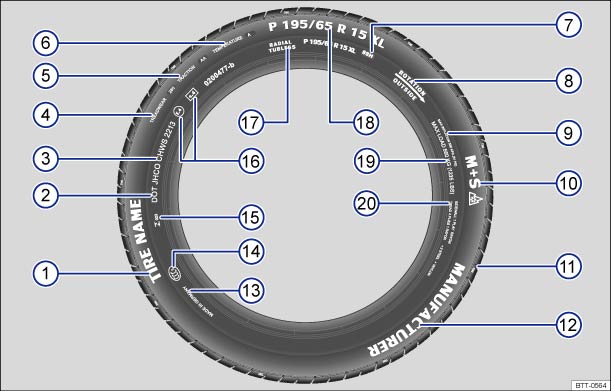 Fig. 131
International tire marking.
 Read and observe the introductory information
and safety warnings first⇒
 Introduction
to the topic
| ⇒ Fig. 131 | Tire marking (example) | Meaning | |
|---|---|---|---|
| ① | Product name | Individual tire designation of the manufacturer. | |
| ② | DOT | The tire complies with the legal requirements of the US Department of Transportation, responsible for tire safety standards. | |
| ③ | JHCO CHWS 2213 | Tire Identification Number (   a) – possibly only on the inner side of the wheel) and date of manufacture: |
|
| JHCO CHWS | Code letter of the manufacturing plant and information from the tire manufacturer on tire size and tire features. | ||
| 2213 | Date of manufacture: 22nd week of 2013. | ||
| Information for end consumers on comparative values for specified base tires (standardized test procedures) ⇒ Consumer information : | |||
| ④ | TREADWEAR 280 | Relative service life of the tire, based on a US-specific standard test. A tire marked 280 wears 2.8 times more slowly than the reference tire, which has a treadwear value of 100. The actual tire performance depends on the respective usage conditions and can differ noticeably from the standard values due to driving behavior, maintenance, different road surface conditions and climatic conditions. | |
| ⑤ | TRACTION AA | Wet braking performance of the tire (AA, A, B or C). This is measured under controlled conditions on certified test tracks. Tires marked C have low traction performance. The traction value assigned to the tire is based on straight-line traction tests and does not include acceleration, cornering, hydroplaning or traction under maximum load. | |
| ⑥ | TEMPERATURE A | Temperature resistance of the tire at higher test-bench speeds (A, B or C). Tires marked A and B exceed the legal requirements. The temperature rating is based on tires with correct air pressure and excludes overpressure. Excessive speed, incorrect air pressure and overpressure, alone or in combination, can cause heat build-up or tire damage. | |
| ⑦ | 88 H | Load index ⇒ Tire load capacity and speed symbol ⇒ Speed symbols . | |
| ⑧ | Rotation and arrow | Marking of the tire rotation direction ⇒ Directional tires . | |
| OR: Outside | Marking of the outside of the tire ⇒ Asymmetric tires . | ||
| ⑨ | MAX INFLATION 350 KPA (51 psi / 3,51 bar) | US limit for maximum inflation pressure. | |
| ⑩ | M+S or M/S or | Marking for winter-capable tires (mud and snow) ⇒ Winter tires . Studded tires are marked with an E after the S. | |
| ⑪ | TWI | Indicates the position of the tread wear indicator (TWI) ⇒ Tread depth and wear indicator. | |
| ⑫ | Brand name, logo | Manufacturer. | |
| ⑬ | Made in Germany | Country of manufacture. | |
| ⑭ |  | Country-specific marking for China (China Compulsory Certification). | |
| ⑮ |  023 | Country-specific marking for Brazil. | |
| ⑯ | E4 e4 0200477-b | Marking according to international regulations with approval country number. Tires approved under ECE regulations are marked with E, tires under EC regulations with e. This is followed by the multi-digit approval number. | |
| ⑰ | RADIAL TUBELESS | Tubeless radial tire. | |
| ⑱ | P 195 / 65 R 15 XL | Size designation: | |
| P | Designation for passenger car tires. | ||
| 195 | Tire width from sidewall to sidewall in mm. | ||
| 65 | Aspect ratio in %. | ||
| R | Belt construction code letter for radial. | ||
| 15 | Rim diameter in inches. | ||
| XL | Reinforced tire (Extra Load). | ||
| ⑲ | MAX LOAD 615 KG (1235 LBS) | US load rating for the maximum load per wheel. | |
| ⑳ | SIDEWALL 1 PLY RAYON | Information on the carcass components: 1 ply rayon. | |
| TREAD 4 PLIES 1 RAYON + 2 STEEL + 1 NYLON | Information on the tread components: In the example, there are 4 plies under the tread: 1 ply rayon, 2 steel belt plies and 1 nylon ply. | ||
The tire marking is also present on the inside of the tire. Certain markings may appear on only one side of the tire, e.g. the tire identification number (TIN) and the date of manufacture.
Any additional digits present are internal markings of the tire manufacturer or country-specific markings.
Low-profile tiresLow-profile tires offer a wider tread and a larger rim diameter with a low sidewall height compared to other wheel and tire combinations ⇒ . Low-profile tires
improve driving characteristics and precision. On poor roads and tracks, however, comfort may be reduced.
Directional tires are designed to roll in one direction only. On directional tires, the tire sidewall is marked with arrows. The indicated direction of rotation must be observed. This is the only way to ensure optimal performance in terms of aquaplaning resistance, grip, noise and wear.
If a tire is nevertheless mounted against the intended direction of rotation, drive with particular care, as the tire is no longer being used as intended. This is especially important on wet roads. The tire must be replaced as soon as possible or mounted in the correct direction of rotation.
Asymmetric tiresAsymmetric tires take into account the behavior of the inner and outer areas of the tread pattern. On asymmetric tires, the tire sidewall is marked with inside and outside. The tire must be mounted on the rim in the correct position. This is the only way to ensure optimal performance in terms of aquaplaning resistance, grip, noise and wear.
Tire load capacityThe load index indicates the maximum load in kilograms that a single tire may carry (load capacity).
Some examples:
78425 kg81462 kg83487 kg85515 kg87545 kg88560 kg91615 kgSpeed symbolsThe speed symbol indicates the maximum speed at which the tire may be driven.
Pmax. 150 km/hQmax. 160 km/hRmax. 170 km/hSmax. 180 km/hTmax. 190 km/hUmax. 200 km/hHmax. 210 km/hVmax. 240 km/hWmax. 270 km/hYmax. 300 km/hOver 240 km/hSome tire manufacturers use the letter combination ZR for tires with a permitted maximum speed above 240 km/h.
Vehicle-specific information on tire load capacity and speed rangeVehicles within the EU and so-called EU user states receive a certificate of conformity (COC paper). The certificate of conformity contains information on size and diameter as well as the load capacity and speed range of the tires approved by Volkswagen for the relevant vehicle type.
Whether the vehicle has a certificate of conformity can be determined from the type plate. After opening the driver's door, the type plate can be seen at the bottom of the door pillar ⇒ Technical data.
- If the type plate contains the line labeled 'Erlaubnis' (approval), the vehicle has a certificate of conformity.
- If there is no type plate or if the line 'Erlaubnis' (approval) is missing, the vehicle does not have a certificate of conformity.
a) The TIN is the serial number of the tire.