Handling wheels and tires
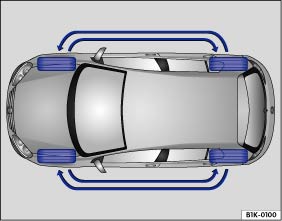 Fig. 126
Diagram for changing the wheels.
 Read and observe the introductory information
and safety warnings first⇒
 Introduction
to the topic
Tires are the most stressed and most underestimated parts of a vehicle. Tires are very important, because the narrow contact patches of the tires are the vehicle's only contact with the road.
Tire service life depends on tire inflation pressure, driving style, handling and correct mounting.
Tires and wheels are important structural components. The tires and wheels approved by Volkswagen are precisely matched to the respective vehicle type and therefore contribute significantly to good road holding and safe handling.
Avoiding damage to wheels and tires- Drive over curbs and similar obstacles only slowly and, if possible, at a right angle.
- Regularly check wheels and tires for visible and hidden damage, such as cracks and deformation ⇒ Tire damage .
- Remove foreign objects that are lodged externally in the tread and have not penetrated into the tire interior ⇒ Tire damage .
- Check the correct tire inflation pressure regularly. If necessary, observe warning messages from the tire pressure monitoring system ⇒ Tire pressure monitoring system .
- Have damaged or worn tires replaced immediately ⇒ Tire damage .
- Never exceed the load capacity and maximum speed of the mounted tires ⇒ Tire markings and tire type .
- Protect tires, including the spare tire, from contact with aggressive substances, including grease, oil, gasoline and brake fluid ⇒ .
- Replace missing valve caps immediately.
To wear all tires evenly, it is recommended to rotate the wheels regularly according to the pattern ⇒ Fig. 126. This gives the tires approximately the same service life.
Volkswagen recommends having the wheels rotated by a specialist workshop.
Tires older than 6 yearsTires age through physical and chemical processes, which can impair their function. Tires that are stored unused for a longer period harden and become brittle sooner than tires that are in constant use on the vehicle.
Volkswagen recommends having tires that are 6 years old or older replaced with new tires. This also applies to tires, including the spare tire, that still appear serviceable on the outside and whose tread depth has not yet reached the legally required minimum value ⇒ .
The age of each tire can be determined from its date of manufacture, which is part of the tire identification number (

 )
⇒ Tire markings and tire types.
Mark wheels before removing them so that they can keep their original direction of rotation when refitted (left, right, front, rear). Always store removed wheels or tires in a cool, dry and preferably dark place. Do not stand tires mounted on rims upright.
Protect tires without rims from contamination in suitable covers and store them standing on the tread.

 Warning
Aggressive fluids and substances can cause visible and invisible damage to tires, which may lead to the tires bursting.
- Always keep chemicals, oils, greases, fuels, brake fluids and other aggressive substances away from the tires.
Warning Old tires – even if they have not been used – can suddenly lose air or burst, especially at high speeds, causing accidents and serious injuries.
- Use tires that are older than 6 years only in an emergency and with extreme caution, and drive accordingly carefully.

 Note
Avoid strong impacts and drive around obstacles where possible. Potholes and curbs in particular can compress and deform tires, especially low-profile tires. This can break the tire's fabric ply and cause bulges or cracks in the sidewalls, as well as deformation or cracks in the wheel rims.

Always dispose of old tires properly and in accordance with regulations.