Checking the tires
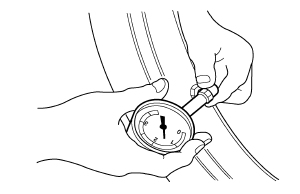
The following procedure applies to both of the tires.
1. Check:
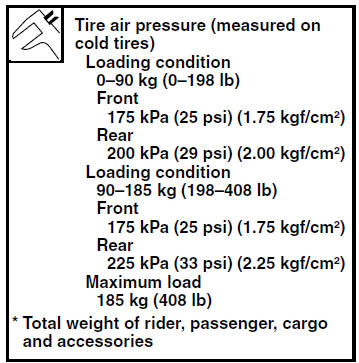
Tire pressure Out of specification  Regulate.
WARNING
- The tire pressure should only be checked and regulated when the tire temperature equals the ambient air temperature.
- The tire pressure must be adjusted according to the total weight (including cargo, rider, passenger and accessories) and the anticipated riding speed.
- Operation of an overloaded vehicle could cause tire damage, an accident or an injury.
WARNING
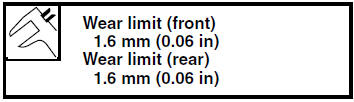
It is dangerous to ride with a worn-out tire.
When the tire tread reaches the wear limit, replace the tire immediately.
2. Check:
Tire surfaces Damage/wear  Replace the tire.
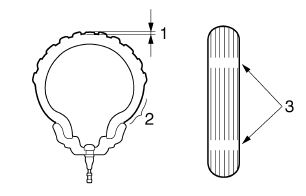
1. Tire tread depth
2. Side wall
3. Wear indicator
WARNING
- Do not use a tubeless tire on a wheel designed only for tube tires to avoid tire failure and personal injury from sudden deflation.
- When using a tube tire, be sure to install the correct tube.
- Always replace a new tube tire and a new tube as a set.
- To avoid pinching the tube, make sure the wheel rim band and tube are centered in the wheel groove.
- Patching a punctured tube is not recommended.
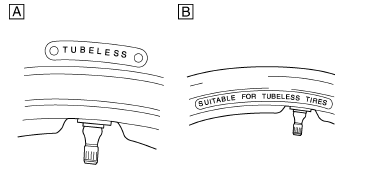
A. Tire
B. Wheel
WARNING
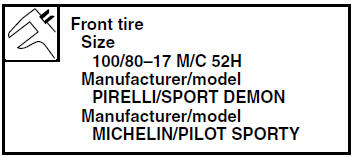
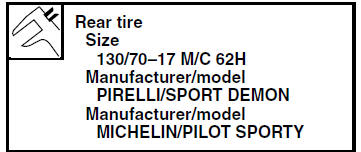
After extensive tests, the tires listed below have been approved by MBK Industrie for this model. The front and rear tires should always be by the same manufacturer and of the same design. No guarantee concerning handling characteristics can be given if a tire combination other than one approved by MBK Industrie is used on this vehicle.
WARNING
New tires have a relatively low grip on the road surface until they have been slightly worn. Therefore, approximately 100 km should be traveled at normal speed before any high-speed riding is done.
NOTE:
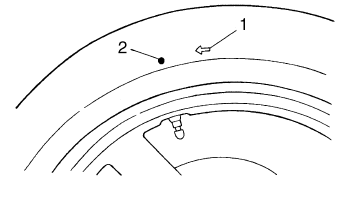
For tires with a direction of rotation mark "1":
- Install the tire with the mark pointing in the direction of wheel rotation.
- Align the mark "2" with the valve installation point.
Test yourself
A quick Yamaha YZF-R125 quiz: every answer comes with an explanation and a link to the manual page.