Battery Removal and Installation
GENERAL INFORMATION
The battery is located in the engine compartment, behind the left headlight.
CAUTION
Disconnecting the battery erases data from some electronic control module memories, for example fault memory of the engine and transmission control systems, as well as the anti-lock brake system. Before disconnecting the battery, read the memory data of the control modules using AUDI diagnostic equipment. If faults reappear as a result of further driving, they are stored again in memory.After reconnecting the battery, the electric window automatic function must be reactivated.
Factory-installed radios have an anti-theft lock. It prevents unauthorized use of the unit if its power supply has been interrupted. Power is interrupted not only when the battery is disconnected, but also when the radio is removed or if the radio fuse has blown.
If the radio is coded, the radio code must be entered before disconnecting the battery. If the code is unknown, the radio can be unlocked at an AUDI service station; also refer to the subsection Entering the Radio Code.
Before disconnecting the battery, record the settings of the stored radio presets.
If the battery is to be replaced:
– If possible, use a modern battery with a central gas vent. In this case, gases generated in the battery are discharged through a hose.
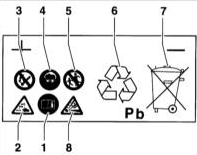
1 – When servicing the battery, observe the safety rules described in the owner's manual. 2 – The battery contains corrosive acid; take care not to spill acid from the battery. 3 – Do not use open flame near the battery. 4 – Wear protective goggles when working with the battery. 5 – Keep the battery out of reach of children. 6 – When disposing of the battery, take it only to designated collection points. 7 – Do not dispose of the battery with household waste. 8 – Gases released during battery charging are explosive.
– If a battery with vented caps is installed, make sure the caps are protected by a plastic cover against water splashes. REMOVAL
PROCEDURE
1. Switch off the ignition.
2. Open the hood.
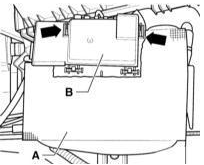
3. Remove the battery protective cover (A) by opening the clip.
4. Open the main fuse block cover (B) forward. To do this, squeeze the locking tabs on the left and right sides of the cover (arrows).
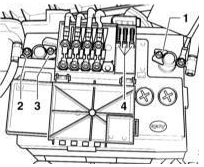
5. Disconnect the negative battery cable (–) and move it aside. To do this, loosen nut –1– (10 mm wrench).
6. Unscrew nut –2– (10 mm wrench). Disconnect the main fuse block from the battery at the front and rear, and remove it.
7. Disconnect the positive battery cable (+) by unscrewing nut –3– (10 mm wrench). 4 – Fuses.

8. Unscrew the bolts securing the mounting plate at the base of the battery (arrow in the accompanying illustration) and remove it.
9. Shift the battery sideways away from the mounting plate and remove it. The plate is located opposite the removed holder. INSTALLATION
10. Make sure the ignition and all electrical consumers are switched off; switch them off if necessary.
CAUTION
When installing the battery, make sure the central gas vent hose is not pinched. This is the only way to guarantee that gases produced while charging the battery are vented freely through the vent hose. The illustration shows a battery that is not the one installed in the AUDI A3. The hose connection (arrow in the illustration) contains a flame arrestor that prevents hydrogen released from the battery through the gas vent hose from igniting. Therefore, the gas vent hose must not be removed.
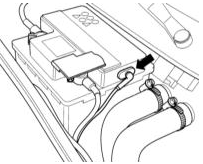
11. Insert the battery into holder –1–.

CAUTION
When installing the battery, make sure that the battery holder tab (arrow in the illustration) engages in the slot of the support plate –1–. After this, do not shift the battery to the left or right.12. The battery is installed correctly if the center slot of the battery support plate aligns with the threaded hole.
13. For a battery with a central gas vent hose, make sure the hose is not pinched and nothing obstructs gas discharge.
14. For batteries without a central gas vent hose, make sure the opening on the upper side of the cover is not blocked.
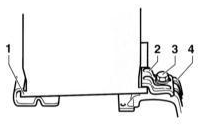
15. Install holder –2– on battery mounting base –4– and secure it with bolt –3– to a torque of 20 N·m.
16. Check that the battery is secure by moving it in different directions. If the battery is not firmly secured, its service life will be shortened. In addition, safety in a collision will be reduced.
17. Install the heat shield, if it was removed.
CAUTION
Incorrect connection of the battery can cause serious damage to the alternator and electrical components.18. Connect the positive cable to the positive terminal (+), tightening torque 6 N·m.
CAUTION
Press the clamp on carefully so as not to damage the battery case. Do not grease the battery terminals. Connect the negative cable only after installing the safety holder.19. Install the safety holder on the battery, placing the current-carrying plate over the positive terminal mounting bolt.
20. Secure the safety holder clamp to the battery.
21. Tighten the bolt securing the current-carrying plate on the positive terminal (+).
22. Connect the fuses to the electrical wires and secure them.
23. Mate the multi-pin connector.
24. Connect the negative cable (–) and secure it to a torque of 6 N·m.
CAUTION
Press the clamp on carefully so as not to damage the battery case. Do not grease the battery terminals.25. If necessary, program the radio. Refer to the subsection Entering the Radio Code.
26. Set the clock.
27. Activate the automatic operation of the power windows.
28. Lock the vehicle from the outside using the driver or front passenger door. Make sure that all doors and windows are fully closed.
29. Unlock and then lock the vehicle again. Hold the key in the locking position for at least 1 second.
CAUTION
If a malfunction occurs in the electric windows, the door lighting flashes.Note for Battery with Vented Caps
30. If possible, install only a battery with a central gas vent.
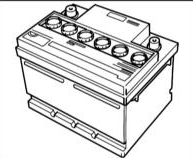
31. On the battery type shown in the illustration, with vented and removable caps, plastic covers must be installed over the caps to protect against water ingress and leaking, corrosive electrolyte.
For a battery with a central gas vent (flat caps that can only be removed with a screwdriver), these covers are not required.
Purchasing a New Battery
Probably the most important point to pay attention to
CAUTION
The buyer should know these battery characteristics. There are three of them. The first is the nominal voltage; it is the same for all batteries, so a mistake is impossible. When buying, it is advisable to check the battery with a load tester. The second is capacity, measured in ampere-hours (Ah); roughly speaking, it means the amount of electrical energy stored in the battery. Capacity determines how long the starter motor can be cranked, more precisely, how many engine start attempts can be made. The price of a battery is almost directly proportional to its capacity. The third characteristic is cranking current (measured in amperes, A), i.e. the current supplied to the starter during starting. Batteries may indicate it according to four different systems: GOST (domestic), EN (European standard), SAE (American standard) and DIN. The last, the German standard, is closest to our GOST and is the "default" on most European batteries, i.e. when no standard is specified. The larger it is, the faster and more forcefully the starter will turn the engine.It is best to buy a battery with the specifications listed in the owner's manual for your vehicle: this way it will last longer at minimum cost. You may save money by buying a battery of lower capacity, but it will serve less than its normal service life and will perform poorly during winter starting. Buying a battery of even slightly higher capacity will not extend its service life, because constant undercharging of the battery will lead to sulfation of the plates, and you will lose money. Do not overdo the higher starting current either: you will burn out the starter. It is better to change the engine oil, and there will be no starting problems.
Recently, the market has been flooded with low-quality goods and counterfeits. Batteries are no exception. There are several signs by which an original can be distinguished from a counterfeit with reasonable accuracy. First and most important: the battery must be marked with the country of manufacture and the producing plant, preferably with an address. Second, the date of manufacture must be indicated, which is very important if the battery is a flooded type. Each battery must be supplied with a technical certificate, while an instruction manual is not mandatory. This is because in the West batteries are almost never sold at retail; they are installed by specialists at service stations. Third, a quality battery cannot exist without a quality case, good caps and smooth terminal posts, often greased with a technical protective grease against oxidation and covered with colored plastic caps.
Test yourself
A quick Audi A3 quiz: every answer comes with an explanation and a link to the manual page.