General Information
Diagnostic equipment information
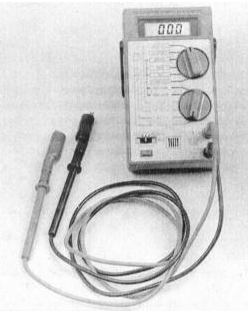
When diagnosing these systems, use a high-impedance digital multimeter to considerably improve measurement accuracy
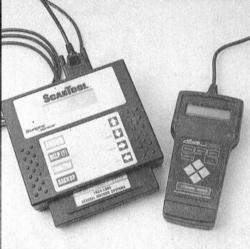
In recent years, scan tools such as handheld scanners like Actron Scantool, AutoXray XP240, or KTS 100 (Bosch) have become absolutely indispensable for diagnosing engine management systems of modern vehicles.
Checking the operation of components of the fuel injection and exhaust emission control systems is performed using a universal digital multimeter (see the accompanying illustration). A digital multimeter is preferred for several reasons. First, with analog instruments it is quite difficult (sometimes impossible) to read results to the nearest hundredth or thousandth of a unit, whereas when testing circuits that include electronic components, such accuracy is especially important. The second, no less important, reason is that the internal circuit of a digital multimeter has a fairly high impedance (the internal resistance of the instrument is 10 MOhm). Since the voltmeter is connected in parallel to the circuit under test, the measurement accuracy is higher the smaller the current flowing through the instrument itself. This factor is not significant when measuring relatively high voltage values (9 ÷ 12 V), but becomes decisive when diagnosing elements that output low-voltage signals, such as the λ-sensor (oxygen sensor), where measurements are in fractions of a volt.
Simultaneous monitoring of signal parameters, resistances and voltages in all control circuits is possible using a breakout box connected in series with the engine control module connector. With the engine off, running, or with the vehicle in motion, measure the signal parameters at the terminals of the breakout box and determine possible faults from the readings.
For diagnosing electronic systems of the engine, automatic transmission, ABS, and SRS, special diagnostic scan tools or testers such as BMW DIS and MoDIC (programmable from a PC) may be used. In addition, scan tools and specialized diagnostic analyzers may be used for this purpose, for example CS 1000, Bosch FSA 560 (www.bosch.de), KTS 300, Sun 2013, or a standard personal computer with a special cable and OBD browser software (for example, refer to the website www.carsoftinternational.com/).
Some scan tools, in addition to standard diagnostic functions, allow, when connected to a personal computer, printing of wiring diagrams stored in the control module memory (if available), programming of the anti-theft system, and real-time monitoring of signals in vehicle circuits.
You can download a free version of the OBD II browser for diagnosing your vehicle from our website arus.spb.ru or from www.obd-2.com; www.obd-2.de
On some models, diagnostic trouble codes stored in the self-diagnosis system memory can also be read using the “check engine” indicator on the instrument panel.
The scan tool only reads stored diagnostic trouble codes and clears the trouble code memory. The tester can additionally activate and display live data.
For diagnosis, tools from ToolRama, Inc. (3500 NW Boca Raton Blvd., Boca Raton, Florida, 33431, USA 1 877 866 5726 - 561 750 4511 - 561 338 8447 FAX) with cartridges for a specific vehicle model may also be used.
All tester cartridges can also be used in the scan tool. In this case, functions are limited to reading and clearing the memory only.
For diagnosis, tools from ToolRama, Inc. (3500 NW Boca Raton Blvd., Boca Raton, Florida, 33431, USA 1 877 866 5726 - 561 750 4511 - 561 338 8447 FAX) may be used, for example:
- tester R000 with cartridge T051D, or scan tool P000 with cartridge T041,
- universal cable N000,
- connector N001.
The OBD II cartridge performs the following functions:
- Reading and erasing OBD II trouble codes. Display of oxygen sensor test results.
- Continuous monitoring of ignition, injection and component systems.
- Display of live data and recorded intermittent faults:
• Intake manifold absolute pressure;
• Oxygen sensor voltage;
• Engine coolant temperature;
• Calculated engine load;
• Vehicle speed;
• Fuel quality;
• Mass air flow;
• Ignition timing advance;
• Throttle position;
• Intake air temperature.
For details on these tools, see www.programatools.com and www.bosch.de.
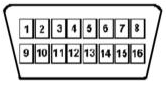
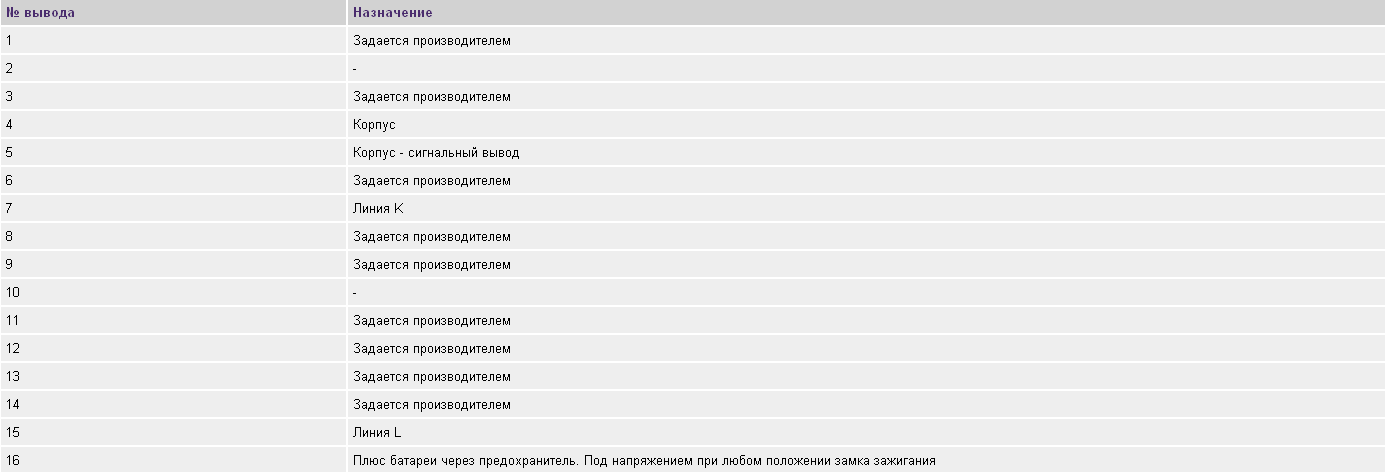
The 16-pin Diagnostic Link Connector (X19527) of the OBD II on-board diagnostic system is located on the center console
Uses ISO 9141-2 protocol.
A standard cable with a J1962 connector is used for connection.
Test yourself
A quick BMW 1 quiz: every answer comes with an explanation and a link to the manual page.