Transporting children safely
For best protection in the event of an impact, all occupants must be seated and secured by suitable restraint systems.
This is particularly important for children.
This regulation is binding in all member states of the European Community under EC Directive 2003/20/EC.
In children, the head is larger and heavier in proportion to the rest of the body than in adults, and the muscles and bone structure are not yet fully developed. For correct restraint in the event of an accident, systems other than adult seat belts are required for them.
The research findings on the best child protection are compiled in the European regulation ECE-R44, which, in addition to becoming mandatory, divides restraint systems into five groups:
Group 0: up to 10 kg body weight. Group 0+: up to 13 kg body weight. Group 1: 9-18 kg body weight. Group 2: 15-25 kg body weight. Group 3: 22-36 kg body weight.
As can be seen, the groups partially overlap. In fact, restraint devices designed for more than one weight class are available on the market.
All restraint devices must have the approval data and the control mark on a securely attached plate on the child seat. The plate must not be removed.
Children over 1.50 m in height are treated the same as adults with regard to restraint systems and wear the seat belts normally.
The Fiat Lineaccessori range includes child seats for every weight group. This selection is recommended, as these seats have been specially developed and tested for Fiat vehicles.
 Note
Infant carriers must not be placed facing backwards on the front passenger seat when the passenger airbag is active. Airbag deployment in a collision could cause fatal injuries to the infant, regardless of the severity of the impact. It is advisable to have children ride on the rear seats, as this is the best-protected position in a collision.
Note Great danger
If absolutely necessary, children in infant carriers facing backwards may ride on the front seat of a vehicle whose passenger airbag (front and side airbag for upper body/pelvis protection (side bag), where fitted) can be deactivated via the set-up menu.
In this case, it is essential to check the relevant warning lamp on the
instrument panel to confirm that deactivation has taken place. Furthermore, the front passenger seat must be set to the furthest position to prevent the child seat from touching the dashboard.
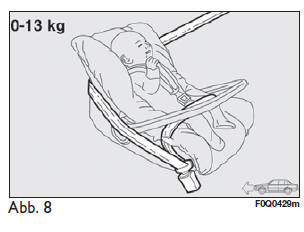
Babies weighing up to 13 kg can be transported in a rear-facing infant carrier which, thanks to the head support, does not place stress on the neck during sharp deceleration.
The carrier is secured with the vehicle's seat belts, as shown in Fig. 8, and the baby is restrained by the carrier's own harness.
Group 1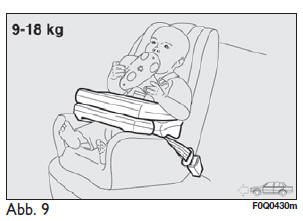
Children weighing more than 9 to 18 kg can be transported forward-facing on seats equipped with a cushion at the front, against which the vehicle's seat belt is fastened, holding the child and seat together, Fig. 9.
 Note
The illustration shows only one installation method. The child seat must be installed in accordance with the instructions that are mandatorily supplied with the seat.
NoteThere are child seats for weight groups 0 and 1 with a base that is secured at the rear with the vehicle's belts and has its own harness on the seat to hold the child. Because of their weight, these seats can be a hazard if improperly secured (e.g., if a cushion is placed underneath when fastening them with the vehicle belts).
The enclosed installation instructions must be followed exactly.
Group 2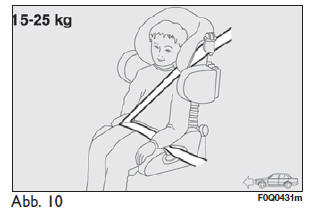
From 15 to 25 kg body weight, children can be secured directly with the vehicle's seat belts, Fig. 10.
At this stage, the child seats only serve to position the child correctly for the belts, so that the diagonal belt runs across the shoulder and not the neck, while the lap belt lies across the pelvis and not the abdomen.
Group 3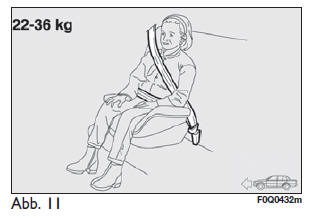
For children weighing 22 to 36 kg, the chest size is already large enough that the backrest can be dispensed with.
Fig. 11 shows an example of the correct positioning of the child on the rear seat.
Above 1.50 m in height, children can be belted in like adults.
NoteThe illustration shows only one installation method. The child seat must be installed in accordance with the instructions mandatorily supplied with the seat.
Suitability of passenger seat for use with child seatsThe vehicle complies with the new European regulation 2000/3/CE, which governs the installation of child seats on the various vehicle seats according to the following tables:
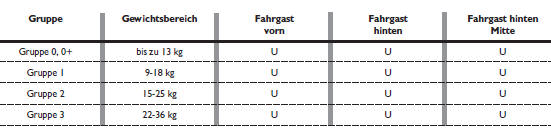
Key to symbols:
U = suitable for restraint systems of the "universal" category under European regulation ECE-R44 for the specified "groups".
The most important safety standards to observe when transporting children are summarised below:- The recommended position for installing child seats is the rear seat, as this is the safest location in an accident.
- When deactivating the passenger airbag, always check the steady warning lamp on the instrument panel to confirm that the airbag has been deactivated.
- The instructions supplied with the child seat by the supplier must be strictly followed. They must be kept in the vehicle together with the documents and this owner's manual.
Child seats without installation instructions should not be used.
- Check that the seat belts have engaged by pulling on the belt.
- Each restraint system has only one seat, and never may two children be transported on it at the same time.
- Always check that the belt does not rest against the child's neck.
- Do not allow your child to adopt unusual positions or unbuckle the belt while the vehicle is in motion.
- Do not hold children on your lap in the vehicle, including newborns.
No one, however strong, can hold a child in place in the event of a collision.
- After an accident, replace the child seat with a new one.
 Note
If a passenger airbag is fitted, never place a rear-facing baby seat on the front passenger seat.
Airbag deployment in a collision could cause fatal injuries to a baby travelling in the front. It is advisable to have children ride in their child seats on the rear seats, as this is the best-protected position in a collision.
Test yourself
A quick Fiat Bravo quiz: every answer comes with an explanation and a link to the manual page.