Passenger Sensing System
This system works with sensors that are part of the front passenger seat and seat belt to detect the presence of a properly seated occupant and determine whether the front passenger airbag should be enabled (may deploy) or not.
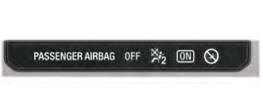
The passenger sensing system uses the passenger airbag status indicator, which illuminates to show that the front passenger airbag is enabled (on) or disabled (off).
The indicators are located in the overhead console.
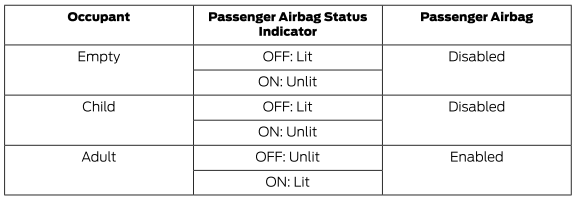
The passenger sensing system is designed to disable (will not inflate) the front passenger airbag when the front passenger seat is unoccupied, or a rear-facing child seat, forward-facing child restraint, or booster seat is detected. Even with this technology, parents are strongly advised to always properly restrain children in the rear seat.
- When the passenger sensing system disables (will not inflate) the front passenger airbag, the passenger airbag off indicator illuminates and remains on to remind you that the front passenger airbag is disabled.
- If you have installed a child restraint and the airbag off indicator is illuminated, turn the vehicle off, remove the child restraint from the vehicle, and reinstall the restraint following the child restraint manufacturer's instructions.
The passenger sensing system is designed to enable (allow deployment of) the front passenger airbag at any time the system determines that an adult-sized occupant is properly seated in the front passenger seat.
- When the passenger sensing system enables the front passenger airbag (may deploy), the airbag status indicator illuminates and remains on.
If an adult-sized occupant is seated in the front passenger seat but the airbag off indicator is illuminated, the occupant may be improperly seated in the seat. If this occurs:
- Turn the vehicle off and ask the occupant to return the seatback to the upright position.
- Ask the person to sit upright in the center of the seat cushion with their legs comfortably extended.
- Restart the vehicle and ask the occupant to remain in this position for approximately a couple of minutes. This allows the system to detect the occupant and enable the passenger front airbag.
- If the airbag off indicator remains illuminated even after this, instruct the occupant to ride in the rear seat.
After all occupants have adjusted their seats and fastened their seat belts, it is very important that they continue to sit properly. A properly seated occupant sits upright, leaning against the seatback and centered on the seat cushion, with their legs comfortably extended to the floor. Improper seating may increase the chance of injury in a crash. For example, if an occupant slouches, lies down, turns sideways, sits forward, leans forward or to the side, or raises one or both legs, the likelihood of injury during a crash increases significantly.
 Make sure the front passenger sensing system is working properly. Refer to Impact Sensors and Airbag Indicator.
Do not attempt to repair or service the system. Take your vehicle to an authorized dealer immediately.
If it is necessary to modify the advanced front airbag system to accommodate a person with a disability, contact the Ford Customer Relationship Center. Refer to Obtaining the Service You Need.
Test yourself
A quick Ford Explorer quiz: every answer comes with an explanation and a link to the manual page.