Load Limit
Vehicle Loading - With and Without a Trailer
This section will help you load your vehicle, trailer, or both correctly. Keep the weight of the loaded vehicle within its designed capacity, with or without a trailer. Loading your vehicle correctly ensures the vehicle performs to its design maximum. Before loading your vehicle, review the following terms. To determine the weight rating of your vehicle with or without a trailer, refer to the tire and loading information label or the vehicle certification label.
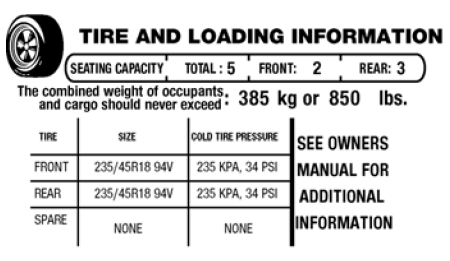
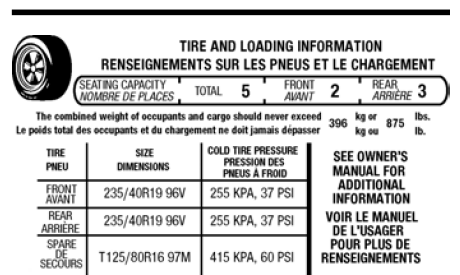
Example of Tire and Loading Information Label:
Payload
Payload is the combined weight of cargo and passengers carried by your vehicle. The maximum payload for your vehicle is shown on the "Tires and Loading" label. The label is located either on the center pillar or on the edge of the driver's door. Vehicles exported outside the United States and Canada may not have a tire and loading label. Look for the statement "The combined weight of occupants and cargo should never exceed XXX kg or XXX lbs" for the maximum payload. The payload shown on the tire and loading label is the maximum load capacity of your vehicle as manufactured at the assembly plant. If you install any additional equipment on your vehicle, you must determine the new payload. Subtract the weight of the equipment from the payload shown on the tire and loading label. When towing, the trailer tongue weight or the hitch weight is also part of the payload.
GAWR (Gross Axle Weight Rating)
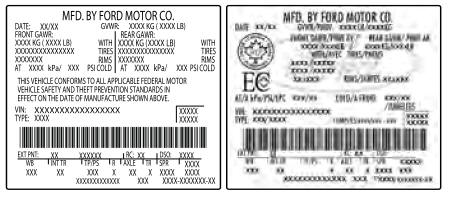
GAWR is the maximum permissible weight that one axle (front or rear) can carry. These values are shown on the certification label. The label is located on the door hinge pillar, door latch pillar, or on the door edge that meets the door latch pillar, near the driver's seat.
The total load on each axle must never exceed the axle's GAWR.
GVWR (Gross Vehicle Weight Rating)
GVWR is the maximum permissible weight of the fully loaded vehicle. This includes all options, equipment, passengers, and cargo. It is shown on the certification label. The label is located on the door hinge pillar, door latch pillar, or on the door edge that meets the door latch pillar, near the driver's seat.
The gross vehicle weight must never exceed the GVWR.
Example of a Safety Compliance Certification Label:
Maximum Loaded Trailer Weight
Maximum loaded trailer weight is the maximum possible weight of a fully loaded trailer that the vehicle can tow. Consult an authorized dealer (or a motorhome and trailer supplier) and the Towing Guide (available from an authorized dealer) for more detailed information.
GCWR (Gross Combined Weight Rating)
GCWR is the maximum permissible combined weight of the vehicle and loaded trailer, including all cargo and passengers, that the vehicle can handle without risk of damage. (Important: The tow vehicle brake system is designed to operate at the vehicle GVWR, not the GCWR.) Separate trailer brakes must be used to safely control towed vehicles and for trailers where the combined weight of the tow vehicle and trailer exceeds the GVWR of the tow vehicle.
The gross combined weight must never exceed the GCWR.
Steps to determine the correct load limit:
- Find the statement "The combined weight of occupants and cargo should never exceed XXX kg or XXX lbs" on your vehicle's label.
- Determine the total weight of the driver and passengers who will be riding in your vehicle.
- Subtract the total weight of the driver and passengers from XXX kg or XXX lb.
- The resulting figure is the available cargo and luggage capacity. For example, if "XXX" is 1400 lb and there will be five passengers weighing 150 lb each in your vehicle, the available cargo and luggage capacity is 650 lb (1400 - 750 (5 x 150) = 650 lb).
- Determine the total weight of the luggage and cargo to be loaded into the vehicle. This weight must not safely exceed the available cargo and luggage capacity calculated in Step 4.
- If your vehicle will tow a trailer, the load from your trailer will be transferred to your vehicle. Refer to this manual to determine how this reduces the available cargo and luggage capacity of your vehicle.
Useful examples for calculating available cargo and luggage capacity
Assume your vehicle has a maximum load capacity of 1400 lb (635 kg) and a luggage compartment. You decide to play golf. Is there enough load capacity to carry you, your four friends and all the golf bags? You and your four friends average 220 lb (99 kg) each, and the golf bags weigh approximately 30 lb (13.5 kg) each. The calculation is as follows: 1400 - (5 x 220) - (5 x 30) = 1400 - 1100 - 150 = 150 lb. Yes, there is enough load capacity in your vehicle to carry your four friends and your golf bags. In metric units, the calculation is as follows: 635 kg - (5 x 99 kg) - (5 x 13.5 kg) = 635 - 495 - 67.5 = 72.5 kg.
Assume your vehicle has a maximum load capacity of 1400 lb (635 kg) and a luggage compartment. You and one of your friends decide to buy cement at a local home improvement store to finish the patio you have been planning for the past two years. Measuring inside the vehicle with the rear seat folded down, you have space for twelve 100 lb (45 kg) bags of cement. Is there enough load capacity to transport the cement for your home? If you and your friend each weigh 220 lb (99 kg), the calculation is as follows: 1400 - (2 x 220) - (12 x 100) = 1400 - 440 - 1200 = -240 lb. No, there is not enough load capacity to carry this much weight. In metric units, the calculation is as follows: 635 kg - (2 x 99 kg) - (12 x 45 kg) = 635 - 198 - 540 = -103 kg. You will need to reduce the cargo weight by at least 240 lb (104 kg). If three 100 lb (45 kg) bags of cement are removed, the calculation is: 1400 - (2 x 220) - (9 x 100) = 1400 - 440 - 900 = 60 lb. You now have enough load capacity to transport the cement and your friend home. In metric units, the calculation is as follows: 635 kg - (2 x 99 kg) - (9 x 45 kg) = 635 - 198 - 405 = 32 kg. The above calculations also assume that the cargo is positioned in your vehicle so as not to exceed the front or rear Gross Axle Weight Rating (GAWR) specified for your vehicle on the Certification Label for Vehicle Safety Compliance.
Special Loading Instructions for Pickup Truck and Truck-Based Utility Vehicle Owners
Test yourself
A quick Ford Explorer quiz: every answer comes with an explanation and a link to the manual page.