Clutch - Overview. Description and Operation
Clutch Components
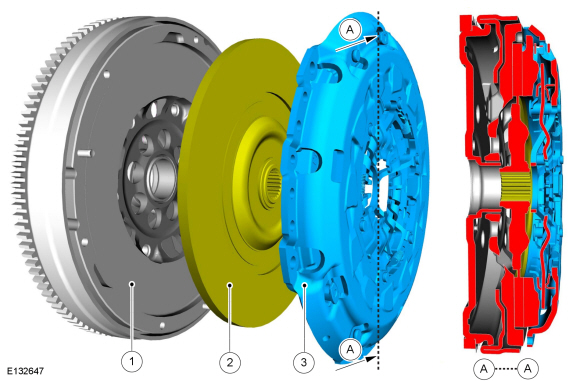
| Item | Part Number | Description |
| 1 | 6375B | Flywheel |
| 2 | part 7L596 | Clutch Disc |
| 3 | part 7L596 | Cover Assembly |
| A | — | Section A-A plane |
The clutch consists of:
- Flywheel
- Clutch Disc
- Cover Assembly
The clutch transmits engine torque to the transmission.
Single-plate, dry friction, diaphragm spring clutch pressure plate and disc. The clutch disc has a hub splined to the transmission input shaft. The clutch disc has friction material where it contacts the flywheel and the clutch pressure plate. The clutch pressure plate applies pressure to the clutch disc, firmly holding it against the flywheel surface. In the engaged position, the diaphragm spring holds the clutch pressure plate against the clutch disc so that engine torque is transmitted to the transmission input shaft.
When the clutch pedal is depressed, the release bearing pushes on the center of the clutch pressure plate diaphragm spring toward the flywheel. The diaphragm spring pivots on the fulcrum, releasing the clutch pressure plate. The clutch slave cylinder assists this action. This relieves the load on the clutch disc. Steel leaf springs riveted to the clutch cover pull the clutch pressure plate away from the clutch disc, disconnecting engine torque from the transmission.
clutch disc
The clutch disc has a splined hub (with integrated torsion spring damping) that attaches the clutch disc to the transmission input shaft. The engine output shaft is connected to the input shaft by friction between the clutch disc facings and the flywheel/clutch pressure plate assembly.
Clutch Cover Assembly
The clutch pressure plate presses the clutch disc tightly against the flywheel surface. In the engaged position, the diaphragm spring holds the clutch pressure plate against the clutch disc so that engine torque is transmitted to the transmission input shaft.
Clutch Release Hub and Bearing
The clutch disengages when the clutch pedal is depressed and engages when the clutch pedal is released. When the clutch pedal is depressed, it pushes the clutch master cylinder plunger, which transmits hydraulic pressure to the clutch slave cylinder. The slave cylinder extends and acts through the release bearing on the clutch pressure plate diaphragm spring, releasing pressure on the clutch disc. This relieves spring load from the clutch pressure plate and eliminates clutch friction between the engine and transmission.
Self-Adjusting Clutches
Clutch size increased with the introduction of more powerful engines. The self-adjusting clutch eliminates the increase in operating force that occurs as wear increases.
The advantages of the self-adjusting clutch are as follows:
- Constant operating force throughout the clutch service life.
- Increased clutch friction disc service life.
- Shorter release bearing travel.
Self-adjusting clutches cannot be reinstalled after clutch disc removal and must also be replaced.
Test yourself
A quick Ford Fiesta quiz: every answer comes with an explanation and a link to the manual page.