Suspension
Minimizing Wheel-to-Tire Runout. General Procedures
In this manual: Suspension
13steps
~78min
3/5difficulty
Done 0 of 13
Check
- Valve stem
- Reference mark
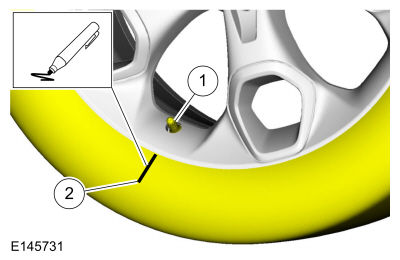
NOTICE: On vehicles with TPMS, the sensor may be damaged by improper tire mounting or demounting. Remove the tire from the wheel as described in the procedure. Failure to follow these instructions may result in damage to the TPMS components.
Using a suitable tire changer, break the tire beads away from the wheel.- Lubricate the tire beads with a suitable fast-drying, anti-corrosion tire bead lubricant. Rotate the tire 180 degrees (halfway) on the wheel so that the valve stem reference mark is now opposite the valve stem.
- Re-inflate the wheel and tire to the specified air pressure and measure the assembly again using a suitable dial indicator or a Hunter Road Force® 9700 Series balancer. Mark the second high point on the tire.
- If runout or Road Force® is reduced to within specification, the problem has been resolved. Balance the assembly and install it on the vehicle using the wheel-to-hub optimization procedure.
- If the second runout or Road Force® measurement is still out of specification, and both high points are close together (within 101.6 mm [4 inches]), the primary cause is likely the tire (high point followed the tire).
- First high point on tire
- Second high point on tire

- To be SURE that the tire is the cause of the high runout, there must be 2 runout or Road Force® measurements out of specification, and the high points must be located at approximately the same place on the tire sidewall. If the tire is the cause, install a new tire, balance the assembly and install it on the vehicle using the Wheel-to-Hub Optimization procedure. If the second high point is not within the first high point, go to the next step.
- If the second high point is still above specification and is within 101.6 mm (4 inches) of the first high point on the wheel, the primary cause is likely the wheel (high point followed the wheel). Remove the tire from the wheel, install the wheel on the balancer, and check wheel runout. If wheel runout exceeds 1.14 mm (0.0449 in), install a new wheel, balance the assembly, and install it on the vehicle using the wheel-to-hub optimization procedure.
Refer to: Tire-to-Hub Runout Minimization (204-04A Wheels and Tires, General Procedures). - First high point on tire
- Second high point on tire
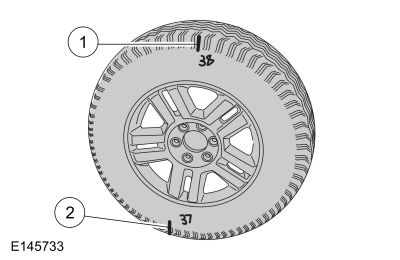
- Draw an arrow on the tire sidewall from the second maximum point to the first high point (in the shortest direction).
- First high point on tire
- Second high point on tire
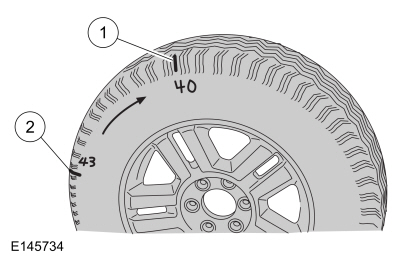
- Separate the tire beads from the wheel and rotate the tire 90 degrees (one-quarter turn) in the direction indicated by the arrow.
Test yourself
A quick Ford Fiesta quiz: every answer comes with an explanation and a link to the manual page.
Was this page helpful?