Accessory Drive. Diagnosis and Testing
Inspection and Verification
- Verify the customer concern.
- Visually inspect for obvious signs of mechanical damage.
Visual Inspection Chart
- Damaged or contaminated accessory drive belt
- Damaged or contaminated pulley(s)
- Incorrect accessory drive belt
- Incorrect accessory drive belt installation
- Generator
- A/C compressor
- Pulley(s)
- Accessory
- If an obvious cause for an observed or reported concern is found, correct the cause (if possible) before proceeding to the next step.
Accessory drive belt concerns
NOTICE: Do not lubricate the accessory drive belt, as damage to the accessory drive belt material may occur.
Cracking
Accessory drive belts are made of rubber, which hardens over time and may develop cracks. Because the accessory drive belt runs over the back of some pulleys, the grooves are exposed. Small cracks are not considered an accessory drive belt fault. Only if a crack is deep enough to reach the bottom of a groove to expose the cord, or if any pieces are missing from the accessory drive belt, is the accessory drive belt condition considered unacceptable.
- Inspect the accessory drive belt for cracks. If the damage exceeds the allowable limit, install a new accessory drive belt.
REFER TO: Accessory Drive Belt (303-05A Accessory Drive — 1.5 L EcoBoost (118 kW/160 L hp) — I4, Removal and Installation).
Chunking
Chunking describes a condition where long sections of rubber separate from the ribs of the accessory drive belt. This is considered a failure of the accessory drive belt.

- Inspect the accessory drive belt for damage. If any chunks are missing, install a new accessory drive belt.
REFER TO: Accessory Drive Belt (303-05A Accessory Drive — 1.5 L EcoBoost (118 kW/160 L hp) — I4, Removal and Installation).
Peeling
Peeling is dust that forms between the ribs of the accessory drive belt from rubber that wears off the belt when it is new. There may also be loose particles left on the accessory drive belt during the manufacturing process. These wear off and form small rubber balls that then become lodged in the grooves of the accessory drive belt. This condition usually goes away after 4800–8000 km (3000–5000 miles) of normal driving.

- Check the accessory drive belt for pilling. The condition of the accessory drive belt should be compared to the illustration.
- Small scattered pellets. Not considered a concern. No action required.
- Small scattered pellets. Not considered a concern. No action required.
- Longer cracks up to 50% of the rib height. Possible noise or concern. INSTALL a new accessory drive belt if noise is heard.
REFER TO: Accessory Drive Belt (303-05A Accessory Drive — 1.5 L EcoBoost (118 kW/160 L PS) — I4, Removal and Installation).
- Longer cracks up to 50% of the rib height. Possible noise or concern. INSTALL a new accessory drive belt if noise is heard.
REFER TO: Accessory Drive Belt (303-05A Accessory Drive — 1.5 L EcoBoost (118 kW/160 L PS) — I4, Removal and Installation).
- Heavy deposits in the grooves. Possible noise and stability concerns. INSTALL a new accessory drive belt.
REFER TO: Accessory Drive Belt (303-05A Accessory Drive — 1.5 L EcoBoost (118 kW/160 L PS) — I4, Removal and Installation).
- Heavy deposits in the grooves. Possible noise and stability concerns. INSTALL a new accessory drive belt.
REFER TO: Accessory Drive Belt (303-05A Accessory Drive — 1.5 L EcoBoost (118 kW/160 L PS) — I4, Removal and Installation).
Incorrect Installation
Accessory drive belt noise may be caused by the accessory drive belt being incorrectly installed on the pulley, as shown in the following illustration. Make sure that all the V-grooves on the accessory drive belt contact the pulley correctly.
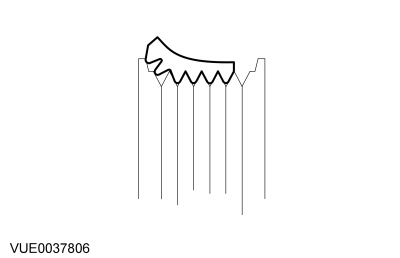
- If the cause is not visually apparent, verify the symptom and refer to the Symptom Chart.
Symptom Chart
| Symptom | Possible Sources | Action |
|---|---|---|
|
|
|
|
|
|
|
|
|
|
|
|
|
|
|
|
|
|
Component Tests
Accessory Drive Belt Tensioner - Static Check
The accessory drive belt tensioner can be checked statically as follows:
- Inspect the area around the accessory drive belt tensioner for grease or other contamination. Correct any leaks before installing a new accessory drive belt tensioner. If the accessory drive belt tensioner is contaminated, do not attempt to clean it, as the internal damping mechanism may be damaged. INSTALL a new accessory drive belt tensioner as necessary.
REFER TO: Accessory Drive Belt (303-05A Accessory Drive — 1.5 L EcoBoost (118 kW/160 L PS) — I4, Removal and Installation). - Disconnect the accessory drive belt in the area of the accessory drive belt tensioner.
- Using a suitable tool, move the accessory drive belt tensioner from the relaxed position through its full travel and back to the relaxed position to make sure there is no excessive stick, binding or catching, and make sure the accessory drive belt tensioner spring is tensioned.
- Rotate the accessory drive belt tensioner pulley and check for damage, free rotation and alignment. INSTALL a new accessory drive belt tensioner as necessary.
REFER TO: Accessory Drive Belt (303-05A Accessory Drive — 1.5 L EcoBoost (118 kW/160 L PS) — I4, Removal and Installation). - If the accessory drive belt tensioner meets the above criteria, proceed to dynamically check the accessory drive belt tensioner. If the accessory drive belt tensioner does not meet the above criteria, INSTALL a new accessory drive belt tensioner.
REFER TO: Accessory Drive Belt (303-05A Accessory Drive — 1.5 L EcoBoost (118 kW/160 L PS) — I4, Removal and Installation).
Accessory Drive Belt Tensioner - Dynamic Check
The accessory drive belt tensioner can be checked dynamically as follows:
- With the engine running, observe the accessory drive belt tensioner movement. The accessory drive belt tensioner must move (respond) when the engine is rapidly accelerated or when the A/C clutch cycles on and off (movement may be up to 4 mm). If the accessory drive belt tensioner movement is erratic without engine acceleration or A/C clutch cycling, the pulley or shaft may be bent or out of round, or the internal damping mechanism of the accessory drive belt tensioner may be damaged. INSTALL a new accessory drive belt tensioner as necessary.
REFER TO: Accessory Drive Belt (303-05A Accessory Drive — 1.5 L EcoBoost (118 kW/160 L PS) — I4, Removal and Installation). - Excessive accessory drive belt wear (uneven groove depth on the accessory drive belt) can cause excessive tensioner movement. Verify the condition by installing a new accessory drive belt.
REFER TO: Accessory Drive Belt (303-05A Accessory Drive — 1.5 L EcoBoost (118 kW/160 L PS) — I4, Removal and Installation).
Test yourself
A quick Ford Fusion quiz: every answer comes with an explanation and a link to the manual page.