Changing a road wheel
If you get a flat tire while driving, do not apply the brake heavily.
Instead, gradually decrease your speed. Hold the steering wheel firmly and slowly move to a safe place on the side of the road.
Have a flat serviced by an authorized dealer in order to prevent damage to the system sensors. See Tire Pressure Monitoring System earlier in this chapter. Replace the spare tire with a road tire as soon as possible.
During repairing or replacing of the flat tire, have the authorized dealer inspect the tire pressure monitoring system sensor for damage.
Dissimilar Spare Tire and Wheel Assembly Information
If you have a dissimilar spare tire and wheel assembly, then it is intended for temporary use only. This means that if you need to use it, you should replace it as soon as possible with a road tire and wheel assembly that is the same size and type as the road tires and wheels that were originally provided by Ford. If the dissimilar spare tire or wheel is damaged, it should be replaced rather than repaired.
A dissimilar spare tire and wheel assembly is defined as a spare tire or wheel that is different in brand, size or appearance from the road tires and wheels and can be one of three types:
1. T-type mini-spare: This spare tire begins with the letter T for tire size and may have Temporary Use Only molded in the sidewall.
2. Full-size dissimilar spare with label on wheel: This spare tire has a label on the wheel that states: THIS TIRE AND WHEEL FOR TEMPORARY USE ONLY
When driving with one of the dissimilar spare tires listed above, do not:
• exceed 80 km/h.
• load the vehicle beyond maximum vehicle load rating listed on the Safety Compliance Label.
• tow a trailer.
• use snow chains on the end of the vehicle with the dissimilar spare tire.
• use more than one dissimilar spare tire at a time.
• use commercial car washing equipment.
• try to repair the dissimilar spare tire.
Use of one of the dissimilar spare tires listed above at any one wheel location can lead to impairment of the following:
• Handling, stability and braking performance
• Comfort and noise
• Ground clearance and parking at curbs
• Winter weather driving capability
• Wet weather driving capability
• All-wheel driving capability
3. Full-size dissimilar spare without label on wheel
When driving with the full-size dissimilar spare tire and wheel assembly, do not:
• exceed 113 km/h.
• use more than one dissimilar spare tire and wheel at a time.
• use commercial car washing equipment.
• use snow chains on the end of the vehicle with the dissimilar spare tire and wheel.
The usage of a full-size dissimilar spare tire and wheel assembly can lead to impairment of the following:
• Handling, stability and braking performance
• Comfort and noise
• Ground clearance and parking at curbs
• Winter weather driving capability
• Wet weather driving capability
• All-wheel driving capability (if applicable)
• Load leveling adjustment (if applicable)
When driving with the full-size dissimilar spare tire and wheel assembly, additional caution should be given to:
• towing a trailer.
• driving vehicles equipped with a camper body.
• driving vehicles with a load on the cargo rack.
Drive cautiously when using a full-size dissimilar spare tire and wheel, and seek service as soon as possible.
Tire Change Procedure
1. Park on a level surface, set the parking brake and activate the hazard flashers.
2. Place the transmission selector lever in position P or N and turn the engine off.
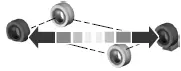
3. Block both the front and rear of the wheel diagonally opposite the flat tire. For example, if the left front tire is flat, block the right rear wheel.

4. Remove the lug wrench, spare tire and jack.
5. Remove the center ornament from the wheel. Loosen each wheel lug nut one-half turn counterclockwise but do not remove them until the wheel is raised off the ground.
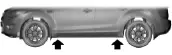
6. The vehicle jacking points are shown here, and can be identified by the triangle markings on the vehicle. Details are depicted on the yellow warning label on the jack.
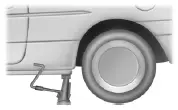
7. Put the jack in the jack notch next to the tire you are changing. Turn the jack handle clockwise until the wheel is completely off the ground.
8. Remove the lug nuts with the lug wrench.
9. Replace the flat tire with the spare tire, making sure the valve stem is facing outward. Reinstall lug nuts until the wheel is snug against the hub.
Do not fully tighten the lug nuts until the wheel has been lowered.
If you are using the temporary tire, the lug nut washers will not appear to be flush with the rim. This is normal only when using the temporary spare tire.
10. Lower the wheel by turning the jack handle counterclockwise.

11. Remove the jack and fully tighten the lug nuts in the order shown. See Wheel Lug Nut Torque Specifications later in this chapter for the proper lug nut torque specification.
12. Put flat tire, wheel ornament, jack and lug wrench away. Make sure the jack is fastened so it does not rattle when you drive.
13. Unblock the wheel.
Test yourself
A quick Ford Mustang quiz: every answer comes with an explanation and a link to the manual page.