Driveline
Driveline Angle
In this manual: Driveline
~1min read
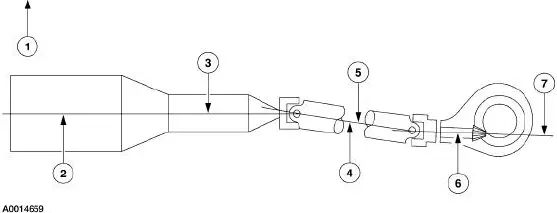
| Item | Description |
| 1 | Bottom of the frame |
| 2 | Engine crankshaft centerline |
| 3 | Engine angle |
| 4 | Driveshaft and coupling shaft centerline |
| 5 | Driveshaft and coupling shaft angle |
| 6 | Rear axle pinion centerline |
| 7 | Axle pinion angle |
An incorrect driveline (pinion) angle can often be detected by the driving condition in which the vibration occurs.
- A vibration during coastdown from 72 to 56 km/h is often caused by an excessive U-joint angle at the axle (pinion nose downward).
- A vibration during acceleration, from 56 to 72 km/h may indicate an excessive Ujoint angle at the axle (pinion nose upward).
When these conditions exist, check the driveline angles as described in the General Procedures portion of this section.
If the tires and driveline angle are not the cause, carry out the NVH tests to determine whether the concern is caused by a condition in the axle.
Universal Joint (U-Joint) Wear
Place the vehicle on a frame hoist and rotate the driveshaft by hand. Check for rough operation or seized U-joints. Install a new U-joint if it shows signs of seizure, excessive wear, or incorrect seating.
Test yourself
A quick Ford Mustang quiz: every answer comes with an explanation and a link to the manual page.
Was this page helpful?