Rear Ride Height Measurement - GT and Base
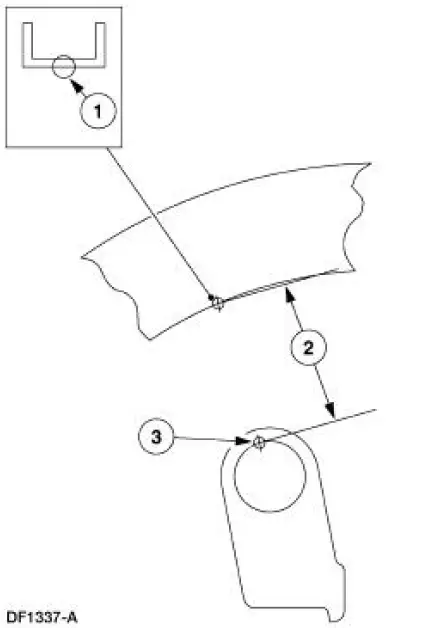
| Item | Description |
| 1 | Body reinforcement |
| 2 | Ride height (shortest distance) |
| 3 | Rear axle |
Wheel Track
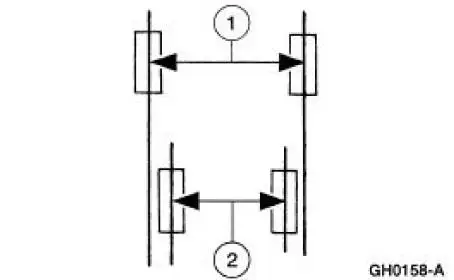
| Item | Part Number | Description |
| 1 | - | Front track |
| 2 | - | Rear track |
Dogtracking
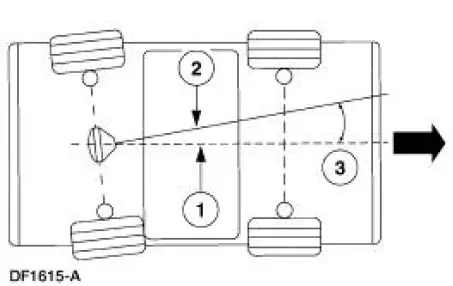
| Item | Part Number | Description |
| 1 | - | Vehicle centerline |
| 2 | - | Axle centerline |
| 3 | - | Thrust angle |
Dogtracking or thrust angle is the condition in which the rear axle is not square to the chassis. Heavily crowned roads can give the illusion of dogtracking.
Wander
Wander is the tendency of the vehicle to require frequent, random left and right steering wheel (3600) corrections to maintain a straight path down a level road.
Shimmy
Shimmy, as observed by the driver, is large, consistent, rotational oscillations of the steering wheel resulting from large, side-to-side (lateral) tire/wheel movements.
Shimmy is usually experienced near 64 km/h, and can begin or be amplified when the tire contacts pot holes or irregularities in the road surface.
Nibble
Sometimes confused with shimmy, nibble is a condition resulting from tire interaction with various road surfaces and observed by the driver as small rotational oscillations of the steering wheel.
Poor Returnability/Sticky Steering
Poor returnability and sticky steering is used to describe the poor return of the steering wheel to center after a turn or steering correction is completed.
Drift/Pull
Pull is a tugging sensation, felt in the steering wheel, that must be overcome to keep the vehicle going straight.
Drift describes what a vehicle with this condition does with hands off the steering wheel.
- Drift/pull may be induced by conditions external to the vehicle (i.e., wind, road camber).
Poor Groove Feel
Poor groove feel is characterized by little or no buildup of turning effort felt in the steering wheel as the wheel is rocked slowly left and right within very small turns around center or straight-ahead (under 20 degrees of steering wheel turn). Efforts may be said to be "flat on center."
- Under 20 degrees of turn, most of the turning effort that builds up comes from the mesh of gear teeth in the steering gear (3504). In this range, the steering wheel is not yet turned enough to feel the effort from the self-aligning forces at the road wheel or tire patch.
- In the diagnosis of a handling problem, it is important to understand the difference between wander and poor groove feel.
Test yourself
A quick Ford Mustang quiz: every answer comes with an explanation and a link to the manual page.