Tire Replacement
WARNING
The vehicle may slip or roll off the jack, causing serious injury or death to you or others nearby. Observe the following safety precautions:
- Never place any part of your body under a vehicle supported by the jack.
- NEVER attempt to change a tire in a traffic lane. ALWAYS move the vehicle completely off the road onto level, firm ground away from traffic before attempting to change a tire. If you cannot find a level, firm spot on the road, call a tow truck for assistance.
- Be sure to use the jack supplied with the vehicle.
- ALWAYS place the jack at the designated jacking points on the vehicle and NEVER under the bumpers or any other part of the vehicle to support the jack.
- Do not start or run the engine while the vehicle is supported by the jack.
- Do not allow anyone to remain in the vehicle while it is supported by the jack.
- Keep children away from the road and the vehicle.
Perform the following steps to change a vehicle tire:
1. Park on a level, firm surface.
2. Move the gear selector lever to the P (Park) position.
3. Press the hazard warning flasher button.
4. Remove the wheel nut wrench, jack, jack handle, and spare tire from the vehicle.
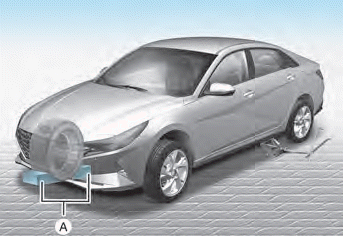
[Wheel Chock
5. Chock the front and rear tire diagonally opposite the tire you are changing.
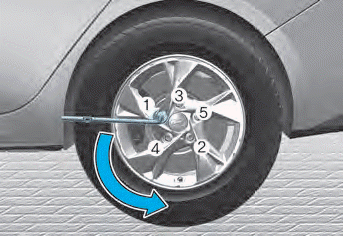
6. Loosen the wheel nuts counterclockwise one turn in the order shown above, but do not remove all wheel nuts until the tire has been raised off the ground.
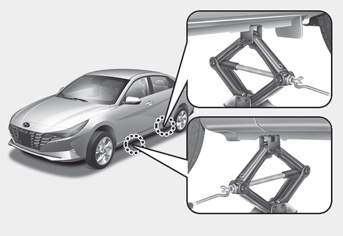
7. Position the jack at the jacking point under the frame closest to the tire you are changing. The jacking points are plates welded to the frame with two notches. Never place the jack at any other position or part of the vehicle. Doing so may damage the side sill molding or other parts of the vehicle.
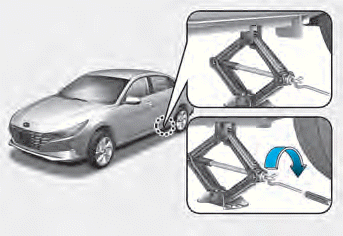
8. Insert the jack handle into the jack and turn it clockwise to raise the vehicle until the tire is off the ground. Make sure the vehicle is stable on the jack.
9. Loosen the wheel nuts with the wheel nut wrench and remove them by hand. Remove the wheel from the stud and place it on the ground out of the way. Remove any dirt or debris from the studs, mounting surface, and wheel.
10. Install the spare tire onto the wheel hub studs.
11. Tighten the wheel nuts by hand onto the studs with the smaller end facing the wheel.
12. Lower the vehicle to the ground by turning the jack handle counterclockwise.
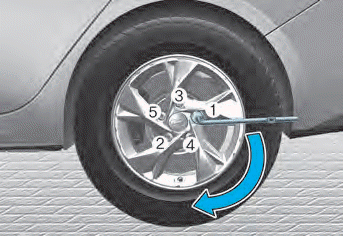
13. Using the wheel nut wrench, tighten the nuts in the sequence shown. Check each nut twice until they are fully tightened. After replacing the tire, have an authorized HYUNDAI dealer tighten the wheel nuts to the correct torque as soon as possible.
If you have a tire pressure gauge, check the tire pressure (see "Tires and Wheels" in Chapter 2 for tire pressure instructions). If the pressure is lower or higher than recommended, drive slowly to the nearest service station and adjust it to the recommended pressure. Always install the valve cap after checking or adjusting the tire pressure. If the cap is not installed, air may leak from the tire. If you lose the valve cap, buy a new one and install it as soon as possible. After replacing the tire, secure the flat tire and return the jack and tools to their storage location. If it is difficult to secure the flat tire, place it in the luggage compartment.
NOTICE
- Check the tire pressure as soon as possible after installing the spare tire. Adjust it to the recommended pressure.
- Check and tighten the wheel nuts after driving more than 30 miles (50 km) after installing the spare tire. Re-check the wheel nuts after driving more than 620 miles (1000 km) after re-installing the replaced tire.
CAUTION
Your vehicle has metric threads on the wheel studs and nuts. When replacing the tire, make sure to reinstall the same nuts that were removed. If you need to replace the nuts, make sure they have metric threads to avoid damaging the studs and to ensure the wheel is properly secured to the hub. Contact an authorized HYUNDAI dealer for assistance.
If any equipment, such as the jack, nuts, studs, or other equipment is damaged or in poor condition, do not attempt to replace the tire; call for assistance.
Using the Compact Spare Tire (if equipped)
The compact spare tire is intended for emergency use only. Drive carefully with the compact spare tire and always follow the precautions.
WARNING
To prevent failure of the compact spare tire and loss of control, which may result in an accident:
- Use the compact spare tire only in an emergency.
- NEVER drive the vehicle faster than 50 mph (80 km/h).
- Do not exceed the maximum load capacity or load capacity indicated on the sidewall of the compact spare tire.
- Do not use the compact spare tire continuously. Repair or replace the original tire as soon as possible to avoid failure of the compact spare tire.
When driving with the compact spare tire installed on your vehicle:
- Check the tire pressure after installing the compact spare tire. The compact spare tire must be inflated to 60 psi (420 kPa).
- Do not drive this vehicle through an automatic car wash while the compact spare tire is installed.
- Do not use the compact spare tire on any other vehicle, because this tire was designed specifically for your vehicle.
- The tread life of the compact spare tire is shorter than that of a regular tire. Inspect your compact spare tire regularly and replace worn compact spare tires with the same size and design, installed on the same wheel.
- Do not use more than one compact spare tire at a time.
NOTICE
When the original tire and wheel are repaired and installed on the vehicle, the wheel nut torque must be set correctly. Correct wheel nut torque is 79~94 lbf·ft (11~13 kgf·m).
CAUTION
To avoid damaging the compact spare tire and your vehicle:
- Drive slowly enough for road conditions to avoid all hazards, such as potholes or debris.
- Avoid driving over obstacles. The diameter of the compact spare tire is smaller than a regular tire and reduces ground clearance by approximately 1 inch (25 mm).
- Do not use snow chains on the compact spare tire. Due to its smaller size, the snow chain will not fit properly.
- Do not use the compact spare tire on any other wheels, and do not use standard tires, winter tires, wheel covers, or trim rings with the compact spare tire.
Test yourself
A quick Hyundai Elantra CN7 quiz: every answer comes with an explanation and a link to the manual page.