Heating, Ventilation and Air Conditioning
Power MOSFET Repair Procedures
In this manual: Heating, Ventilation and Air Conditioning
11steps
~66min
3/5difficulty
Done 0 of 11
Inspection
- Start.
- Turn on the control switch and measure the blower motor voltage.
- Select the high speed on the control switch and check that the voltage increases.


1. Drain
2. Drain Return3. Source
4. Rear Door
SpecificationSegment Blower Voltage (±0.5 V) 1 3,6 2 4,8 3 5,9 4 7,0 5 8.1 6 9.2 7 10,6 8 BATTERY +
Diagnosis with GDS
- The heating, ventilation and air conditioning (HVAC) system can be diagnosed quickly (defective parts) using the Global Diagnostic System (GDS). ※ The GDS provides the following information. (1) Self-diagnosis: checks and displays diagnostic trouble codes (DTC). (2) Current data: checks the status of input/output signals. (3) Active test: checks system operating conditions. (4) Additional functions: in addition to control, such as zero point adjustment.
- Select the "Vehicle Model" and the system to be checked in order to inspect the vehicle with the scan tool.
- Select the "Current Data" menu to check the current input/output status. The input/output data for the sensors related to the MOSFET power can be checked.

- To perform a forced operation on the MOSFET power input factors, select "ACTUAL TEST".

REPLACEMENT
- Disconnect the negative (-) battery terminal.
- Remove the center fascia panel. (Refer to Instrument Panel - Center Fascia Panel)
- Disconnect the MOSFET connector (A), then remove the power MOSFET (B) after loosening the screws.
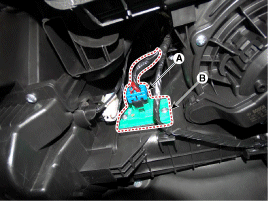
- To install, perform the removal procedure in reverse order.
Test yourself
A quick Hyundai i20 quiz: every answer comes with an explanation and a link to the manual page.
Was this page helpful?