Tire Replacement
WARNING
The vehicle may slip or roll off the jack, resulting in serious injury or death to you or bystanders. Observe the following precautions:
- Do not get under a vehicle supported by a jack.
- NEVER attempt to change a tire on a traffic lane. ALWAYS move the vehicle completely off the road onto level, solid ground away from traffic before attempting to replace a tire. If you cannot find level ground, move away from the road and contact a towing service for assistance.
- Always use the jack supplied with the vehicle.
- ALWAYS place the jack at the designated jacking points on the vehicle, and NEVER under the bumpers or any other part of the vehicle.
- Do not start or run the engine while the vehicle is supported by the jack.
- Do not allow anyone to remain in the vehicle while it is supported by the jack.
- Keep children away from the road and the vehicle.
To replace a tire on your vehicle, follow these steps:
1. Park on a level, firm surface.
2. Move the shift lever to P (Park, for vehicles with a dual clutch transmission) or N (Neutral, for vehicles with a manual transmission), apply the parking brake, and turn the ignition key to the LOCK/OFF position.
3. Press the hazard warning flasher button.
4. Remove the wheel nut wrench, jack, jack handle and spare tire from the vehicle.
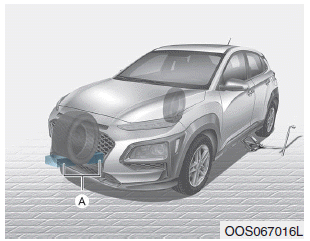
[Wheel Chock
5. Block the front and rear of the tire diagonally opposite the tire being changed.
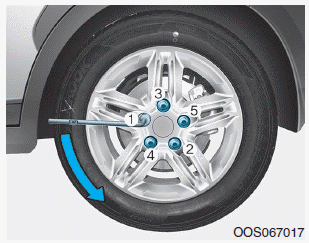
6. Loosen each wheel nut counterclockwise one turn in the order shown above, but do not remove the wheel nuts until the tire is off the ground.
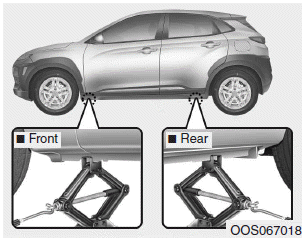
7. Place the jack at the jacking point closest to the tire you are replacing. The jacking points are plates welded to the frame with two notches. Never use the jack at any other location on the vehicle. This may damage the side sill molding.
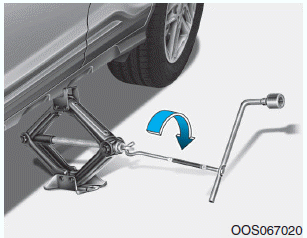
8. Insert the jack handle into the jack and turn it clockwise to raise the vehicle until the tire is off the ground. Make sure the vehicle is stable on the jack.
9. Remove the wheel nuts with the wheel nut wrench and remove them by hand. Remove the wheel from the studs and place it flat on the ground outside the way. Remove dirt or debris from the studs, mounting surfaces and wheel.
10. Install the spare tire onto the hub studs.
11. Hand-tighten the wheel nuts onto the studs with the tapered end facing the wheel.
12. Lower the vehicle to the ground by turning the jack handle counterclockwise.
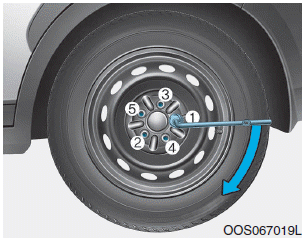
13. Using the wheel lug wrench, tighten the wheel nuts in the sequence shown. Check each wheel nut twice until they are fully tightened. After replacing a tire, we recommend that an authorized HYUNDAI dealer tighten the wheel nuts to the specified torque as soon as possible. The wheel nuts must be tightened to 11~13 kgf·m (79~94 lbf·ft).
If you have a tire pressure gauge, check the tire pressure (refer to "Tires and Wheels" in Chapter 8 for tire pressure instructions). If the pressure is lower or higher than recommended, drive slowly to the nearest service station and adjust it to the recommended pressure. Always install the valve cap after checking or adjusting the tire pressure. If the cap is not installed, air may leak from the tire. If you lose the valve cap, buy a new one and install it as soon as possible. After replacing the tire, reinstall the flat tire in its place and return the jack and tools to their storage locations.
NOTICE
- Check the tire pressure as soon as possible after installing the spare tire. Adjust it to the recommended pressure.
- Check and tighten the wheel nuts after driving 50 km if the tires have been replaced. Re-check the wheel nuts after driving 1000 km.
CAUTION
Your vehicle has metric thread studs and nuts. Make sure that when changing tires, the same nuts that were removed are installed. If you need to replace the wheel nuts, make sure they are metric thread to avoid damaging the studs, and make sure the wheel is properly secured to the hub. Contact an authorized HYUNDAI dealer for assistance.
If any equipment, such as the jack, wheel nuts, studs or other equipment, is damaged or in poor condition, do not attempt to change the tire and call for assistance.
Test yourself
A quick Hyundai Kona quiz: every answer comes with an explanation and a link to the manual page.