Emergency Precautions
Tires
Do not use tires and wheels of a different size and type than those originally installed on your vehicle. This may affect the safety and performance of your vehicle, which may result in steering failure or rollover, which may result in serious injury.
When replacing tires, make sure that all four tires have the same size, type, tread, brand and load capacity. If you equip your vehicle with any tire/wheel combination not recommended by HYUNDAI for off-road driving, you must not use these tires for highway driving.
WARNING
Never start or run the engine when an all-wheel drive vehicle with full-time drive is raised on a jack. The vehicle may slip or roll off the jack, resulting in serious injury or death to you or others.
Tow/Haul
All-wheel drive vehicles must be towed with a wheel lift and dolly or flatbed equipment with all wheels off the ground. For more information, see "Towing" in chapter 6.
Dynamometer Testing
The all-wheel drive vehicle must be tested on a special four-wheel dynamometer.
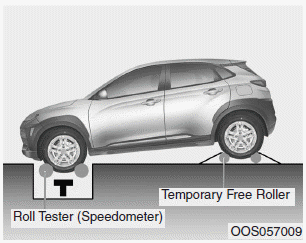
The all-wheel drive vehicle should not be tested on a two-wheel drive roller tester. If a 2WD roller tester must be used, perform the following procedure:
1. Check the tire pressure recommended for your vehicle.
2. Position the front wheels on the speedometer tester as shown in the illustration.
3. Release the parking brake.
4. Position the rear wheels on the temporary free rollers as shown in the illustration.
CAUTION
- Never apply the parking brake during the test.
- When the vehicle is raised, do not use the front and rear wheels separately. All four wheels must be engaged.
WARNING
Keep away from the front of the vehicle when it is on the dynamometer. The vehicle may jump forward and cause serious injury or death.
Test yourself
A quick Hyundai Kona quiz: every answer comes with an explanation and a link to the manual page.