Four-Wheel Drive (4WD) System
Electro-hydraulic direct clutch
In this manual: Four-Wheel Drive (4WD) System
18steps
~108min
4/5difficulty
Done 0 of 18
Components and Component Location
COMPONENT LOCATION

| 1. Transmission 2. Transfer kit |
3. Transfer gear 4. Coupling assembly |
COMPONENTS

| 1. Coupling Housing 2. Input Shaft 3. Pressure Sensor |
4. Wiring Harness Extension 5. Oil Hydraulic Motor (Drive) |
Description and Operation
Description
The 4WD ECU processes signals from various sensors and determines the current driving and road conditions. The ECU then uses this information to precisely control the multi-plate clutch of the 4WD coupling and smoothly regulate the torque delivered to the rear wheels. 4WD Transfer System (4WD)- AUTO MODE:
- When driving in AUTO 4WD mode, the vehicle operates like a conventional 2WD vehicle under normal driving conditions. However, if the system determines that 4WD is needed, engine power is automatically delivered to all four wheels without driver intervention.
- When driving on ordinary roads and surfaces, the vehicle behaves like a conventional four-wheel-drive vehicle.
- LOCK MODE:
- This mode is used for climbing or descending steep slopes, driving off-road, or on muddy or sandy surfaces, etc., to maximize traction.
- This mode automatically deactivates above 30 km/h and switches to AUTO 4WD mode above 40 km/h. However, if the vehicle speed drops below 30 km/h, the transfer mode switches back to 4WD LOCK mode.
- Cruise Control (Auto Mode) - Power is mainly delivered to the front wheels.

- Steering (Auto Mode) - Adjusts the power delivered to the rear wheels depending on the steering radius and steering speed.

- Wheel Slip (Auto Mode) - If one or both front wheels lose traction, the system transfers the appropriate power to the rear wheels depending on the slip of the front wheels.

- Lock Mode - Maximizes performance on uneven roads (active only at speeds below 40 km/h).

Operation
Electronic clutch
[Idle]

- The 4WD ECU receives CAN signals from the vehicle sensors.
- The 4WD ECU calculates the required torque for the rear wheels and sends the corresponding control current to the actuator (electric motor and hydraulic pump).
- Hydraulic pressure generated by the actuator moves the piston.
- Friction from the piston movement engages the clutch.
- Power is transmitted to the rear wheels.
Repair Procedures
Inspection
DEPOSIT
- Remove the bolts from the 4WD coupling assembly (A - 3 pcs) and the rear propeller shaft (B).
Tightening torque: 49.0 ~ 69 N·m

- Using a flat-blade tool, separate the drive shaft from the 4WD coupling assembly.
- Disconnect the pressure sensor connector (A) and the oil hydraulic motor connector (B).
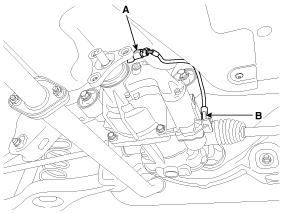
- Loosen the 4 coupling assembly mounting bolts (A).
Tightening torque: 58.8 ~ 64 N·m
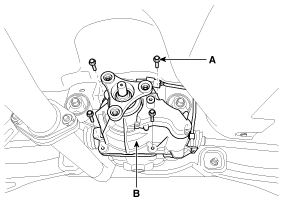
- Using a flat-blade tool, separate the 4WD coupling assembly from the rear differential bracket.
REMEDY
- To install, perform the removal procedure in reverse order.
- After replacing the coupling, reset the 4WD coupling learning value of the 4WD ECU using GDS. (Refer to 4WD Control System - "Adjustment".)
Test yourself
A quick Hyundai Tucson quiz: every answer comes with an explanation and a link to the manual page.
Was this page helpful?