Child Safety Seats
When traveling in the vehicle, children must be seated in the rear seat, and their position must always be secured in a way that minimizes the risk of injury in a traffic accident, sudden stop, or sharp maneuver. According to traffic accident statistics, the safest place for children is the rear seat rather than the front seat, and only when properly restrained. Older children who have outgrown child safety seats must use one of the available seat belts.
Be aware of the special requirements in effect in the country where the vehicle is operated. Child safety seats must be properly positioned and secured on the rear seat of the vehicle. Use commercially available child safety seats that comply with the safety standards of the country in which the vehicle is operated.
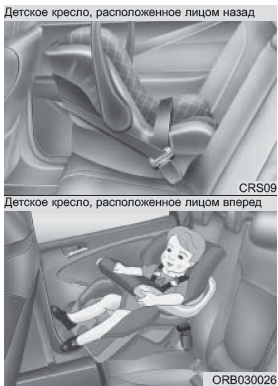
Child safety seats are designed to be secured to vehicle seats using the lap portion of the seat belt (lap/shoulder belt), or the tether anchorage and/or ISOFIX anchorage.
Children may be injured in a traffic accident if the child safety seat they are in is not properly secured. Infants and small children must use special child seats.
Before purchasing a child seat, make sure it is compatible with the vehicle's seat and seat belt design and is suitable for the child's size.
Follow all manufacturer instructions when installing such a device in the vehicle.
WARNING
• A special child safety seat must be installed on the rear seat. Never install a child safety seat on the front passenger seat. In the event of a traffic accident, the passenger airbag may deploy, which may cause serious injury or death to a child sitting in such a seat. Therefore, a child safety seat should only be installed on the rear seat of the vehicle.
• The seat belt or child safety seat may become extremely hot if left in a closed vehicle on a sunny day, even if the outside air temperature is not very high.
• Check the temperature of the seat surface and the safety belt buckles before placing a child in this seat.
• If a child seat is not in use, store it in the luggage compartment or secure it with the safety belts so that it does not move forward suddenly in the event of emergency braking or a collision.
• Children may suffer serious injury or death from the deployment of an airbag.
All children, even those who have outgrown child seats, must ride in the rear seat while the vehicle is in motion.
WARNING
To reduce the risk of serious injury or death:
• It is safest for children of any age to ride in the rear seat with the safety belts fastened. A child in the front passenger seat may be struck with great force by a deploying airbag, which may result in serious injury or death.
• Always follow the child seat manufacturer's installation and use instructions.
• Always make sure the child seat is properly secured in the vehicle and that the child is firmly restrained in the seat.
• Never hold a child in your arms or on your lap while the vehicle is in motion. The large forces generated in a collision will tear the child from the adult's arms, and the child may strike the interior of the vehicle.
• Never allow an adult and a child to share one safety belt. In a collision, the belt may dig deeply into the child's body and cause serious internal injuries.
• Never leave children unattended in the vehicle, even for a short time. The vehicle interior can heat up quickly, causing serious injury or death to children inside. Even very young children may accidentally set the vehicle in motion, become trapped in the windows, or lock themselves and others inside the vehicle.
• Never allow one safety belt to be used by two children or by any two people.
• Children often move about restlessly and may assume improper positions.
Never allow the shoulder portion of the safety belt to be placed under a child's arm or behind the child's back while the vehicle is in motion. Always seat the child in the rear seat and restrain the child properly.
• Never allow a child to stand or kneel on the seat or floor while the vehicle is in motion.
In a collision or sudden stop, a child may strike the interior of the vehicle with great force, resulting in serious injury.
• Never use a portable cradle or child seat that is attached to the seatback with hook-type anchors; it may not provide the required level of protection in a traffic accident.
• Safety belts can become extremely hot, especially if the vehicle is parked in direct sunlight.
Always check the safety belt buckles before using them to secure a child.
• After an accident, have the child seat, upper and lower anchor bolts inspected by an authorized HYUNDAI dealer.
• If there is not enough space to install a child seat behind the driver's seat, install the seat in the right rear seat.
Test yourself
A quick Hyundai Solaris quiz: every answer comes with an explanation and a link to the manual page.