Rear Cross-Traffic Collision-Avoidance Assist Malfunction and Limitations
Rear Cross-Traffic Collision-Avoidance Assist Evasive Steering Assist Malfunction
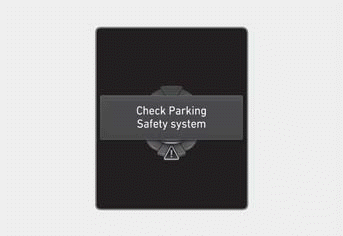
If the Rear Cross-Traffic Collision-Avoidance Assist or other related functions do not operate properly, the warning message "Check Rear Safety Assist System" may appear on the instrument cluster and the Rear Cross-Traffic Collision-Avoidance Assist system may be turned off automatically. Have the system inspected by an authorized HYUNDAI dealer.
Rear Cross-Traffic Collision-Avoidance Assist Disabled
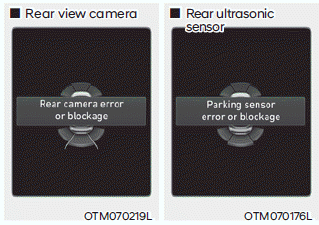
The warning message "Rear Camera Error or Blocked" or "Parking Sensor Error or Blocked" may appear on the instrument cluster if:
- The rear view camera or rear ultrasonic sensor(s) is covered or blocked by snow or rain.
- Severe weather conditions, such as heavy snow or heavy rain, may cause the Rear Cross-Traffic Collision-Avoidance Assist system to turn off or malfunction. Make sure the rear view camera and rear ultrasonic sensors are clean.
Rear Cross-Traffic Collision-Avoidance Assist Limitations
Rear Cross-Traffic Collision-Avoidance Assist may not provide braking assist or may not warn you even when pedestrians or objects are present if:
- Any non-genuine equipment or accessory is installed on the rear of your vehicle.
- Your vehicle is damaged due to a collision or other causes.
- The bumper height or the installation position of the rear ultrasonic sensors has been changed.
- The rear view camera or rear ultrasonic sensor(s) is damaged.
- The rear view camera or rear ultrasonic sensor(s) is covered or blocked by snow, water or dirt.
- The surroundings are very bright or dark.
- The weather is very hot or cold.
- The wind speed is greater than 20 km/h or blows perpendicular to the rear bumper.
- Objects that generate excessive noise, such as car horns, loud motorcycle engines or truck air brakes, are near your vehicle.
- An ultrasonic sensor with a similar frequency is near your vehicle.
- The road surface is slippery or sloped.
- There is a difference in height between your vehicle and the pedestrian.
- The pedestrian blends into the background when viewed through the rear view camera.
- The pedestrian is located at the rear edge of your vehicle.
- The pedestrian is not standing upright.
- The pedestrian is very short or very tall.
- The pedestrian is wearing clothing that easily blends into the background, making them difficult to detect.
- The pedestrian is wearing clothing that does not reflect ultrasonic waves well.
- The size, thickness, height or shape of the object does not reflect ultrasonic waves well (for example, a pole, bush, curb, shopping cart, wall edge, etc.).
- The pedestrian or object is moving very fast.
- The pedestrian or object is very close to the rear of your vehicle.
- There is a pedestrian or object behind a wall.
- The object is not located at the center of the rear of your vehicle.
- The object is not parallel to the rear bumper.
- The road surface is slippery or sloped.
- The pedestrian is in a position that is difficult to detect.
- You start reversing the vehicle immediately after shifting to R (Reverse).
- You accelerate your vehicle or drive in circles.
Rear Cross-Traffic Collision-Avoidance Assist may warn you unnecessarily or provide braking assist even when there are no pedestrians or objects if:
- Any non-genuine equipment or accessory is installed on the rear of your vehicle.
- Your vehicle is damaged due to a collision or other causes.
- The bumper height or the installation position of the rear ultrasonic sensors has been changed.
- Your vehicle height is lower or higher than normal due to heavy loads, abnormal tire pressure, etc.
- The rear view camera or rear ultrasonic sensor(s) is covered or blocked by snow, water or dirt.
- A pattern on the road is mistaken for a pedestrian.
- There are shadows or light reflecting on the ground.
- Objects that generate excessive noise, such as car horns, loud motorcycle engines or truck air brakes, are near your vehicle.
- Your vehicle is reversing into a narrow passage or parking space.
- Your vehicle is reversing onto an uneven road surface, such as a dirt road, gravel, speed bump, slope, etc.
- A vehicle towing a trailer or a tow hitch-mounted object is located behind your vehicle.
- An ultrasonic sensor with a similar frequency is near your vehicle.
- Pedestrians or objects are located near the path of your vehicle.
- The pedestrian or object is moving very fast.
- You accelerate your vehicle or drive in circles.
WARNING
Rear Cross Traffic Collision-Avoidance Assist may not operate in all situations and cannot prevent all collisions. To avoid serious injury or death:
- Always pay attention to the road and driving conditions while driving. Brake as necessary to avoid collisions. Do not rely solely on Rear Cross Traffic Collision-Avoidance Assist to prevent collisions.
- Always inspect your vehicle to make sure there are no pedestrians or objects before reversing.
- Rear Collision-Avoidance Assist performance may differ under certain conditions. If your vehicle speed exceeds 2 mph (4 km/h), Rear Collision-Avoidance Assist provides collision-avoidance assistance only when pedestrians are detected.
- Some objects may not be detected by the rear ultrasonic sensors due to the distance to the object, its size, or its material.
WARNING
- A noise may be heard when sudden braking occurs to avoid a collision.
- When another system's warning message appears or a warning sound is heard, Rear Collision-Avoidance Assist may not warn you.
- You may not hear the Rear Collision-Avoidance Assist warning sound if the surrounding environment is too noisy.
- Rear Collision-Avoidance Assist may not operate properly if the bumper has been damaged, replaced, or repaired.
- Rear Collision-Avoidance Assist may not operate normally if there is interference from strong electromagnetic waves.
- Deactivating Rear Collision-Avoidance Assist - Trailer Towing. When towing a trailer and reversing, Rear Collision-Avoidance Assist activates when it detects a trailer.
- Brake control may not operate properly depending on the ESC (Electronic Stability Control) condition. The warning appears only when:
- The ESC (Electronic Stability Control) indicator light is on.
- The ESC (Electronic Stability Control) is controlling braking force to the wheel. - Check the brake fluid and brake pad condition periodically. Depending on the condition, brake performance may decrease.
Information
Rear Collision-Avoidance Assist may not detect or may miss a pedestrian or object when:
- A pedestrian is standing behind the vehicle.
- A large obstacle, such as a vehicle parked directly behind the center of your vehicle.
Test yourself
A quick Hyundai Tucson LM quiz: every answer comes with an explanation and a link to the manual page.