Electronic Stability Control (ESC)
This system enhances directional control and stability of the vehicle under various driving conditions. The ESC corrects for over/under steering of the vehicle by applying the brake of the appropriate wheel to assist in counteracting the over/under steer condition. Engine power may also be reduced to help the vehicle maintain the desired path.
ESC uses sensors in the vehicle to determine the vehicle path intended by the driver and compares it to the actual path of the vehicle. When the actual path does not match the intended path, ESC applies the brake of the appropriate wheel to assist in counteracting the oversteer or understeer condition.
• Oversteer - when the vehicle is turning more than appropriate for the steering wheel position.
• Understeer - when the vehicle is turning less than appropriate for the steering wheel position.
The “ESC Activation/Malfunction Indicator Light” (located in the instrument cluster), starts to flash as soon as the tires lose traction and the ESC system becomes active. The “ESC Activation/Malfunction Indicator Light” also flashes when TCS is active. If the “ESC Activation/Malfunction Indicator Light” begins to flash during acceleration, ease up on the accelerator and apply as little throttle as possible. Be sure to adapt your speed and driving to the prevailing road conditions.
ESC also cannot prevent accidents resulting from loss of vehicle control due to inappropriate driver input for the conditions. Only a safe, attentive, and skillful driver can prevent accidents. The capabilities of an ESC equipped vehicle must never be exploited in a reckless or dangerous manner which could jeopardize the user’s safety or the safety of others.
The ESC system has three available operating modes in 4H range. The system has one operating mode in 4L range. Two-wheel drive vehicles and four-wheel drive vehicles in 2H range have two operating modes.
4H Range (4WD Models) Or 2WD Models
On
This is the normal operating mode for ESC in 4H and 2WD vehicles.
Partial Off
This mode is entered by momentarily pressing the ESC OFF switch.
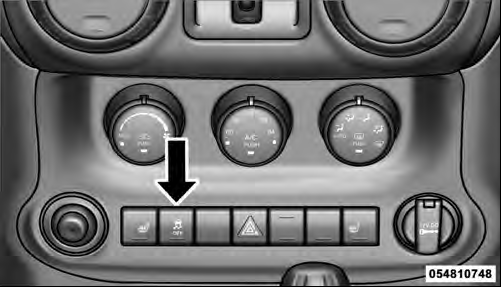
ESC OFF Switch
When in Partial Off mode, the TCS portion of ESC has been disabled and the “ESC Activation/Malfunction Indicator Light” will be illuminated.
All other stability features of ESC function normally. This mode is intended to be used if the vehicle is in deep snow, sand, or gravel conditions and more wheel spin than ESC would normally allow is required to gain traction. To turn ESC on again, momentarily press the ESC OFF switch. This will restore the normal “ESC On” mode of operation.
4L Range (4WD Models)
ESC Off
This is the normal operating mode for ESC in 4L range.
Whenever the vehicle is started in 4L range, or the transfer case (if equipped) is shifted from 4H range or NEUTRAL to 4L range, the ESC system will be in this mode. In 4L range, ESC and TCS, except for the “limited slip” feature described in the TCS section, are turned off until the vehicle reaches a speed of 64 km/h. At 64 km/h, the normal ESC stability function returns but TCS remains off. When the vehicle speed drops below 56 km/h, the ESC system shuts off.
The ESC is off at low vehicle speeds in 4L range so that it will not interfere with off-road driving, but the ESC function returns to provide the stability feature at speeds above 64 km/h. The “ESC Activation/ Malfunction Indicator Light” will always be illuminated in 4L range when ESC is off.
Test yourself
A quick Jeep Wrangler quiz: every answer comes with an explanation and a link to the manual page.