Description and operation
Description
AEB system is designed to help avoid a potential collision or reduce its impact when drivers applies inadequate, delayed or no brakes at all to avoid a collision.
The system detects the risk factors on the road by using the frontal impact sensor and warn the driver and activate the emergency brake to prevent collision or reduce collision speed.
The following is the system control process
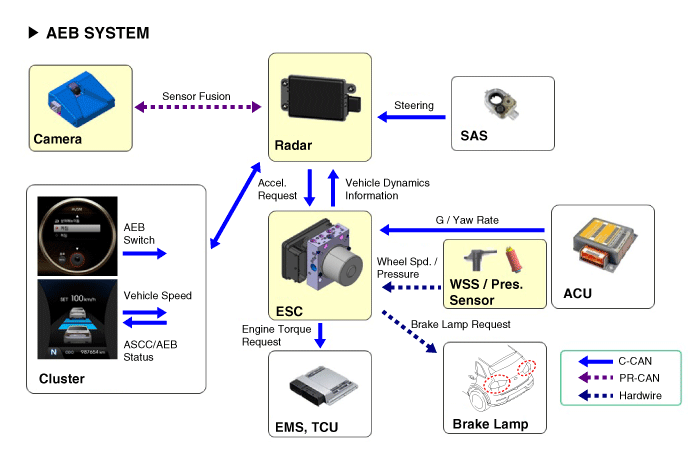
Detect preceding vehicles (pedestrians) and analyze the data (CAN comm.) by using the radar sensor of the Smart Cruise Control System (SCC) and the camera sensor of Lane Departure Warning System (LDWS).
Confirm the object to be protected by AEB system (vehicles and pedestrians) by using the analyzed data.
Calculate the speed reduction depending on the speed, distance, existence or nonexistence of preceding vehicle.
Report the "required speed reduction" to Vehicle Dynamics Control (VDC) (CAN Comm.)
VDC performs automatic control after calculating the required torque to achieve "required speed reduction" (CAN Comm.).
Operation

? The time indicated will be changed according to vehicle speeds.
Step 1: Issue a visual (display) and vocal alarm when a danger is detected.
Step 2: Reduce engine torque and activates AEB when there is a high chance of collision.
Step 3: Activate emergency brake when a collision is imminent.
After stopping the vehicle: Maintain the braking control for a certain time and then release it.
The following is the configuration of the AEB system.
Detection device (radar and camera) that can recognize potential obstacles in the front.
Human-Machine Interface (HMI) to warn driver or change settings.
Braking system to automatically brake the car
AEB, contrary to SCC (Smart Cruise Control), has to work on a stationary car so the system uses the Fusion Target system to combine radar with camera.