Curtain Airbag
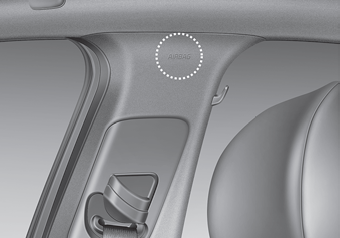
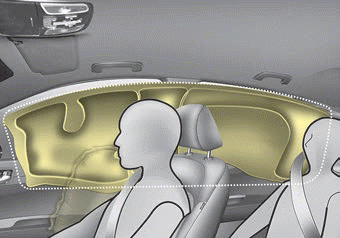
Side curtain airbags are located on both sides of the roof side rails above the front and rear doors.
They are designed to protect occupants in certain side impacts and help prevent occupants from being ejected from the vehicle in a rollover, especially when seat belts are also used.
- Curtain airbags are designed to deploy in certain side impacts, depending on the severity, angle, speed and point of impact of the collision. However, when the side deployment threshold is met in a frontal impact, the side airbags may deploy.
- Curtain airbags may deploy on the impact side or on both sides.
- In addition, curtain airbags on both sides of the vehicle deploy in certain rollover situations.
- Side curtain airbags are not designed to deploy in all side impacts or rollover situations.
Do not allow occupants to lean their head or body against the doors, place their hands on the doors, extend their arms out of the window, or place objects between the doors and occupants when seated in seats equipped with side airbags and/or curtain airbags.
✽ NOTICE
Never attempt to open or repair any component of the side and curtain airbag system. This must be done only by an authorized Kia dealer.
WARNING! Do not attach objects
- Do not place any objects on top of the airbag cover. Also, do not attach any objects around the airbag deployment area, such as the door, side door glass, front and rear pillars, or side roof rail.
- Do not hang hard or breakable objects on the coat hook.
Why did my airbag not deploy in a collision? (Inflation and Non-Inflation Airbag Conditions)
There are many types of collisions in which the airbags are not expected to deploy. The airbags are designed to provide supplemental protection.
These include rear impacts, secondary or tertiary collisions in multiple impacts, and low-speed impacts.
Airbag Crash Sensors

(1) SRS Control Module / Rollover Sensor
(2) Frontal Impact Sensor
(3) Side Impact Sensor
(4) Side Impact Sensor
(5) Side Impact Sensor
WARNING - Airbag Sensors
- Do not strike or allow any objects to enter the areas where the airbags or sensors are installed. This may cause unexpected airbag deployment, which may result in serious injury or death.
- If the installation location or installation angle of the sensors is changed in any way, the airbags may deploy when they should not, or may not deploy when they should. Therefore, do not attempt to perform maintenance on or around the airbag sensors. Have the vehicle inspected and repaired by an authorized Kia dealer.
Problems may occur if the installation angles of the sensors change due to deformation of the front bumper, front end module, body or front doors in a side collision where the sensors are installed. Have the vehicle inspected and repaired by an authorized Kia dealer.
Installing bumper guards (or side steps or running boards) or replacing the bumper (or front door module) with non-genuine parts may adversely affect collision performance and airbag deployment.
Airbag Deployment Conditions

Front Airbags
Front airbags are designed to deploy in a frontal collision depending on the severity, speed, or angle of the frontal impact.


Side airbags and/or curtain airbags
The side airbags and/or curtain airbags deploy when the side impact sensors detect an impact, depending on the force, speed, or angle of the side impact.
In addition, side airbags and curtain airbags deploy when a rollover is detected by the rollover sensor.
Although the front airbags (driver and front passenger) are designed to inflate in frontal collisions, they may also inflate in other types of collisions if the frontal impact sensors detect sufficient frontal force in another type of impact. Side airbags and curtain airbags are designed to deploy in certain side impacts. They may inflate in other types of collisions when lateral force is detected by the sensors. The side airbag and/or curtain airbag may also deploy when the rollover sensors indicate a possible rollover (even if no rollover actually occurs), or in other situations, including when the vehicle tilts during towing.
Even if the side airbags and/or curtain airbags do not provide protection in rollover impacts, they will still deploy to prevent occupants from being ejected, especially those wearing seat belts.
If the underbody of the vehicle strikes bumps or objects on rough roads, the airbags may deploy. Drive carefully on rough roads or surfaces not intended for vehicle travel to prevent unintentional airbag deployment.
Airbag Non-Deployment Conditions

• In certain low-speed collisions, the airbags may not deploy. Airbags are not designed to deploy in such cases, as they may provide no benefit other than the seat belt protection in such collisions.
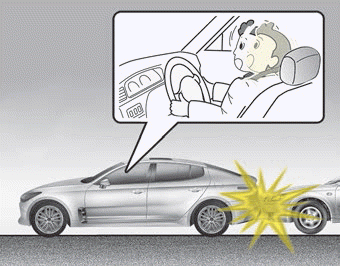
• Airbags are not designed to deploy in rear impacts, because occupants are pushed back into the seat by the force of the impact. In this case, deployed airbags cannot provide any additional benefit.
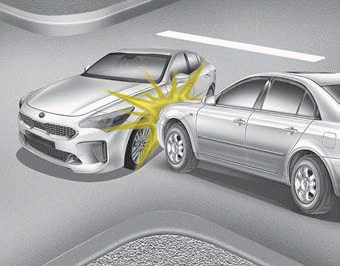
• Frontal airbags may not deploy in side collisions, because occupants move in the direction of the collision. Therefore, in a side impact, frontal airbag deployment will not provide additional occupant protection.

• In an angled collision, the force of the impact may direct occupants in a direction where the airbags could not provide any additional benefit; therefore, the sensors may not activate the airbags.
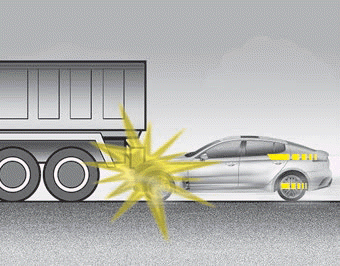
• Immediately before a collision, drivers often brake hard. This hard braking lowers the front of the vehicle, causing it to "underride" under a vehicle with a higher ground clearance. The airbags may not deploy in this "underride" situation, because the deceleration forces detected by the sensors may be significantly reduced by such underride collisions.
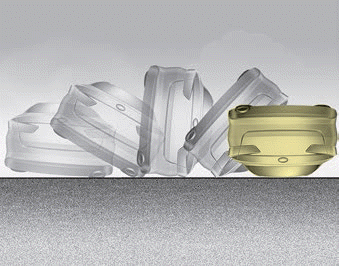
• Front airbags may not deploy in all rollover cases when the SRSCM determines that front airbag deployment will not provide additional occupant protection.
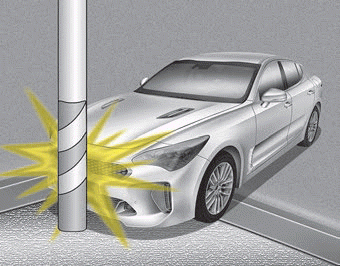
• Airbags may not deploy when the vehicle strikes objects such as utility poles or trees, where the impact is concentrated in one area and the full force of the impact is not transmitted to the sensors.
Test yourself
A quick Kia Stinger CK quiz: every answer comes with an explanation and a link to the manual page.