General Information
General Information
Vehicle Identification Number Location
Vehicle Protection
Always cover the fenders, seats, and floor before performing service.
Preparation of Tools and Measuring Equipment
Make sure all required tools and measuring equipment are available before servicing.
Special Service Tools
Use the appropriate Special Service Tools.


Part Removal
First determine the cause of the problem, then decide whether removal or disassembly is required before servicing.
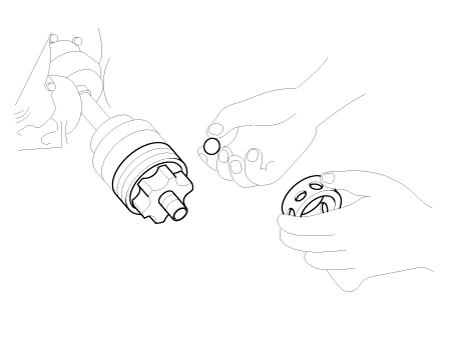
Disassembly
If the disassembly procedure is complex and requires removing many parts, all parts must be disassembled in a way that does not affect their function or appearance.
Part Inspection
After removal, carefully inspect each part for malfunction, deformation, damage, and other problems.
Part Arrangement
All disassembled parts must be neatly arranged for efficient reassembly.
Be sure to separate and correctly identify parts to be replaced from those to be reused.
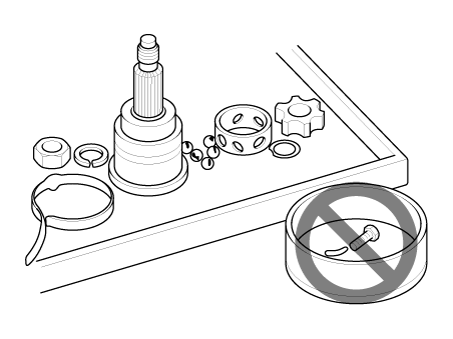
Cleaning Parts for Reuse
All reusable parts must be thoroughly cleaned using an appropriate method.

Parts
When replacing parts, use genuine Kia Motors parts or parts of equivalent quality.

Replacement
Specified values, such as torque and specified adjustments, must be strictly observed when assembling all parts.
After removal, replace the following parts with new ones.
Oil Seals
Gaskets
O-rings
Lock Washers
Cotter Pins
Plastic Nuts

Apply sealant to the gaskets.
Apply oil to the moving surfaces of parts.
Apply the specified oil or grease to the prescribed locations (oil seals, etc.) before assembly.

Adjustment
Use gauges and testers to properly adjust parts to the specified values.
Electrical System
Disconnect the negative (-) battery terminal before working on the electrical system to prevent damage from short circuits.
Never pull on the wires when disconnecting connectors.
Locking connectors will click when the connector is secured.
Handle sensors and relays carefully. Be careful not to drop them onto other parts.

Rubber Parts and Hoses
Do not allow gasoline to contact rubber parts or hoses.

Body Dimension Measurement
Basically, all measurements in this manual are made with a tracking measuring tape.
When using a tape measure, make sure the tape is not stretched, twisted, or bent.
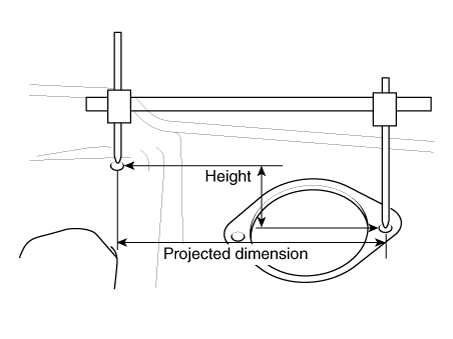
For measurements, both projected dimensions and actual measurements are used in this manual.
Projection dimensions
These are dimensions measured by projecting measurement points from the vehicle surface, and are reference dimensions used for body modification.
If the length of the tracking gauge probes is adjustable, measure it by extending one of the two probes until the height difference between the two surfaces is eliminated.
Actual Dimension Measurement
These dimensions indicate the actual linear distance between points and are used as reference dimensions when measuring.
First adjust both probes to the same length (A=A') before measuring.

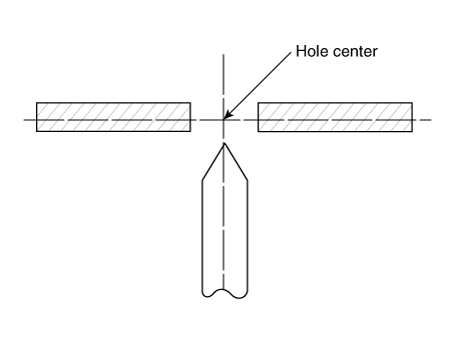
Measuring point
Measurements should be taken at the center of the hole.
Inspection of Cables and Wires
Check the terminal for tightness.
Check terminals and wires for corrosion from battery electrolyte, etc.
Check terminals and wires for open circuits.
Check wire insulation and coating for damage, cracks, and wear.
Check the conductive parts of the terminals for contact with other metal parts (vehicle body and other components).
Check the grounded parts to make sure there is continuity between their mounting bolt(s) and the vehicle body.
Check for correct connections.
Make sure wiring is secured so it does not contact sharp body edges or hot parts (exhaust manifold, etc.).
Make sure wiring is securely fastened to provide sufficient clearance from the fan pulley, fan belt, and other rotating or moving parts.
Make sure the wiring has enough slack to vibrate between stationary and moving parts, such as the body and the engine.
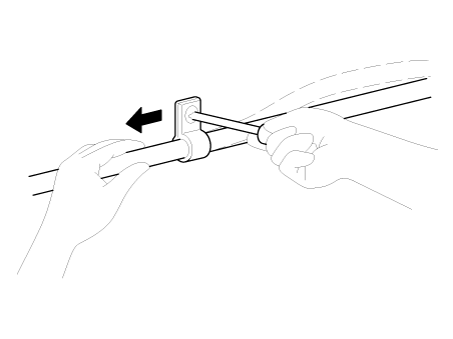
Check fuses
The blade-type fuse test taps are used to check the fuse itself without removing it from the fuse block. The fuse is good if the test lamp lights when one lead is connected to the test taps (one at a time) and the other lead is grounded. (Turn the ignition on so the fuse circuit is energized.)
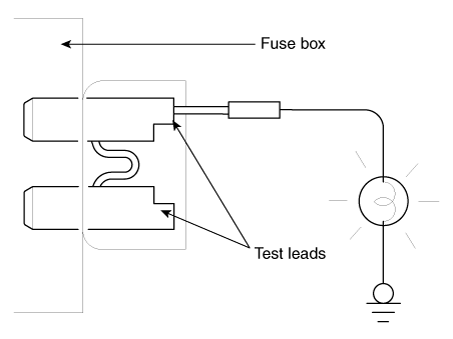
Electrical System Maintenance
Before servicing the electrical system, be sure to turn the ignition switch OFF and disconnect the battery ground cable.
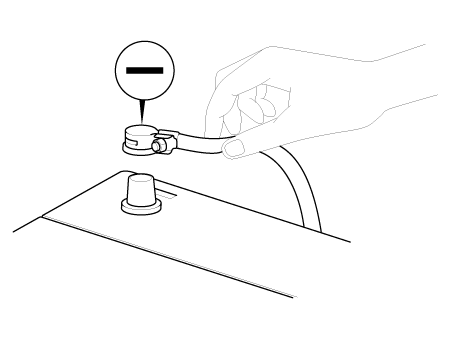
Secure wire harnesses with clamps so they do not sag. However, for any harness that passes near the engine or other vibrating parts of the vehicle, allow enough slack so that engine vibration does not cause the harness to contact any surrounding parts, then secure the harness with a clamp.
If any section of the wire harness contacts the edge of a part or a corner, wrap that section with tape or an equivalent to protect it from damage.

When installing any parts, take care not to pinch or damage the wiring harness.

Never drop relays, sensors, or electrical parts, and do not subject them to strong shocks.

Electronic parts used in the computer, relays, etc. are easily damaged by heat. If there is a need to perform service operations that may cause the temperature to exceed 80 °C, remove the electronic components beforehand.

Loose connectors cause problems. Make sure connectors are always securely connected.
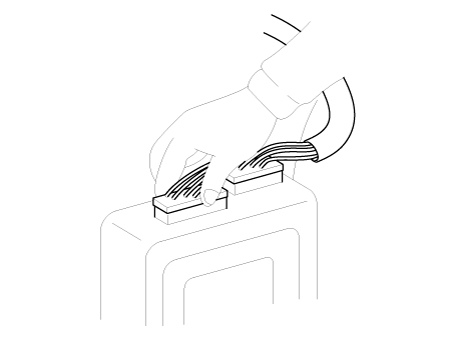
When disconnecting a connector, hold the connector halves, not the wires. Do not pull on the wires.

Disconnect the lock connector by pressing in the direction of the arrows shown in the illustration.

Connect the lock connector by inserting it until it clicks.
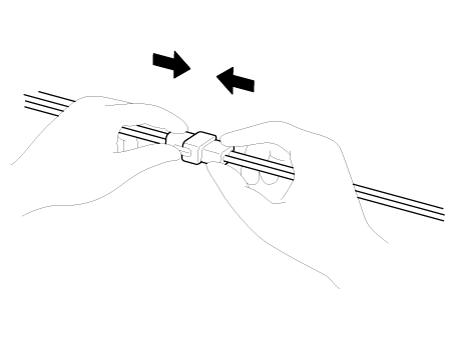
When using a circuit tester to check continuity or voltage at a connector terminal, insert the test probe from the wire harness side. If the connector is a waterproof connector, insert the test probe through the hole in the rubber cap until it reaches the terminal. Be careful not to damage the wire insulation.

To avoid overloading the wiring, select the appropriate wire size based on the current load of the additional equipment.
Nominal
SizeSAE Gauge No. Allowable Current In Engine Compartment Other Areas 0.3 mm² AWG 22 - 5A 0.5 mm² AWG 20 7A 13A 0.85 mm² AWG 18 9A 17A 1.25 mm² AWG 16 12A 22A 2.0 mm² AWG 14 16A 30A 3.0 mm² AWG 12 21A 40A 5.0 mm² AWG 10 31A 54A
Catalytic Converter Precautions
Use only unleaded gasoline.
Do not start the engine if the vehicle has not been used for a long time. Avoid running the engine at high idle speed for more than 10 minutes and at speeds above 20 minutes.
Do not perform an engine compression test for a long time. Engine compression tests must be performed as quickly as possible. Remove the fuel pump relay before performing the compression test.
Do not dispose of a used catalytic converter together with parts contaminated with gasoline or oil.
Test yourself
A quick Kia Stinger CK quiz: every answer comes with an explanation and a link to the manual page.