Tire Pressure Check
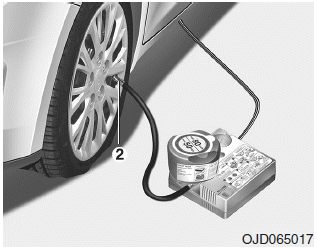
1. After driving approximately 7 to 10 km (4 to 6 miles, or about 10 minutes), stop in a safe place.
2. Connect the compressor fill hose (2) directly to the tire valve.
3. Connect the compressor power cable to the vehicle power outlet.
4. Adjust the tire pressure to the recommended tire pressure. With the ignition in the ON position, proceed as follows.
- To increase the inflation pressure: Turn on the compressor, position I. To check the current inflation pressure setting, briefly turn off the compressor.
- To decrease the inflation pressure: Press the button (8) on the compressor.
✽ NOTICE
Do not run the compressor for more than 10 minutes, otherwise the unit may overheat and be damaged.
✽ NOTICE
The pressure gauge may show a higher reading than the actual pressure while the compressor is running. To obtain accurate tire pressure readings, the compressor must be turned off.
CAUTION
If the tire pressure is not restored, drive the vehicle for a second time, refer to the section Distributing Sealant. Then repeat steps 1 to 4.
Use of the TMK may not be effective for tire damage larger than approximately 4 mm (0.16 in). We recommend that you contact an authorized Kia dealer if the tire cannot be made serviceable with the Tire Mobility Kit.
WARNING
Tire pressure must be at least 220 kPa (32 psi). If it is not, do not continue driving. Call roadside assistance or a tow truck.
WARNING - Tire pressure sensor
Sealant on the tire pressure sensor and wheel must be removed when replacing the tire with a new one, and the tire pressure sensors must be inspected at an authorized dealer.
Test yourself
A quick Kia Cee'd quiz: every answer comes with an explanation and a link to the manual page.