Fuses
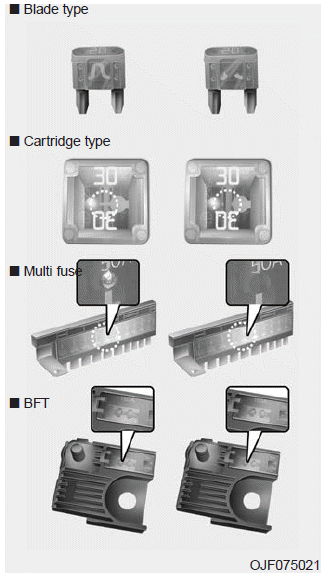
The vehicle's electrical system is protected from electrical overload damage by fuses.
This vehicle has 2 (or 3) fuse panels, one located on the driver's side of the instrument panel and another in the engine compartment near the battery.
If any of the lights, accessories or controls on your vehicle do not work, check the corresponding circuit fuse. If a fuse has blown, the element inside the fuse will melt.
If the electrical system does not operate, first check the fuse panel on the driver's side.
If a replacement fuse blows, this indicates an electrical problem. Avoid using the system and contact an authorized Kia dealer immediately.
Three types of fuses are used: blade-type for lower current ratings, cartridge type, and multi-fuse for higher current ratings.
WARNING - Fuse Replacement
- Never replace a fuse with anything other than a fuse of the same rating.
- A fuse with a higher rating may cause damage and fire.
- Never install wire or aluminum foil in place of a proper fuse, even as a temporary repair. This may cause severe wiring damage and fire.
- Do not modify or add to the vehicle's electrical wiring on your own.
CAUTION
Do not use a screwdriver or any other metal object to remove fuses, as this may cause a short circuit and damage the system.
✽ NOTICE
- When replacing a fuse, turn the ignition off and switch off all electrical devices, then disconnect the negative (-) battery terminal.
- The actual fuse/relay panel label may differ from the equipped components.
WARNING - Electrical Fire
Always make sure replacement fuses and relays are firmly seated when installed. Failure to do so may cause a vehicle fire.
CAUTION
- When replacing a blown fuse or relay, make sure the new fuse or relay fits firmly into the clips. Incorrect installation of a fuse or relay may cause damage to the wiring and electrical systems.
- Do not remove fuses, relays, and terminals secured by bolts or nuts. Fuses, relays, and terminals may be improperly secured, which may cause damage to the vehicle.
CAUTION
- Do not insert any objects other than fuses or relays into the fuse/relay terminals, such as a screwdriver or wire. This may cause poor contact and system malfunction.
- Do not connect screwdrivers or non-original wiring to the terminals, which are designed only for fuses and relays. The electrical system and internal wiring of the vehicle may be damaged or burned due to poor contact.
- If you connect a wire directly to the taillight or replace a bulb with one exceeding the rated wattage for trailer installations, etc., the internal junction block may burn out.
CAUTION
Visually inspect the battery cover to make sure it is securely closed. If the battery cover is not closed tightly, moisture may enter the system and damage electrical components.
WARNING! Electrical Wiring Repair
All electrical repair work must be performed by authorized Kia dealers using genuine Kia certified parts. Using other electrical wiring components, especially when adding an AVN or security alarm system, remote engine start, car phone, or radio, may damage the vehicle and increase the risk of vehicle fire.
✽ WARNING - Modifications Prohibited
Never modify your vehicle's electrical wiring, as this may affect the performance of several safety features in your vehicle. Modifying the vehicle's electrical wiring may also void your warranty and make you responsible for any subsequent damage to the vehicle.
✽ CAUTION - Precautions for Window Tinting
Window tinting (especially metallic film) may cause communication errors, poor radio reception, and malfunction of the automatic lighting system due to reflections from the mirror-like tint inside the vehicle. The solution used may also seep into electronic components, which may cause malfunction or damage.
Test yourself
A quick Kia Optima DL3 quiz: every answer comes with an explanation and a link to the manual page.