Seat Belts - Precautions
Seat belts reduce the likelihood of serious injury from collisions and sudden braking. Mazda recommends that the driver and passengers use seat belts in all situations.
Front seat and outboard rear seat
The front seats and the outer rear seats are equipped with three-point seat belts. The belts have inertia locking retractors that allow the belt to retract when not in use. The belt locking mechanisms provide passenger comfort, and in the event of a collision the belts lock.
Center rear seat
For the three-point seat belt
The three-point seat belt has a lap and shoulder belt. This type of belt has a retractor with an inertia lock, which allows the belt to retract when not in use. The belt lock provides passenger comfort, and in the event of a collision the belt locks.
For the two-point seat belt
The two-point seat belt has a lap belt with manual adjustment.
WARNING
Always use seat belts and make sure that all passengers have fastened them correctly: Not wearing a seat belt is very dangerous. In a collision, unbelted passengers may strike other passengers or objects inside the vehicle, or even be ejected from the vehicle. This may result in serious injury or even death.
In a collision, passengers wearing their seat belts will be safer.
Do not fasten a twisted seat belt: Using a twisted seat belt is a safety hazard. The force of a collision is not absorbed across the full width of the belt. This causes greater forces to act on the skeletal structure beneath the belt, which may result in serious injury or death. Therefore, if the seat belt is twisted, you should straighten it to remove the twists and allow the belt to be used across its full width.
Never fasten more than one person with one seat belt: Using the same seat belt for two people is a safety hazard.
A seat belt used in this way cannot properly absorb the forces involved, and both passengers may be crushed, which may result in serious injury or death. Never use the same seat belt for two people, and while driving, make sure each passenger has their seat belt properly fastened.
Do not use the vehicle with a damaged seat belt: Using a damaged seat belt is a safety hazard. The seat belt webbing may be damaged in a collision. A damaged seat belt does not provide sufficient protection in a collision. Seat belts on a vehicle involved in an accident must be inspected by a specialist before reuse. We recommend using Authorized Mazda Service Centers.
Seat belt pretensioners and load limiters must be replaced immediately if the vehicle was involved in a collision and the mechanisms have operated: After every collision, the seat belt pretensioners and airbags should be inspected by a specialist service. We recommend using Authorized Mazda Service Centers. Like airbags, seat belt pretensioners and load limiters can operate only once. After an accident they are not suitable for reuse and must be replaced immediately. Seat belt pretensioners and load limiters that are not replaced increase the risk of injury in a subsequent collision.
Adjusting the shoulder part of the seat belt: Incorrect positioning of the shoulder belt is a safety hazard. Always check that the shoulder belt lies across the shoulder and close to the neck, never under the arm, on the neck, or on the upper arm.
Positioning the lap part of the seat belt: Placing the lap belt too high is a safety hazard. In a collision, such positioning will concentrate the impact force directly on the abdomen, which may cause serious internal injuries. Position the lap belt snugly and as low as possible.
Instructions for using seat belts: Seat belts are designed to follow the structure of the human skeleton and should be fastened properly around the pelvis, chest and shoulders. Avoid wearing the lap part of the belt across the abdomen.
Seat belts should be adjusted as snugly as possible, but in a way that ensures comfort, so that they provide the protection they were designed for. A loose seat belt significantly reduces passenger safety.
Avoid contaminating the webbing with paint, grease and chemicals, especially battery acid. Use mild soap and water to clean seat belts. If the webbing is frayed, contaminated or damaged, it must be replaced.
If a seat belt has locked during a severe collision, the entire mechanism should be replaced, even if no damage is visible.
Do not use twisted seat belts.
Each seat belt may be used by only one passenger.
Fastening a child seated on a passenger's lap with the seat belt is a safety hazard.
The user must not make any modifications or alterations that prevent the seat belt webbing from retracting and extending automatically.
CAUTION
Retraction may be impaired if the webbing or the guide loop is dirty, so keep them clean. For more information on cleaning seat belts, see the section "Cleaning the seat belt webbing" (page 6-78). 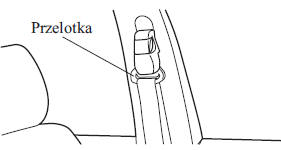
Pregnant women and persons with serious health problems
Pregnant women should always wear their seat belt. Detailed recommendations should be obtained from a doctor.
The lap part of the belt should be fastened SNUGLY AND AS LOW AS POSSIBLE AROUND THE HIPS.
The shoulder part should be properly fastened across the shoulder, but never across the abdomen.
Persons with serious health problems should also use seat belts. Consult your doctor for detailed recommendations based on your health condition.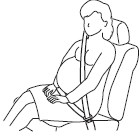
Standby mode for emergency
When the seat belt is fastened, it is always in the emergency locking mode.
In the emergency locking mode, the belt lies close to the occupant's body, and the retractor locks the webbing in the event of a collision.
If the seat belt is locked and cannot be pulled out, release the belt so that it retracts, then slowly pull it out again. If this does not work, pull the belt firmly once, release it, and then slowly pull it out.
Test yourself
A quick Mazda 2 quiz: every answer comes with an explanation and a link to the manual page.