AdBlue. Engine oil. Brake fluid
The section on AdBlue, engine oil and brake fluid for the Mercedes E-Class (4th generation, W212, 2009–2016) explains the importance of high-quality operating fluids and their proper handling. Notes on fill quantities and change intervals help ensure operating safety.
AdBlue
Important Safety Notes
When handling AdBlue, observe the important safety notes on operating fluids.AdBlue is a water-soluble fluid for exhaust aftertreatment of diesel engines. It is:
- non-toxic
- colorless and odorless
- non-flammable
Ammonia vapors have a pungent odor and irritate mainly the skin, mucous membranes and eyes. This can cause a burning sensation in the nose, throat and eyes. Coughing and watery eyes are possible.
Do not inhale escaping ammonia vapors. Only fill the AdBlue tank in well-ventilated areas.Low outside temperatures
AdBlue freezes at a temperature of about -11 °C. . The vehicle is equipped with an AdBlue preheating system as standard. This ensures winter operation even at temperatures below 11is guaranteed.
Additives
Note Use only AdBlue that meets ISO 22241. Do not add any additives to AdBlue and do not dilute AdBlue with water. This can destroy the BlueTEC exhaust aftertreatment system.Purity
Note Contamination of AdBlue, e.g. by other operating fluids, cleaning agents or dust, leads to- increased emission levels
- Catalytic converter damage
- Engine damage
- Malfunctions of the BlueTEC exhaust aftertreatment system
To avoid malfunctions of the BlueTEC exhaust aftertreatment system, the purity of AdBlue is especially important.
If AdBlue is pumped out of the AdBlue tank, e.g. during a repair, it must not be refilled. The purity of the fluid can no longer be guaranteed.Fluid capacities
| Model | Total capacity |
|---|---|
| All models | 25,5 l |
Engine oil
General Notes
When handling engine oil, observe the important safety information on operating fluids.The quality of engine oils is decisive for the function and service life of an engine. Based on extensive testing, Mercedes-Benz continuously approves engine oils that meet the current technical standard.
For this reason, only engine oils approved by Mercedes-Benz may be used in Mercedes-Benz engines.Further information on tested and approved engine oils is available at any Mercedes-Benz service outlet. Mercedes-Benz recommends having the oil change performed by a qualified workshop. You can recognize Mercedes-Benz approval on the oil container by the wording "MB-Freigabe" (MB approval) and the corresponding specification designation, e.g. MB-Freigabe 229.51.
You can view an overview of approved engine oils on the Internet at http://bevo.mercedes-benz.com by entering the specification designation, e.g. 229.5.The table shows which engine oils are approved for your vehicle.
Gasoline engines: In certain countries, other engine oils may be used in conjunction with reduced service intervals. For further information, contact a qualified workshop.| Gasoline engines | MB approval |
|---|---|
| All models | 229.5 |
| Diesel engines | MB approval |
| E 350 CDI | 228.51, 229.31, 229.51 |
| All other models | 228.51, 229.31, 229.51, 229.52 |
For AMG vehicles, only engine oils SAE 0W-40 or SAE 5W-40 may be used.
Info

If the engine oils listed in the table are not available, you may top up the following engine oils until the next oil change:
- Gasoline engines: MB approval 229.1, 229.3 or ACEA A3
- Diesel engines: MB approval 229.1, 229.3, 229.5 or ACEA C3
Fluid capacities
The following values apply to an oil change including the oil filter.| Model | Oil change quantity |
|---|---|
| E 180 | 6,1 l |
| E 200 E 250 |
6,3 l |
| E 500 E 500 4MATIC E 300 BlueTECE 350 CDI E 350 BlueTECE 350 BlueTEC 4MATIC |
8,0 l |
| AMG vehicles | 8,5 l |
| All other models | 6,5 l |
Additives
Note Do not add any additional additives to the engine oil. This can damage the engine.Engine oil viscosity
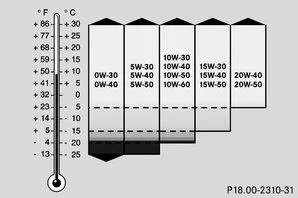
Viscosity describes the flow behavior of a fluid. For engine oil, high viscosity means thick, low viscosity means thin.
Select the engine oil according to the SAE grade (viscosity) for the respective outside temperatures. The table shows the SAE grades to be used. The low-temperature properties of engine oils can deteriorate significantly, e.g. due to aging and soot and fuel contamination during operation. Regular oil changes with an approved engine oil of the appropriate SAE grade are therefore strongly recommended.Brake fluid
WARNINGBrake fluid constantly absorbs moisture from the atmosphere. This lowers the boiling point of the brake fluid. If the boiling point is too low, vapor bubbles can form in the brake system under high brake loads. This impairs braking performance. Risk of accident!
Have the brake fluid replaced at the specified interval.When handling brake fluid, observe the important safety information on operating fluids.
The brake fluid change intervals can be found in the service booklet.Use only brake fluid approved by Mercedes-Benz according to MB approval 331.0.
Information on approved brake fluid is available from any qualified workshop or on the Internet at http://bevo.mercedes-benz.com.Info
Have the brake fluid replaced regularly at a qualified workshop and have the change confirmed in the service booklet.
The notes on AdBlue, engine oil and brake fluid for the Mercedes E-Class W212 (model years 2009–2016) show how important it is to use approved operating fluids for operating safety. This is the only way to optimally protect the exhaust aftertreatment system, engine and brake system.
Mercedes recommends regular checks and replacement of these fluids according to manufacturer specifications to avoid damage and malfunctions.
In this way, the E-Class underlines its commitment to quality and safety in all operating conditions.
Test yourself
A quick Mercedes-Benz E-Class quiz: every answer comes with an explanation and a link to the manual page.