Brake Pad
Exploded View
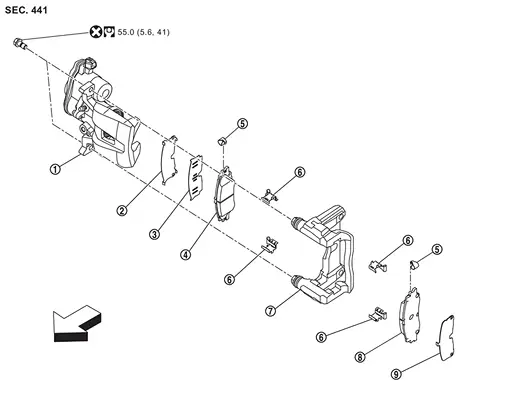
 |
Cylinder body |  |
Inner shim cover |  |
Inner shim |
 |
Inner pad |  |
Pad wear sensor |  |
Pad retainer |
 |
Torque member |  |
Outer pad |  |
Outer shim |
| : vehicle front | |||||
 |
: N·m (kg-m, ft-lb) | ||||
 |
: Always replace after every disassembly. | ||||
Removal and Installation
REMOVAL
Release the parking brake.
Remove tires. Refer to ROAD WHEEL TIRE : Removal & Installation.
Disconnect the parking brake actuator harness connector  .
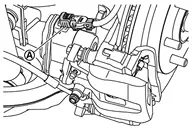
Remove sliding pin bolts .
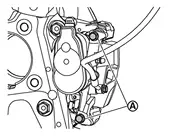
Remove the cylinder body , and suspend the cylinder body with suitable wire so that the brake hose and the electric parking brake harness will not stretch.
Remove the brake pads, shims and shim covers.
Perform inspection after removal. Refer to Inspection.
INSTALLATION
Install the brake pads to the torque member.
Using the brake caliper wrench (Commercial Service Tool) (A), rotate the piston clockwise so that the center line  between the dent
 of the piston and the slide pin bolt hole is 90 degree (D).
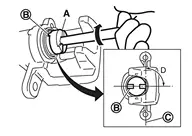
Align the protrusion of the inner pad with the dent of the piston and attach the cylinder body to the torque member.
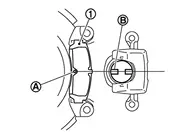
Apply rubber grease to the sliding pins, and then install the cylinder body to torque member.
Install the sliding pin bolts and tighten it to the specified torque. Refer to Exploded View.
Connect the parking brake actuator harness connector .
Must be performed additional service when replacing brake pad. Refer to Description.
Depress the brake pedal several times to check that no drag feel is present for the rear disc brake. Refer to Inspection and Adjustment.
Install tires. Refer to ROAD WHEEL TIRE : Removal & Installation.
Inspection
INSPECTION AFTER REMOVAL
Replace the shims and shim covers if rust is excessively attached.
Eliminate rust on the pad and the torque member. Replace them if rust is excessively attached.
INSPECTION AFTER INSTALLATION
Check a drag of rear disc brake. If any drag is found, follow the procedure described below.
Remove brake pads. Refer to Removal and Installation.
Press the pistons. Refer to Removal and Installation.
Install brake pads. Refer to Removal and Installation.
Depress the brake pedal several times.
Check a drag of rear disc brake again. If any drag is found, disassemble the cylinder body and replace if necessary. Refer to Disassembly and Assembly.
Burnish contact surfaces brake pads and disc rotor after refinishing or replacing brake pads, or if a soft pedal occurs at very low mileage. Refer to Inspection and Adjustment.