Water Pump
Exploded View
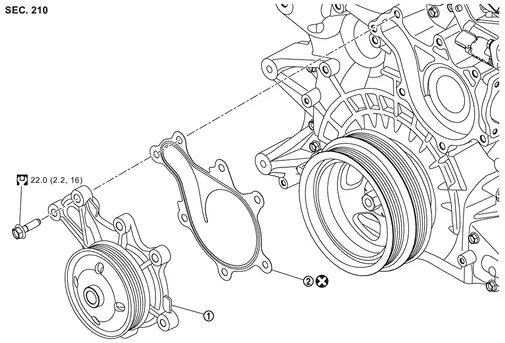
 |
Water pump |  |
Gasket | ||
 |
: N·m (kg-m, ft-lb) | ||||
 |
: Always replace after every disassembly. |
Removal & Installation
REMOVAL
Remove front undercover using a power tool. Refer to Removal and Installation.
Drain engine coolant from drain plugs on radiator and cylinder block. Refer to following:
Radiator: Refer to ENGINE COOLANT : Draining.
Cylinder block: Refer to Setting.
Remove air duct 1 and inlet air duct 2. Refer to Removal and Installation.
Remove drive belt. Refer to Removal & Installation.
Remove reservoir tank tube .
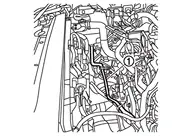
Remove water pump.
Engine coolant will leak from cylinder block, so have a receptacle ready under vehicle.
INSTALLATION
Install in the reverse order of removal.
Inspection
INSPECTION BEFORE REMOVAL
A small amount of engine coolant is discharged from the lubrication surface during normal operation and may be found as a coolant residue on the plug, bleed hole, or bottom of water pump assembly.
In case of coolant residue is found on the water pump assembly, check the water pump leakage as following steps.
Wipe off the engine coolant residue on water pump assembly.
Open the reservoir tank cap.
Apply pressure to the cooling system with the radiator cap tester (commercial service tool) (A) and radiator cap tester adapter (commercial service tool) (B).

Testing pressure : Refer to RADIATOR : Service Data. Hold pressure for 20 minutes and check the engine coolant leakage from plug or bleed hole.
Close the reservoir tank cap.
Maintain idling for 20 minutes after engine warm up and stop engine.
Check the water leakage around plug
 , drain hole
 or bleed hole
 .
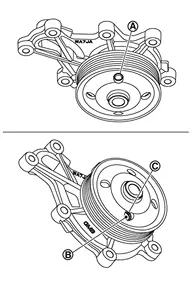
If engine coolant leakage is found in step 4 or 7, replace the engine water pump assembly.
INSPECTION AFTER REMOVAL
Check visually that there is no significant dirt or rusting on water pump body and vane
.
Check that there is no looseness in vane shaft, and that it turns smoothly when rotated by hand.
Replace water pump, if necessary.
INSPECTION AFTER INSTALLATION
Check that the reservoir tank cap is tightened.
Check for leakage of engine coolant using the radiator cap tester adapter (commercial service tool) and the radiator cap tester (commercial service tool). Refer to ENGINE COOLANT : Inspection.
Start and warm up the engine. Visually check that there is no leakage of engine coolant.