Charging system - testing
Note: Refer to the warnings given in "Safety first!" .
1. If the ignition warning light fails to illuminate when the ignition is switched on, first check the alternator wiring connections for security.
If satisfactory, check that the warning light bulb has not blown, and that the bulbholder is secure in its location in the instrument panel.
If the light still fails to illuminate, check the continuity of the warning light feed wire from the alternator to the bulbholder. If all is satisfactory, the alternator is at fault and should be renewed or taken to an autoelectrician for testing and repair.
2. If the ignition warning light illuminates when the engine is running, stop the engine and check that the drivebelt is correctly tensioned and that the alternator connections are secure. If all is so far satisfactory, have the alternator checked by an auto-electrician for testing and repair.
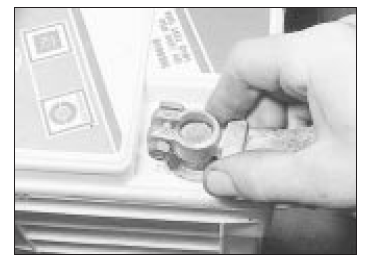
Disconnect the battery negative terminal first
3. If the alternator output is suspect even though the warning light functions correctly, the regulated voltage may be checked as follows.
4. Connect a voltmeter across the battery terminals and start the engine.
5. Increase the engine speed until the voltmeter reading remains steady; the reading should be approximately 12 to 13 volts, and no more than 14 volts.
6. Switch on as many electrical accessories (eg, the headlights, heated rear window and heater blower) as possible, and check that the alternator maintains the regulated voltage at around 13 to 14 volts.
7. If the regulated voltage is not as stated, the fault may be due to worn brushes, weak brush springs, a faulty voltage regulator, a faulty diode, a severed phase winding or worn or damaged slip rings. The alternator should be renewed or taken to an auto-electrician for testing and repair.
Test yourself
A quick Opel Corsa quiz: every answer comes with an explanation and a link to the manual page.