Battery
Special notes
To remove the battery, unscrew the retaining clamp (A).
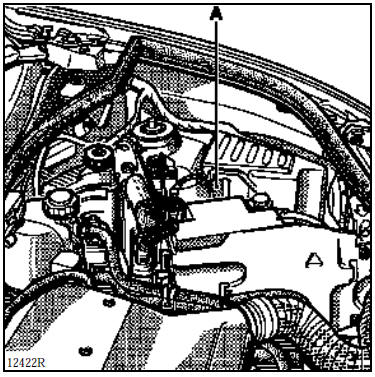
A - CHECKING
Check and make sure of the following:
that the battery case and cover are not cracked or broken,
that the top of the battery is clean,
the condition of the terminals.
It is essential to:
make sure there is no creeping salt (sulphation) on the terminals,
clean and grease them if necessary,
check that the terminal nuts are correctly tightened. A poor connection can cause starting or charging faults, which may produce sparks and cause the battery to explode,
check the electrolyte level.
Batteries fitted with removable cell caps:
remove the cover either by hand or with a tool (rigid spatula),
check that the electrolyte level in all cells is well above the separators,
if necessary, top up the levels with distilled water.
NOTE: Some batteries have translucent cases, which makes it possible to see the electrolyte level.
Never add electrolyte or any other products.
B - PRECAUTIONS
It is worth reminding that a battery:
contains sulphuric acid, which is a hazardous substance,
produces oxygen and hydrogen during charging. The mixture of these two gases forms an explosive gas, creating a risk of explosion.
1) DANGER = ACID
Sulphuric acid solution is a very aggressive, toxic and corrosive substance. It attacks skin and clothing, damages concrete and corrodes most metals.
It is therefore very important to take the following precautions when handling a battery:
protect your eyes with goggles,
wear gloves and acid-resistant clothing.
In case of acid splashes, rinse all contaminated parts thoroughly with water. If the eyes have been affected, consult a doctor.
2) DANGER = EXPLOSION RISK
When a battery is charging (either in the vehicle or outside it), oxygen and hydrogen are produced. Gas production is at its maximum when the battery is fully charged, and the quantity of gas produced is proportional to the charging current.
Oxygen and hydrogen combine in the free spaces at the surface of the plates and form an explosive mixture. This mixture is highly explosive.
The smallest spark, or a match just extinguished, is enough to cause an explosion.
The explosion is so violent that the battery can shatter and the acid can be dispersed into the surrounding air. People nearby are put at risk (flying fragments, acid splashes). Acid splashes are dangerous to the eyes, face and hands. They also damage clothing.
The warning about the explosion hazard that a mishandled battery can present must therefore be taken very seriously.
Avoid any risk of sparks.
Make sure the "consumers" are switched off before disconnecting or reconnecting a battery.
When charging a battery in an enclosed area, stop the charger before connecting or disconnecting the battery.
Do not place any metal object on the battery, to avoid short-circuiting the terminals.
Test yourself
A quick Renault Kangoo quiz: every answer comes with an explanation and a link to the manual page.