General information
The catalytic converter reaches high temperatures during operation. Therefore, never park where combustible materials could come into contact with it and catch fire.
Under certain conditions, these materials could catch fire.
WARNING:
- the seal from the exhaust manifold flange up to and including the catalytic converter must be perfect,
- any gasket that has been removed must be REPLACED without fail (especially at the catalytic converter flange),
- during removal and refitting, the catalytic converter must not be subjected to repeated mechanical shocks, otherwise it may be damaged.
EXHAUST LINE UNDERBODY MOUNTING
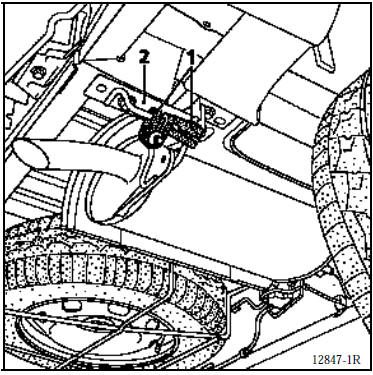
The exhaust line is mounted underbody on rubber mounts (1).
These can generally be unhooked by hand after relieving the exhaust line.
However, in some cases it may be necessary to unscrew the bolts retaining the underbody bracket (2) to unhook the rubber mounts more easily.
EXHAUST LINE CUTTING
The exhaust lines are of the one-piece type.
That is, there is no joint from the catalytic converter inlet or intermediate silencer inlet through to the rear silencer outlet.
It is therefore necessary, when replacing one of the components in the aftermarket, to cut the exhaust line.
To do this, it is essential to:
- mark the cutting area,
- use cutting tool Mot. 1199-01,
- position the aftermarket sleeve.
MARKING THE CUTTING AREA
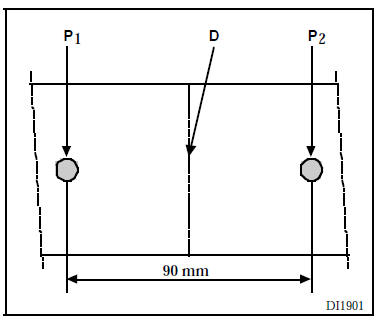
The cutting area is defined by two centre punch marks made on the exhaust pipe.
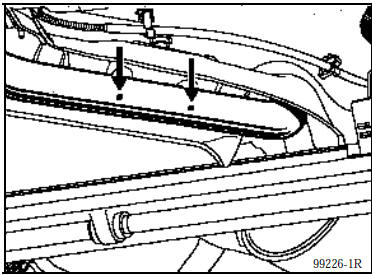
There are at most (depending on engine) two cutting areas on the exhaust lines, located between the catalytic converter and the intermediate silencer, and between the intermediate silencer and the rear silencer.
The distance between the two marks is 90 mm. To cut the pipe, mark the midpoint (D) between the two marks (P1 and P2).
WARNING: to cut the exhaust pipes, you must have tool Mot. 1199-01. This tool is used to cut pipes 2 mm thick.
POSITIONING THE AFTERMARKET SLEEVE
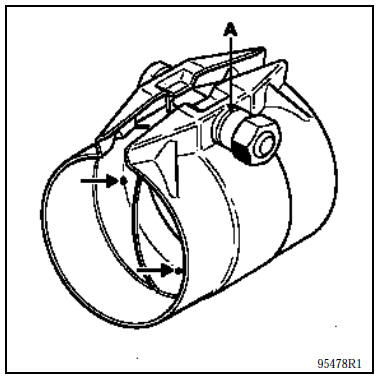
To prevent any exhaust leaks, it is important to position the sleeve correctly over both exhaust pipes. The pipe must bottom out against the lugs inside the sleeve.
Start by positioning the sleeve on the old section of the line, then adjust the clamp diameter by tightening it slightly.
Check the position of the pipe relative to the lugs.
Fit the replacement component.
Before positioning the sleeve on the line, prevent leaks by applying sealant to the inner ring of the sleeve.
(Exhaust sealant Ref.: 77 01 421 161 SODICAM).
A clamp that has already been fitted must not be reused.
The clamp nut has a groove (A) to ensure the correct tightening torque.
When tightening, once this groove disappears it produces a characteristic click, and the nut is then tightened to torque (2.5 daN.m).
NOTE: two sleeves of different diameters are available:
- Ø 50 mm,
- Ø 45 mm.
WARNING:
- check that the exhaust line does not contact the body,
- check that all heat shields of the exhaust line are correctly secured and in place,
- check that the two cutting marks are correctly aligned.
Test yourself
A quick Renault Kangoo quiz: every answer comes with an explanation and a link to the manual page.