Diagnostic introduction
General method
Warning: The Mégane can only be diagnosed with the CLIP diagnostic tool fitted with the new vehicle interface lead (part number: Elé. 1674 or 00 00 167 400).The Mégane is a new-generation multiplexed vehicle. Indeed, the characteristics of the multiplex network have changed. The main change is the communication speed: increased from 250 kBaud to 500 kBaud on the Mégane.
NOTE: The vehicle's multiplex network is the main functional communication network of the vehicle. Some optional features are, however, still carried out via a "wired" link.
This development allowed a new optimisation of the vehicle's electronic architecture in two respects:
- Distribution of vehicle functions: the main control units on the multiplex network manage several functions (example: Passenger Compartment Central Unit: access - vehicle protection - lighting - wipers - passenger compartment heating - tyre pressure monitoring).
- Elimination of redundant sensors: the "steering wheel angle" information used by stability control is produced by the electric power steering, which then transmits it on the multiplex network. Thus, the steering wheel angle sensor used by stability control no longer exists.
Finally, this development also made it possible to diagnose the control units on the multiplex network no longer via a wired network dedicated to diagnosis (K / L lines), but via the vehicle's main communication network (multiplex network).
IMPORTANT:However, the Mégane still uses two different physical diagnostic media:
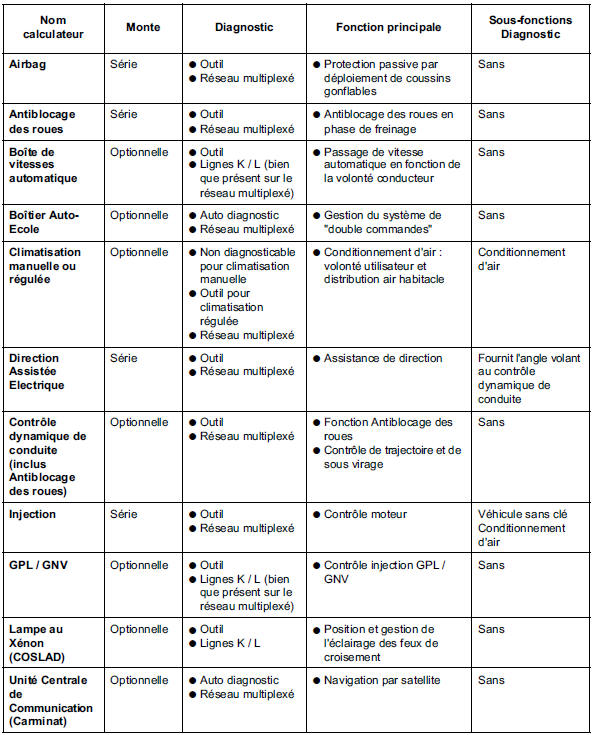
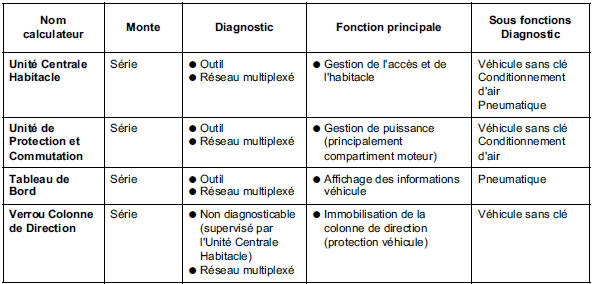
- Multiplex network: used to diagnose the following control units: instrument panel, electric power steering, airbag, automatic air conditioning, Passenger Compartment Central Unit, ABS - Dynamic Stability Control, protection and switching unit, and injection.
- K / L line diagnostic network: used to diagnose the following control units: automatic gearbox, LPG - CNG box, Xenon lamp.
Some other control units, although present on the vehicle multiplex network, still have "self-diagnosis": communication central unit (Carminat), driving school box.
IMPORTANT:Power supply to control units for diagnosis:
To diagnose the vehicle control modules, proceed as follows:
- Vehicle badge on badge holder (keyless vehicle scenario 1 (entry level, non hands-free) and scenario 2 (high end, hands-free)
- Long press (more than 5 seconds) on the "start" button without starting conditions
- Then connect the diagnostic tool and carry out the required operations.
Innovations on the Mégane:
Innovations on the Mégane can be grouped into three categories:
FUNCTIONAL INNOVATIONS
This section describes the new features on the vehicle and how they are integrated into the vehicle.
ARCHITECTURE INNOVATIONS
This section describes the distribution of the main functions and the new control units fitted to the vehicle.
DIAGNOSTIC INNOVATIONS
This section describes the diagnostic changes made for the Mégane in order to:
- Allow diagnosis on the vehicle multiplex network (new interface lead between diagnostic tool and vehicle).
- Develop and complete multiplex network diagnosis (physical measurement of fault type, fault-finding assistance...).
- Hide the diversity and complexity of certain vehicle functions: diagnosis by function, multi-control-unit...
1 - Functional innovations:
The main functional innovations on the vehicle are as follows :
KEYLESS VEHICLE (access, protection - deprotection and hands-free starting)
This function is performed by the following control units:
- Passenger Compartment Central Unit: responsible for access and vehicle protection (immobiliser).
- Column lock: contributes to vehicle protection (electromechanical locking of the steering column).
- Injection: responsible for vehicle protection (immobiliser) and starter motor control.
- Protection and Switching Unit: responsible for power supplied to the starter motor on request from the Passenger Compartment Central Unit, and control of the injection.
STABILITY CONTROL
This function is performed by the following control units:
- Anti-lock braking system - Dynamic Driving Control: responsible for the function, analysis of the vehicle path using the wheel speed sensors, yaw sensor, lateral acceleration sensor and steering wheel angle (driver intention: information transmitted by the Electric Power Steering).
- Injection: management of engine torque in order to correct the vehicle path on request from the Dynamic Driving Control or Automatic Gearbox.
- Automatic gearbox: interpretation (shared with injection) of the driver's intention, sends torque requests to the injection.
LIGHTING - XENON LAMP
This function is performed by the following control units:
- Body Control Unit: interpretation of the driver's intention, management of the lighting switch, turn indicators and rear fog lamps.
- Power and Switching Unit: responsible for the power supply required for the lighting, position lamps, main beam and front fog lamps.
- Xenon lamp: responsible for managing and levelling the dipped beam lighting.
MULTIMEDIA
This function is performed by the following control units:
- Central Communication Unit (Carminat): responsible for the function.
- Navigation display: displays navigation information.
IMPORTANT:
This function may also be provided by the radio display, depending on the type of navigation system (entry-level or high-end).
TYRE PRESSURE MONITORING
This function is performed by the following control units:
- Body Control Unit: responsible for the function; it also houses the tyre pressure transmission receiver.
- Instrument panel: displays information related to tyre pressure monitoring.
NOTE: Tyre pressure is monitored by specific valves fitted with a pressure sensor.
2 - Architecture innovations:
These innovations concern functions already known but implemented in a specific way on Mégane II:
AIR CONDITIONING
This function is conventional on RENAULT vehicles; only the distribution of tasks is specific:
- Air conditioning: responsible for the user's request (temperature management for automatic climate control) and for air mixing and distribution in the passenger compartment (manual and automatic air conditioning).
- Body Control Unit: responsible for the heating function.
- Injection: responsible for managing the air conditioning (refrigerant circuit).
- Power and Switching Unit: responsible for the power supply related to air conditioning (compressor and engine cooling fan unit).
WIPING
The function is distributed as follows:
- Body Control Unit: responsible for the driver's request, management of the wiper switch and rear window wiper.
- Power and Switching Unit: responsible for the power supply related to the front windscreen wiper.
LIGHTING
This function has already been described in the previous chapter "1 - Functional innovations". Refer to that chapter for further information.
NOTE: When lighting without a xenon lamp is fitted, the Power and Switching Unit manages the dipped beam lamps.
ENGINE MANAGEMENT - INJECTION
This function is shared between two control units:
- Injection: management of the strategies and information related to engine management, including the "speed regulation - speed limiter" function.
- Power and Communication Unit: management of the power supply related to engine management. The Power and Communication Unit also integrates the fuel pump relays and actuators controlled by wire by the injection.
Finally, the Mégane houses a new control unit, never previously fitted to any RENAULT vehicle: the Power and Switching Unit. The main functions of this control unit are as follows:
VEHICLE ELECTRICAL POWER SUPPLY
The vehicle's main power relays are integrated directly into the Power and Switching Unit (including fuel pump relay and injection actuators).
POWER UNIT FOR INJECTION
Management of the starter motor, air conditioning compressor and engine cooling fan unit.
POWER UNIT FOR THE BODY CONTROL UNIT
Management of the lighting (combined with the xenon lamps) and wiping.
POWER UNIT FOR AIR CONDITIONING
Management of the heated rear window.
3 - Diagnostic innovations:
The evolution of the Mégane's electronic and functional architecture required changes to the diagnostic procedures used. The main diagnostic changes are therefore as follows:
- New diagnostic tool-to-vehicle interface lead: this change is required by the new communication medium with the control units on the vehicle's main communication network: the multiplexed network. This lead integrates the communication cards for the control units on the multiplexed network and the control units diagnosable via K / L lines.
IMPORTANT:
Airbag harness tests and the various physical measurement tests must always be performed using the existing leads and modules of the diagnostic tool.
- New navigation interface of the diagnostic tool: the diagnostic tool's navigation presentation has been changed to handle the Mégane vehicle. The following points are particularly noteworthy:
- Vehicle identification by VIN entry: this change is currently specific to the Mégane. It is carried out either manually or automatically, by querying the vehicle. It also allows the aftersales type, engine type and gearbox type of the vehicle to be determined.
NOTE: This change will eventually be extended to all RENAULT vehicles already diagnosed that use VIN identification (example: Laguna II, Clio II Phase 2...).
- Distinction between vehicle "diagnosis" menus and "repair" menus: the diagnosis menu includes all functions related to analysing an electrical/electronic fault (fault handling, conformity checks, actuator commands and customer-effect processing), while the repair menu performs all operations linked to replacing a component and/or changing the configuration of the diagnosed system (configuration reads, configuration, learning, specific commands, etc.).
- New vehicle electronic architecture integrity test: since correct vehicle operation depends on the integrity of the vehicle multiplexed network (main functional communication network) and of the wired electronic systems, the multiplexed network test has evolved into the vehicle electronic architecture integrity test. The changes are as follows:
- Multiplexed network test: this test remains close to the one known for RENAULT multiplexed vehicles. It also now includes reading the number of faults of the multiplexed control modules, physical measurements on the types of multiplexed network failure (open circuit, short circuit to ground, short circuit to positive) of the faulty segments, as well as an assisted procedure to help detect the faulty control module-segment (in case of total network paralysis).
- Test of other diagnosable control modules on the vehicle: this test includes connecting and identifying the diagnosable control modules on K / L lines present on the vehicle.
- New diagnosis topics: the diagnosis topics are now divided into two separate menus:
- Control module diagnosis: similar to the existing diagnosis topics except for the change in menu presentation. The "states" and "parameters" menus have been modified to allow simultaneous display of this data and are split into screens by function and sub-function (example: "ignition" sub-function in injection). In addition, the "control module" diagnosis gives access to the vehicle "repair" menu when replacing a part that must be paired to the vehicle (configuration, learning).
- Function diagnosis: limited to the diagnosis of control modules present on the vehicle multiplexed network and to the "keyless vehicle", "air conditioning" and "tyre pressure" functions. This new type of diagnosis allows a global diagnosis of a function through simultaneous dialogue with all the control modules involved in the service. It is thus possible to analyse all the elements linked to a function and also to simultaneously monitor the inter-system exchanges between the control modules responsible for a customer service.
NOTE: If a faulty component is detected, it is necessary to switch to the "control module" diagnosis mode in order to carry out the configuration and learning operations for the replaced part.
"A fault is detected on a function, a physical part is replaced, hence the navigation choices made in the diagnostic tool."
Summary lists of control modules and functions present on the Mégane vehicle:
Test yourself
A quick Renault Megane quiz: every answer comes with an explanation and a link to the manual page.