Cruise control - speed limiter
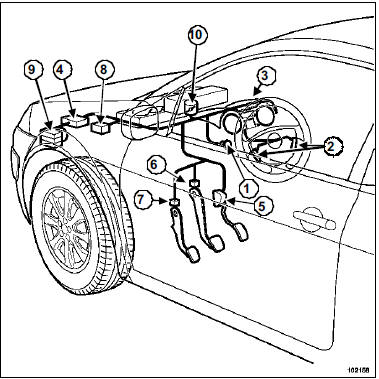
- Three-position switch (off - cruise control - speed limiter)
- Steering wheel switches
- Instrument panel
- Injection ECU
- Accelerator pedal position potentiometer
- Brake switch (dual contact)
- Clutch switch (initial travel)
- Automatic gearbox control unit (if fitted)
- ABS control unit
- Motorised throttle body (petrol engine) or diesel metering unit
The vehicles are fitted with the following equipment:
- cruise control, which maintains a speed selected by the driver. This function can be cancelled at any time by pressing the brake or clutch pedal, or via the steering wheel switches,
- speed limiter, which allows the driver to set a maximum speed. Above this speed, the accelerator pedal becomes inactive. The limited speed can be exceeded at any time by pressing the accelerator pedal past its kickdown point.
These cruise control and speed limiter functions are managed by the injection ECU. The ECU exchanges information with the ABS control unit, the body control unit, the automatic gearbox control unit (if fitted) and the instrument panel. It applies the set values by controlling the motorised throttle body or diesel metering unit.
Note: A flashing indicator light on the instrument panel means that the set speed cannot be maintained (downhill, for example).I - WIRING DIAGRAM
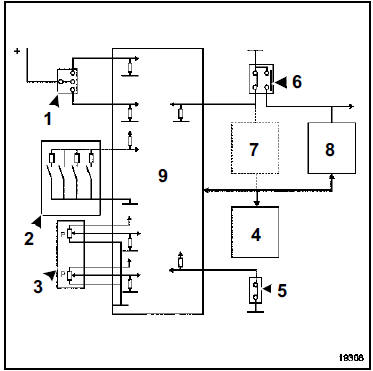
- Off - cruise control - speed limiter switch
- Steering wheel control
- Accelerator pedal
- Instrument panel
- Clutch pedal switch (if fitted)
- Brake pedal switch
- Body control unit
- ABS control unit
- Injection ECU
II - DESCRIPTION
The body control unit sends the "brake pedal pressed" signal (normally open contact).
The ABS control unit sends the "vehicle speed" signal.
The automatic gearbox control unit (if fitted) sends the "gear engaged" signal.
The instrument panel displays the set value (cruise control or speed limiter) and the function status (tri-colour indicator) (see Instrument panel chapter).
Each time these functions are activated, the on-board computer display switches to the corresponding function.
Note: The cruise control and speed limiter functions have no fault warning lamp.1 - Controls
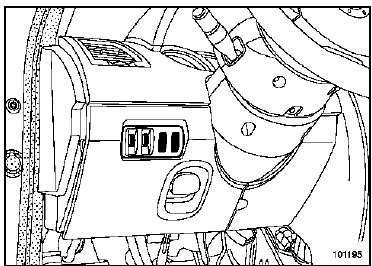
- The three-position switch selects off, cruise control or speed limiter.
- The steering wheel switches are used to change the set speed, cancel cruise control or resume the stored speed.
- The accelerator and brake pedal switches are the same as those used for injection and brake lights.
- The clutch switch is specific to the cruise control function. This switch may also be used by the injection system.
- The vehicle has two clutch sensors: one for vehicle starting (end of travel) and one for the cruise control function (initial travel).
- The accelerator pedal must have a firm stop (kickdown point) at the end of its travel for safety.
2 - Injection ECU
The injection ECU receives the following via the multiplex network:
- vehicle speed (ABS control unit),
- brake pedal switch signal (normally open contact) (body control unit),
- gear engaged (automatic gearbox, if fitted).
The injection ECU sends over the multiplexed network:
- the cruise control or speed limiter set value to the instrument panel,
- steady or flashing status of the instrument panel indicator (two-colour indicator),
- control information for the motorised throttle body or diesel metering unit,
- the gear change information for the automatic gearbox (if the vehicle is fitted with one).
The injection ECU receives the following via hard-wired connections:
- from the accelerator pedal,
- from the brake switch (two contacts: normally closed and normally open),
- from the clutch switch (if fitted),
- from the on/off switch (three positions),
- from the steering wheel controls.
Test yourself
A quick Renault Megane quiz: every answer comes with an explanation and a link to the manual page.