Circuit description
Refer to dtc p0010
| Dtc no. | Dtc detection condition | Trouble area |
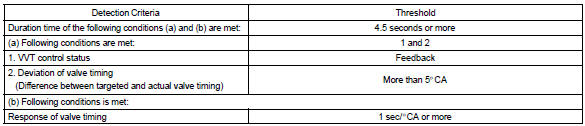
| P0011 | Condition (a) or (b) continues after engine is warmed up and engine speed at 550 to 4,000 rpm (problem of the advanced ocv):
|
|
| P0012 | Condition (a) or (b) continues after engine is warmed up and engine speed at 550 to 4,000 rpm (problem of the retarded ocv):
|
The ecm optimizes the valve timing using the variable valve timing (vvt) system to control the intake valve camshaft. The vvt system includes the ecm, the oil control valve (ocv) and the vvt controller. The ecm sends a target ”duty–cycle” control signal to the ocv. This control signal, applied to the ocv, regulates the oil pressure supplied to the vvt controller. The vvt controller can advance or retard the intake valve camshaft.
Example: when a difference between the targeted and actual valve timing is more than 5 camshaft angle ”ca” and this condition continues for more than 4.5 Sec, and if the ocv is forcibly activated 63 times or more.
Advanced cam dtcs are subject to ”1 trip” detection logic.
Retarded cam dtcs are subject to ”2 trip” detection logic.
Monitor strategy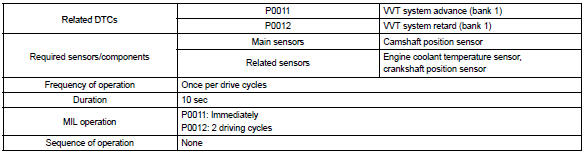

Refer to dtc p0010
Test yourself
A quick Toyota Corolla quiz: every answer comes with an explanation and a link to the manual page.