Circuit description
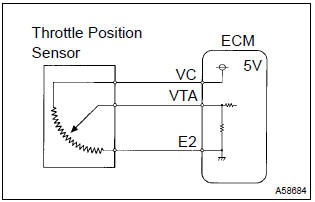
The throttle position sensor is mounted in the throttle body and detects the throttle valve opening angle.
When the throttle valve is fully closed, a voltage of approximately 0.3 To 1.0 V is applied to terminal vta of the ecm. The voltage applied to terminal vta of the ecm increases in proportion to the opening angle of the throttle valve and becomes approximately 3.2 To 4.9 V when the throttle valve is fully opened. The ecm judges the vehicle driving conditions from these signals input from terminal vta, uses them as one of the conditions for deciding the air–fuel ratio correction, power increase correction and fuel–cut control etc.
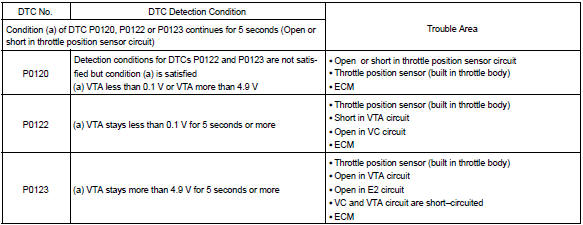
: after confirming dtcs, confirm the throttle valve opening percentage and closed throttle position switch condition using the hand–held tester or the obd ii scan tool.

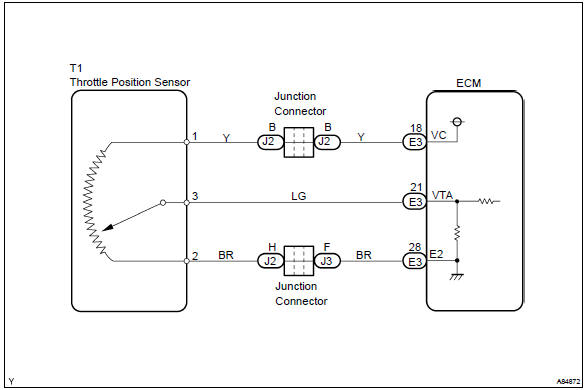
The throttle position sensor varies its resistance with the throttle valve angle. The ecm applies a regulated reference voltage to the throttle position sensor “+: vc” terminal and calculates the angle of the throttle valve based on the voltage present at the throttle position sensor “signal: vta” terminal.
When the throttle valve is near the fully closed position, the output voltage of the throttle position sensor is low. When it is near the fully open position, the output voltage is high.
If the ecm detects that the output voltage of the throttle position sensor is out of the normal range, the ecm interprets this as a malfunction in the throttle position sensor and sets a dtc.
Monitor strategy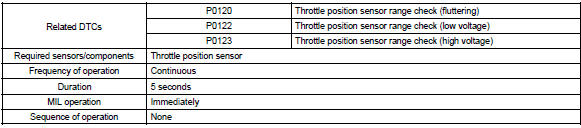



Test yourself
A quick Toyota Corolla quiz: every answer comes with an explanation and a link to the manual page.