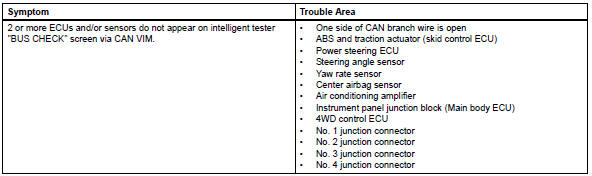
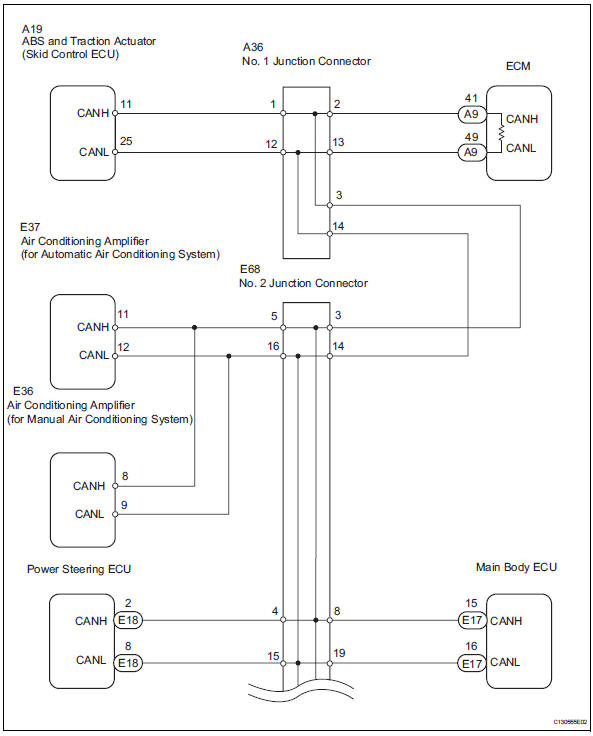
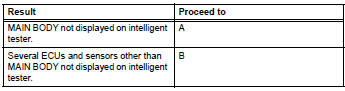
If 2 or more ecus and/or sensors do not appear on the intelligent tester's "bus check" screen via the can vim, one side of the can branch wire may be open. (One side of the canh [branch wire] /canl [branch wire] of the ecu and/or sensor is open.)
Wiring diagram Inspection procedureNotice:
Turn the ignition switch off before measuring the resistances of the main wire and the branch wire.
After the ignition switch is turned off, check that the key reminder warning system and light reminder warning system are not in operation.
Before measuring the resistance, leave the vehicle for at least 1 minute and do not operate the ignition switch, any switches or doors. If doors need to be opened in order to check connectors, open the doors and leave them open.
Hint:
Perform the following inspection for the ecus (sensors) which are not displayed on the intelligent tester. If a malfunction cannot be identified, perform the following inspections for the ecus (sensors) connected to the can communication system.
Do not remove the combination meter and ecm, as they are the end parts of the circuit. If removed, can communication will not be possible.
The open circuit confirmation of the combination meter, ecm and main wire is performed in the check can bus line procedure of how to proceed with troubleshooting. This inspection only has procedures for checking for an open circuit on one side of the can branch wire.
Check for open in one side of branch wire (abs and traction actuator)
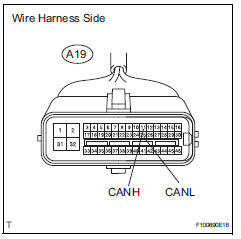
Disconnect the a19 abs and traction actuator (skid control ecu) connector.
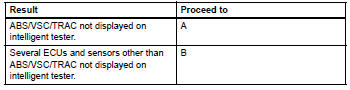
Select "bus check" on the intelligent tester display via the can vim (see page ca-34).
Result
Check for open in one side of branch wire (abs and traction actuator branch wire)
Measure the resistance of the wire harness side connector.
Standard resistance: 54 to 69 Replace abs and traction actuator (skid control ecu)
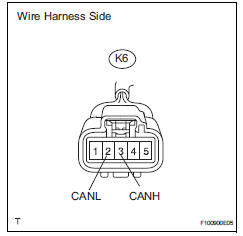
Check for open in one side of branch wire (yaw rate sensor)
Disconnect the k6 yaw rate sensor connector.
Select "bus check" on the intelligent tester display via the can vim (see page ca-34).
Result
Check for open in one side of branch wire (yaw rate sensor branch wire)
Measure the resistance of the wire harness side connector.
Standard resistance: 54 to 69 Replace yaw rate sensor
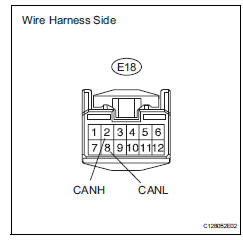
Check for open in one side of branch wire (power steering ecu)
Disconnect the e18 power steering ecu connector.
Select "bus check" on the intelligent tester display via the can vim (see page ca-34).
Resul
t
Check for open in one side of branch wire (power steering ecu branch wire)
Measure the resistance of the wire harness side connector.
Standard resistance: 54 to 69 Replace power steering ecu
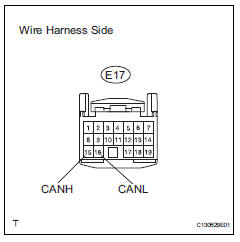
Check for open in one side of branch wire (main body ecu)
Disconnect the e17 main body ecu connector.
Select "bus check" on the intelligent tester display via the can vim (see page ca-34).
Result
Check for open in one side of branch wire (main body ecu branch wire)
Measure the resistance of the wire harness side connector.
Standard resistance: 54 to 69 Replace instrument panel junction block (main body ecu)
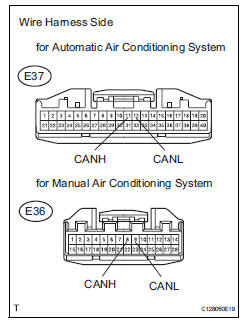
Check for open in one side of branch wire (air conditioning amplifier)
Disconnect the e37*1 or e36*2 air conditioning amplifier connector.
Hint:
*1: For automatic air conditioning system.
*2: For manual air conditioning system.
Select "bus check" on the intelligent tester display via the can vim (see page ca-34).
Result
Check for open in one side of branch wire (air conditioning amplifier branch wire)
Measure the resistance of the wire harness side connector.
Standard resistance: 54 to 69 Replace air conditioning amplifier
Check for open in one side of branch wire (steering angle sensor)
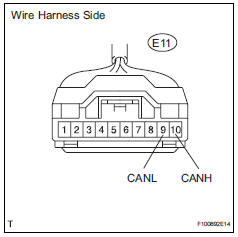
Disconnect the e11 steering angle sensor connector.
Select "bus check" on the intelligent tester display via the can vim (see page ca-34).
Result
Check for open in one side of branch wire (steering angle sensor branch wire)
Measure the resistance of the wire harness side connector.
Standard resistance: 54 to 69 Replace steering angle sensor
Check for open in one side of branch wire (4wd control ecu)
Notice:
For vehicles without 4wd, go to "check for open in one side of branch wire (center airbag sensor assembly branch wire)".
Disconnect the e57 4wd control ecu connector.
Select "bus check" on the intelligent tester display via the can vim (see page ca-34).
Result
Check for open in one side of branch wire (4wd control ecu branch wire)
Measure the resistance of the wire harness side connector.
Standard resistance: 54 to 69 Replace 4wd control ecu
Check for open in one side of branch wire (center airbag sensor assembly branch wire)
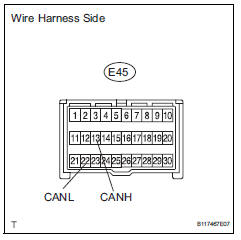
Disconnect the e45 center airbag sensor connector.
Measure the resistance of the wire harness side connector.
Standard resistance: 54 to 69 Replace center airbag sensor assembly
?
Test yourself
A quick Toyota RAV4 quiz: every answer comes with an explanation and a link to the manual page.