Wheels and Tyres Guide - General Information
Balancing wheel, checking radial and lateral run-out of wheels and tyres
In this manual: Wheels and Tyres Guide - General Information
~2min read
Before you start balancing the wheels, the following requirements must be met.Tyre pressure must be OK.Tread must not be worn on one side. Tread depth should be at least 4 mm.The tyre must not show any signs of damage, for example cuts, piercing, foreign bodies, etc. Wheel suspension and steering, including shock absorbers, must be in perfect condition.Road test has been carried out → Chapter.Radial and lateral run-out occur when the wheel and tyre do not run absolutely true.For technical reasons, 100% true running is not possible.Therefore, the manufacturers of these components allow a precisely determined tolerance. Aligning the tyre in an unfavourable position on the wheel can cause the maximum allowed tolerance for wheel with tyre to be exceeded.Checking lateral run-out
|
 Note If the difference is greater than 1.3 mm, the lateral run-out is too great.In this case, the radial run-out can be reduced by matching wheel and tyre → Chapter. Extreme values on the tyre gauge due to small irregularities in the rubber may be disregarded.Checking radial run-out
|
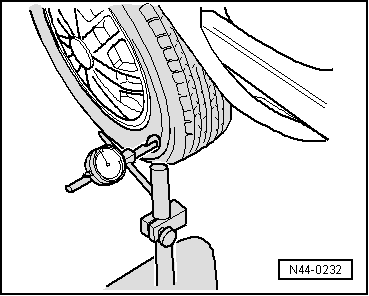 |
Note
If the difference is greater than 1 mm, the radial run-out is too great.In this case, the radial run-out can be reduced by matching wheel and tyre → Chapter. The table shows the maximum permissible tolerances for a wheel with mounted tyre.Tolerances for radial and lateral run-out of rim with tyre |
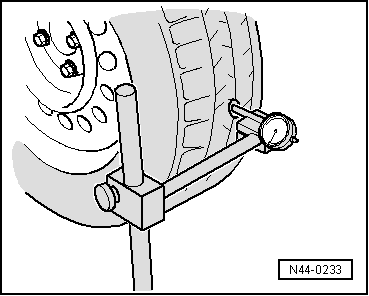 |
| Wheel with tyre | Radial run-out (mm) | Lateral run-out (mm) | |
| Passenger cars | 0,9 | 1,1 (1.3 in vicinity of lettering) | |
Test yourself
A quick Volkswagen Golf quiz: every answer comes with an explanation and a link to the manual page.
Was this page helpful?