Note The average air pressure of the earth's atmosphere at sea level is 1013 mbar and decreases steeply as the altitude increases (approx. 100 mbar/1,000 m altitude). Local and time fluctuations also influence vacuum generation. A cold engine, a switched-on air-conditioning system as well as engine idling have an adverse influence on generation of a vacuum.
Before starting work, check all vacuum hoses for damage (e.g. cracks or marten bite) and to check that they are correctly and firmly attached
Normally (see notes), the vacuum that is generated should be between 600 and 950 mbar (depending on engine size).
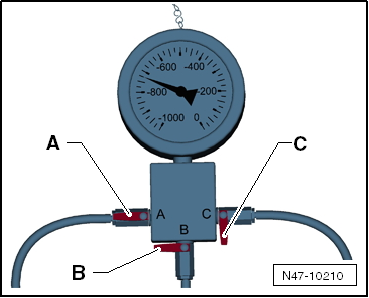
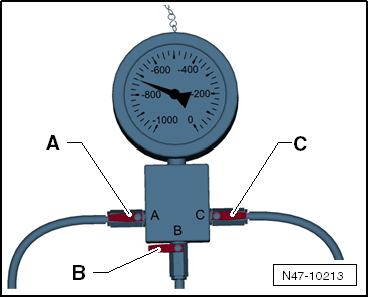
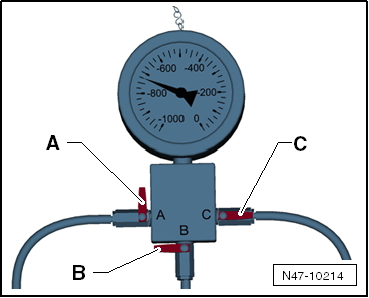
Open cut-off valve -C- to evacuate brake servo.
Switch off engine.
Read and make a note of measured value shown.
A vacuum decrease of 400 mbar in 12 hours is permissible.
If the vacuum decrease is greater, check for leaks in the vicinity of ...
1 -
Brake servo
or
2 -
Non-return valve of vacuum hoses with connectors and vacuum pump/suction pipe.
.
If there are large leaks, the vacuum decreases steeply within a few seconds.
Vacuum check in vicinity of brake servo:
After generation of vacuum, close cut-off valve -A- to check brake servo vacuum system.
Vacuum check in vicinity of non-return valve, vacuum hoses with connectors and vacuum pump or intake manifold:
Once vacuum has been generated, close shut-off valve -C- to check vacuum system from brake servo vacuum gauge -VAS 6721- to intake manifold or to vacuum pump.
Open cut-off valve -B- to facilitate removal of hose connections and adapter.
?
Test yourself
A quick Volkswagen Golf quiz: every answer comes with an explanation and a link to the manual page.
 Note The average air pressure of the earth's atmosphere at sea level is 1013 mbar and decreases steeply as the altitude increases (approx. 100 mbar/1,000 m altitude). Local and time fluctuations also influence vacuum generation. A cold engine, a switched-on air-conditioning system as well as engine idling have an adverse influence on generation of a vacuum.