Fuel supply system - Petrol engines
Connection diagram - activated charcoal filter
In this manual: Fuel supply system - Petrol engines
~1min read
 Note Fuel tank leak detection takes advantage of the fact that a vacuum develops naturally in the fuel system as the fuel in the tank cools. The variables temperature and pressure are necessary for fuel tank leak detection. The temperature sensor is integrated into the control unit for fuel tank leak detection -J909-. The tank pressure sensor -G400- is fitted in the pressure control valve. The system is deemed leak-free if 2.5 mbar vacuum is measured as the tank temperature drops. If no vacuum develops, there is a leak in the fuel system, and an entry will be made in the event memory of the engine control unit. |
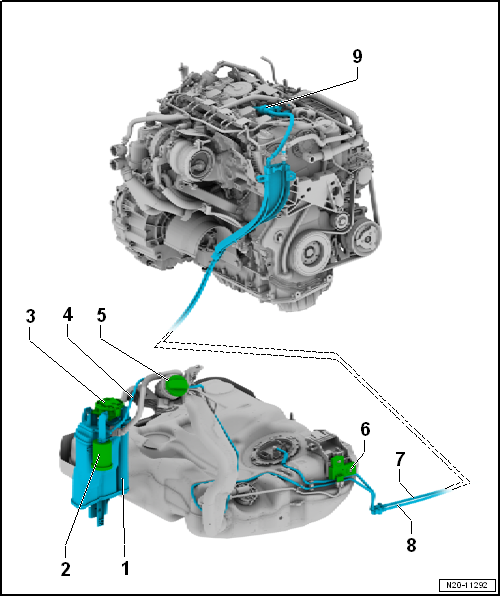
| 1 - | Activated charcoal filter |
Fitting location: In rear right wheel housing beneath liner
Removing and installing → Chapter.
| 2 - | Air filter |
| 3 - | Pressure regulating valve |
With tank pressure sensor -G400-
| 4 - | Breather line |
From activated charcoal filter to engine
| 5 - | Cap |
The gasket must not be dirty or damaged
| 6 - | Control unit for fuel tank leak detection -J909- |
With temperature sensor
| 7 - | Fuel supply line |
Black
| 8 - | Breather line |
White
| 9 - | Activated charcoal filter solenoid valve 1 -N80- |
Checking → Vehicle diagnostic tester
Test yourself
A quick Volkswagen Golf quiz: every answer comes with an explanation and a link to the manual page.
Was this page helpful?