4- cylinder injection engine(1.4 1 direct inction. turbocharger)
Draining and filling coolant
In this manual: 4- cylinder injection engine(1.4 1 direct inction. turbocharger)
~5min read
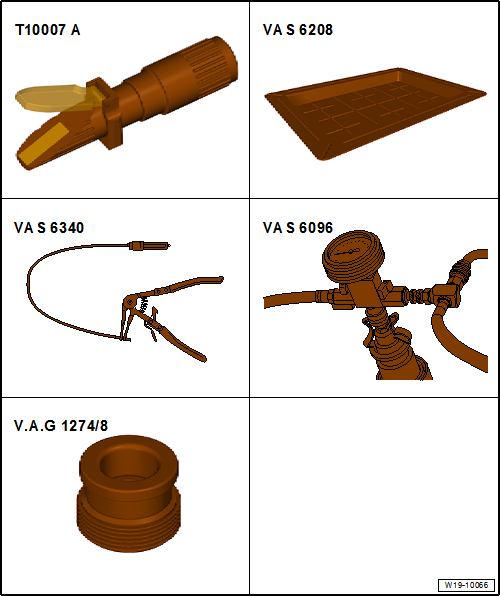
Special tools and workshop equipment required
Refractometer -T10007 A-
Drip tray for workshop hoist -VAS 6208-
Hose clip pliers -VAS 6340-
Cooling system charge unit -VAS 6096-
Adapter for cooling system tester -V.A.G 1274/8-
Eye protection
Protective gloves
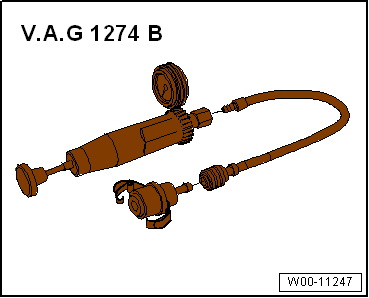
Cooling system tester -V.A.G 1274 B-
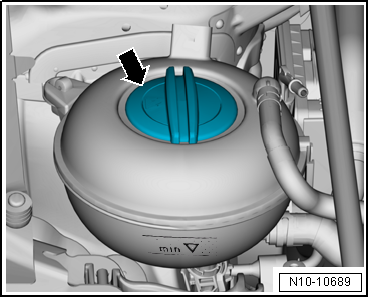
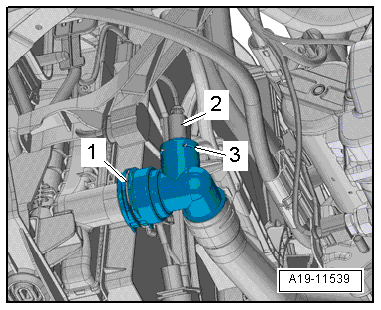
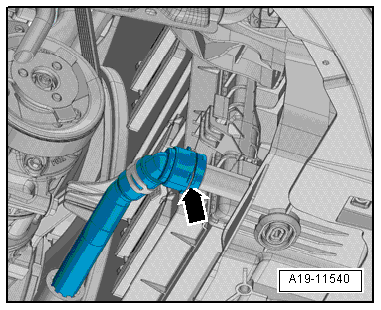
Draining |
 |
|
 |
|
 |
Filling Note The water used in the coolant mixture has a great influence on its effectiveness. Because the water quality differs from country to country and even region to region, the quality of the water to be used has been defined. Distilled water fulfils all requirements. For this reason, we recommend using distilled water when mixing coolant for topping up or replacing coolant. Use only coolant additives which conform with the → Electronic Parts Catalogue (ETKA). Other coolant additives may reduce corrosion protection substantially. The resulting damage could lead to loss of coolant and subsequent severe damage to the engine. The correct coolant solution ratio helps prevent damage due to freezing and corrosion as well as scaling. Moreover, the boiling temperature is raised. Therefore, the cooling system must be filled all year round with coolant additive. Because of its higher boiling point, the coolant improves engine reliability under heavy loads, particularly in countries with tropical climates. |
 |
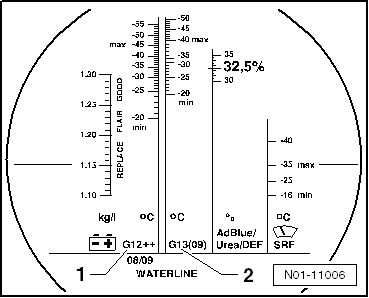
ONLY refractometer -T10007A- may be used for determining current anti-freeze value. Frost protection must be guaranteed down to -25°C as a minimum and, in countries with arctic conditions, down to approx. -36°C. Increasing the frost protection is permissible only if climatic conditions require stronger frost protection. But only to -48°C. Otherwise, the cooling effect of the coolant will be impaired. The coolant concentration must not be reduced by adding water even in warmer seasons and in warmer countries. The frost protection must be at least -25°C. Read off anti-freeze figures for respective replenished anti-freeze.The temperature read off the refractometer -T10007A- equates to the »ice flocculation point«. Ice crystals can start forming in the coolant below this temperature.Do not reuse old coolant.Use only a water/anti-freeze mixture as a slip agent for coolant hoses.Coolant mixture ratio |
 |
| Frost protection to | Coolant additive concentration | Coolant additive 1) | Distilled water 1) |
| -25 °C -36 °C | 40 % 50 % | 3.2 l 4.0 l | 4.8 l 4.0 l |
1) The quantity of coolant can vary depending on the vehicle equipment.Coolant: → Electronic Parts Catalogue.Procedure
|
|
|
Note Exhaust air takes a slight quantity of coolant along with it; this should be collected.
Pressure: 6 … 10 bar. |
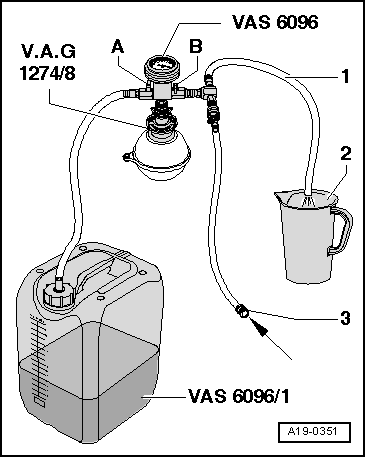 |
Note
If the needle does not reach the green zone, repeat the process.If the vacuum drops, the cooling system must be checked for leaks.
|
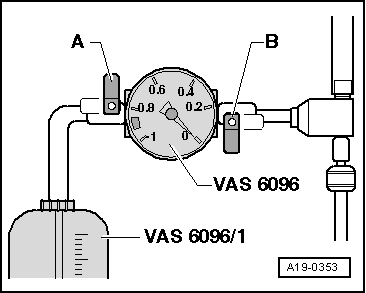 |
LED in the button must not light up.
|
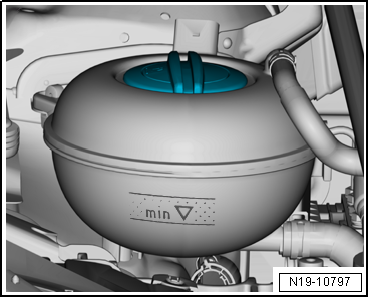 |
The coolant level can be at or above the “max.” mark when the engine is warm. |
|
Test yourself
A quick Volkswagen Golf quiz: every answer comes with an explanation and a link to the manual page.
Was this page helpful?