Technical Data
Safety Information
Safety precautions when working on the fuel supply
Risk of injury from fuel under high pressure
The fuel system is under high pressure. Injury from spraying fuel is possible.
- Before opening the fuel system, relieve the fuel high pressure.
Procedure for relieving fuel high pressure.
Fire hazard from escaping fuel
With the battery connected, the door contact switch activates the fuel pump when the driver's door is opened. Escaping fuel may ignite and cause a fire.
- Before opening the fuel system, disconnect the power supply to the fuel pump.
Safety precautions for road tests with test and measuring equipment
Risk of injury from unsecured test and measuring equipment
If the passenger airbag deploys in an accident, inadequately secured test and measuring equipment becomes a dangerous projectile.
- Secure test and measuring equipment on the rear seat with seat belts.
Or
- Have a second person operate the test and measuring equipment on the rear seat.
Safety precautions when working on the cooling system
Scalding risk from hot coolant
When the engine is warm, the cooling system is under excess pressure. Risk of scalding from hot steam and hot coolant.
- Wear protective gloves.
- Wear safety goggles.
- Relieve excess pressure: cover the coolant expansion tank cap with a cloth and carefully open it.
Safety precautions when working on the ignition system
Risk of injury from electric shock
When the engine is running, the ignition system is under high voltage. Electric shock is possible when touching the ignition system.
- Never touch or disconnect ignition leads while the engine is running or while it is being cranked.
Risk of damage to components
With the engine running, engine washing as well as connecting or disconnecting electrical wiring can damage components.
- Before connecting or disconnecting electrical wiring, switch off the ignition.
- Before engine washing, switch off the ignition.
Identification
Engine Number/Engine Characteristics
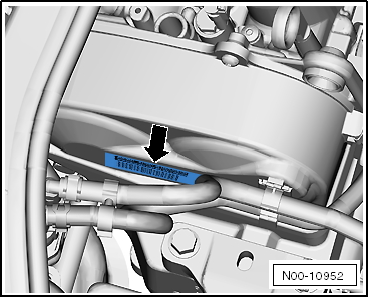
The engine code letters and engine number are located on the label -arrow- on the upper timing belt cover.
The engine code letters are also listed on the vehicle data label and on the crankcase above the transmission.
The engine number consists of up to 9 characters (alphanumeric). The first part (maximum 3 identification letters) represents the "engine code letters," the second part (six digits) the "serial number." If more than 999,999 engines with the same code letters have been produced, the first of the 6 digits is replaced by a letter.
Vehicles with four-character engine code letters
Starting with the letter "C", four-character engine code letters are used. The first 3 characters describe the mechanical design of the engine and are stamped on the engine as before. The 4th character describes the engine output and torque and depends on the engine control unit -J623-. The four-character engine code letters can be found on the type plate, on the vehicle data label and on the engine control unit.

Note
Installation locations of the vehicle data label.

Repair notes
Cleanliness rules
When working on the fuel supply/injection, the following "5 rules" of cleanliness must be carefully observed:
- Thoroughly clean connection points and their surroundings before loosening.
- Place removed parts on a clean surface and cover them. Do not use lint-producing rags!
- Carefully cover or seal open components if the repair is not carried out immediately.
- Install only clean parts: remove replacement parts from their packaging only immediately before installation. Do not use parts that have been kept unpackaged (e.g. in tool boxes, etc.).
- With the system open: do not work with compressed air. Do not move the vehicle.
Foreign objects in the engine
To prevent foreign objects from entering, open ports of the intake and exhaust tracts must be sealed with suitable plugs, for example from the sealing plug set for engine -VAS 6122-, during engine assembly work.
Contact corrosion
Contact corrosion can occur if unsuitable fasteners (screws, nuts, washers, ...) are used.
For this reason, only fasteners with a special surface coating are installed.
Furthermore, rubber or plastic parts and adhesives are made of electrically non-conductive materials.
If there is any doubt about the suitability of parts, always use new parts → Electronic parts catalog.
Routing and securing of lines
- To ensure the original installation position, lines for fuel, hydraulics, vacuum, the activated charcoal canister system, or electrical wiring must be marked before removal. If necessary, make sketches or take photos.
- Due to the tight space in the engine compartment, ensure sufficient clearance to all moving or hot components. This prevents damage to lines.
- If clips, cable ties or other retainers have been damaged by cutting or loosening during disassembly, replace these fasteners.
- Insulation or heat shield mats must always be reinstalled in their original installation position.
Installation of radiators and condensers
Even when installed correctly, the radiator, condenser and charge air cooler may show slight impressions on the fins. This is not damage. Radiators, condensers or charge air coolers must not be replaced because of such slight impressions.