Loading and storage. Loading. Loading - ski hatch. Roof load. Cargo tie-down eyes
Loading the Volvo S80 (2nd generation, 2013–2016) should always be carried out with safety and vehicle balance in mind. This section explains the correct placement of cargo, the use of cargo tie-down eyes and the ski hatch, and the importance of evenly distributing roof load. It also provides important warnings so that the protective function of the airbags is not impaired and cargo does not shift during hard braking. Tips on safely transporting long objects complete the information.
Loading
The total payload depends on the vehicle's curb weight.
The total payload depends on the vehicle's curb weight. The total payload of the vehicle is reduced by the combined weight of the occupants and all special equipment.
For detailed weight information, see Weights.
 The tailgate is opened using the button on the lighting switch panel or on the transponder key, see Locking/unlocking - tailgate.
The vehicle's handling characteristics change depending on the weight and arrangement of the cargo.
When loading, observe the following
- Place the cargo pressed against the backrest of the rear seat.
Note that no objects may obstruct the function of the WHIPS system of the front seats when one of the rear seat backrests is folded down, see WHIPS - seat position.
- Place the cargo in the center.
- Position heavy objects as low as possible. Avoid placing heavy cargo on folded-down backrests wherever possible.
- Fit sharp edges with soft edge protection to prevent damage to the upholstery.
- Secure all cargo with straps or retaining belts attached to the cargo tie-down eyes.
In the event of a frontal collision at a speed of 50 km/h, an object weighing 20 kg corresponds to an impact weight of 1000 kg.
WARNINGThe protective effect of the head/shoulder airbag in the roof lining may be absent or reduced if the load is too high.
- Never load beyond the top of the backrest.
Cargo must always be secured properly. Under hard braking, unsecured cargo can shift and injure occupants.
Protect sharp edges and corners with soft padding.
When loading or unloading the vehicle with long cargo, switch off the engine and apply the parking brake.
In unfavorable cases, the cargo may otherwise move the gear selector lever, engaging a gear. The vehicle may then roll away.
Related information
- Load anchorages
- Loading - long cargo
- Roof load
Loading - long cargo
To make loading the cargo area easier, the rear seat backrests can be folded down. For particularly long items, the front passenger seatback can also be folded down2*.
Fold down rear seat backrest
If the rear seatback must be folded down, see Rear seat.
2 Only applies to comfort seats.
Loading - ski flap
The flap in the backrest can be opened to transport long, narrow items.
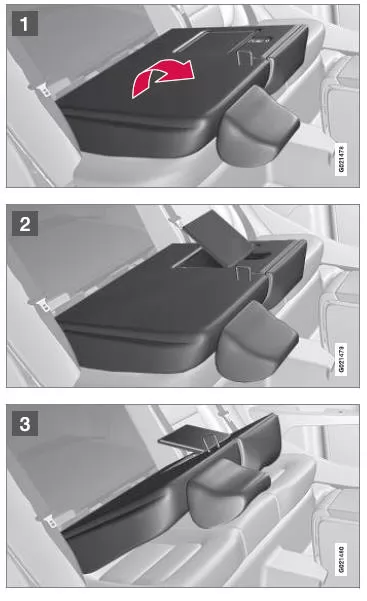
- Fold the right-hand backrest forward.
- Release the flap in the rear seatback. To do this, slide the flap latch upward and at the same time press the flap downward/forward.
- Fold the backrest back with the flap open.
Secure the cargo with the safety belt to prevent it from shifting.
WARNINGWhen loading and unloading the vehicle, switch off the engine and apply the parking brake. Otherwise, the gear selector lever may be moved, engaging a gear, and the vehicle may roll away.
Removing the flap
First release the flap and fold the backrest rearward. Then open the flap approx. 30 degrees and pull it straight up.
Installing the flap
Reinsert the flap into the grooves behind the trim and close the flap.
Related information
- Loading
Roof load
Volvo-developed roof racks are recommended for roof loads.
This helps prevent damage to the vehicle and ensures the highest possible level of safety while driving.
Carefully follow the installation instructions supplied with the roof rack.
- Check regularly that the roof rack and load are securely fastened. The load must be well secured with cargo straps.
- Distribute the load evenly on the roof rack. Place the heaviest items at the bottom.
- As the load volume increases, wind resistance and fuel consumption increase.
- Drive carefully and anticipate traffic.
Avoid hard acceleration, hard braking and sharp cornering.
With a roof load, the vehicle's center of gravity and handling characteristics change.
For information on the maximum permitted roof load, including roof rack and any roof box, see
Weights
Related information
- Loading
Load anchorages
The fold-down load-securing eyelets3 are used to anchor the cargo straps that secure items in the luggage compartment.
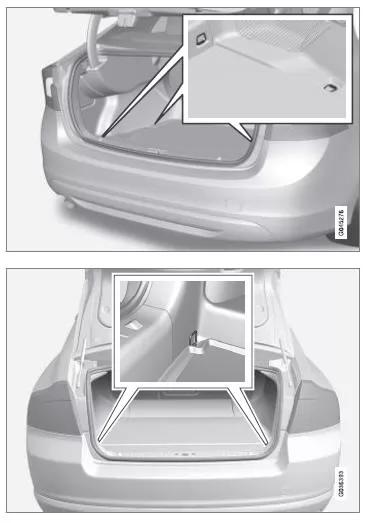
Hard, sharp-edged and/or heavy objects that are unsecured or protruding can cause injuries in the event of hard braking.
Always secure large, heavy objects with the safety belt or a load-securing strap.
Related information
- Loading
3 The number and arrangement of the eyelets depends on the market.
The loading and storage concept of the Volvo S80 (2nd gen) is designed for safety and flexibility. Whether in the luggage compartment, on the load anchorages or via the ski flap, everything can be stored and secured safely.
Volvo also places great emphasis on the correct distribution and secure fastening of roof loads so that handling is not negatively affected. This keeps the vehicle safe and comfortable even when loaded.
The well-thought-out solutions ensure every journey remains relaxed and safe, no matter how much you load.
Test yourself
A quick Volvo S80 quiz: every answer comes with an explanation and a link to the manual page.